
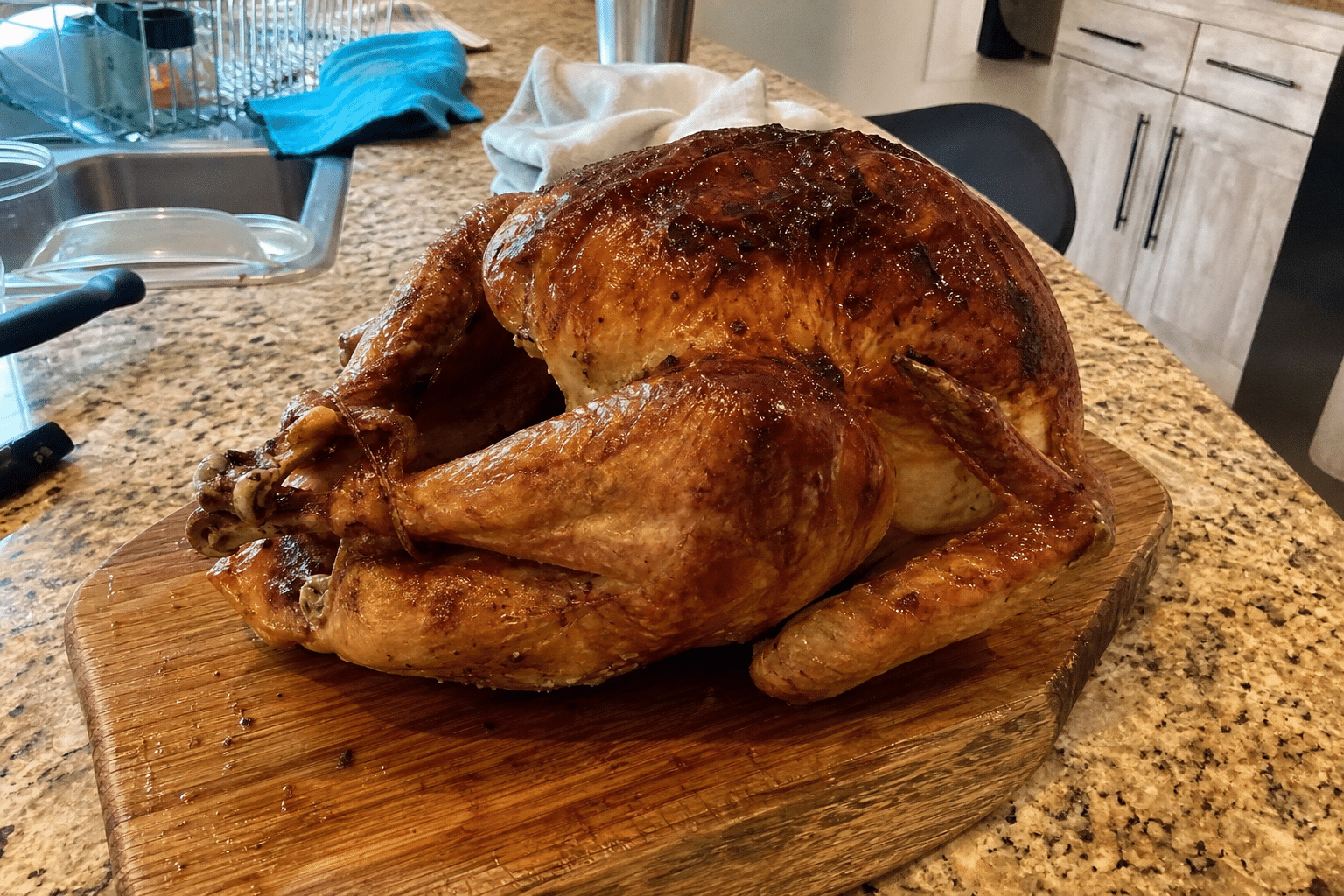

A properly roasted whole turkey comes down to three decisions made before the bird ever hits the oven: how long to brine, how low to roast, and when to stop. The rest is timing.
This method starts with a dry brine up to three days ahead, roasts at 325°F (163°C), and rests the bird before carving. A spatchcock option is included for anyone who wants a faster cook and crispier skin all over.
Why this recipe works
Dry brining seasons the meat all the way through and dries out the skin. Salt draws out surface moisture in the first few hours, then reabsorbs into the bird as a seasoned brine over 24-72 hours. By roasting day, the skin is taut and dry – exactly what you want for a golden, lacquered finish.
Low and slow at 325°F keeps the breast from drying out while the thighs, which need higher internal temperature to become tender, have room to cook through. The USDA FSIS sets 325°F as the minimum safe oven temperature for roasting turkey.
Temperature – not time – is the real test. The turkey is done when the thickest part of the thigh, the innermost part of the wing, and the thickest part of the breast all read 165°F (74°C) on a food thermometer. Time charts are guides; the thermometer is the answer.
Thaw first, brine second
A frozen turkey needs to thaw in the refrigerator before anything else. According to the USDA FSIS, allow about 1 day in the refrigerator for every 4-5 pounds of turkey. A thawed bird can stay in the fridge for 1-2 days before cooking, so thawing ahead of the brine is fine.
For a 12-15 lb (5.4-6.8 kg) bird, plan on 3-4 days in the fridge.
Read more: Crispy homemade chicken parmesan: the technique that keeps the crust from going soggy
If time is short: submerge the still-wrapped bird in cold water and change the water every 30 minutes. Cook it immediately after thawing.
Never thaw on the counter. The outer layers warm into the danger zone long before the center is thawed.
Ingredients
Serves 10-12, for a 12-15 lb (5.4-6.8 kg) whole turkey
For the dry brine:
- 2 tablespoons kosher salt
- 1 teaspoon black pepper
- 1 teaspoon dried thyme
- 1 teaspoon dried sage
- ½ teaspoon garlic powder
For the bird:
- 1 whole turkey, 12-15 lbs (5.4-6.8 kg), fully thawed, giblets and neck removed
- 4 tablespoons (55 g) unsalted butter, softened
- 1 tablespoon olive oil
For the cavity:
- 1 medium onion, quartered
- 2 celery stalks, roughly chopped
- 1 apple, quartered
- 4 garlic cloves, smashed
- A few sprigs fresh thyme and sage
For basting:
- 4 tablespoons (55 g) unsalted butter, melted
- Pan drippings from the roasting pan
Instructions
1. Dry brine, 1-3 days ahead. Mix the kosher salt, pepper, thyme, sage, and garlic powder. Remove the giblets and neck from the cavity and set them aside (the neck is useful for gravy stock). Pat the turkey completely dry with paper towels, inside the cavity too. Rub the brine all over the outside skin, under the skin over the breasts and thighs, and lightly inside the cavity. Place the bird on a rack set over a rimmed sheet pan, uncovered, in the refrigerator for at least 24 hours and up to 72. The skin will dry and tighten – that’s the goal.
2. Take the chill off. Pull the turkey from the fridge 1 hour before roasting. A cold bird going straight into a hot oven cooks unevenly.
3. Heat the oven to 325°F (163°C), with a rack in the lower third.
Read more: How to make Roman carbonara without cream, and why it works
4. Prep the bird. Rub softened butter all over the outside skin, then brush with olive oil. Loosely fill the cavity with the onion, celery, apple, garlic, and herb sprigs. These aromatics add fragrance only – don’t pack them tight. Tuck the wing tips under the body and tie the legs loosely together with kitchen twine.
5. Roast. Place the turkey breast-side up on a rack in a roasting pan. Roast at 325°F (163°C), using the chart below as a rough guide. Baste with melted butter and pan drippings every 45-60 minutes.
6. Check the temperature early. Starting about 30 minutes before the low end of the time range, insert an instant-read thermometer into the thickest part of the thigh without touching the bone. Then check the innermost part of the wing and the thickest part of the breast. The turkey is done when all three locations read at least 165°F (74°C).
7. Rest before carving. Transfer to a cutting board and tent loosely with foil. Rest for at least 20 minutes – 30 for a larger bird. The juices redistribute, the carry-over heat finishes the work, and carving becomes much cleaner.
Roasting times at 325°F (163°C), approximate:
Weight | Unstuffed | Stuffed |
|---|---|---|
8-12 lbs (3.6-5.4 kg) | 2¾-3 hours | 3-3½ hours |
12-14 lbs (5.4-6.4 kg) | 3-3¾ hours | 3½-4 hours |
14-18 lbs (6.4-8.2 kg) | 3¾-4¼ hours | 4-4¼ hours |
18-20 lbs (8.2-9 kg) | 4¼-4½ hours | 4¼-4¾ hours |
20-24 lbs (9-10.9 kg) | 4½-5 hours | 4¾-5¼ hours |
Always verify with a food thermometer regardless of time.
Read more: Eggs Benedict at home: the hollandaise technique that makes it easy
Tips and variations
Spatchcock option. Cut out the backbone with heavy kitchen shears and press the bird flat. A 12-14 lb spatchcocked turkey roasts at 400°F (200°C) in roughly 1¼-1½ hours – about half the time of a whole bird – with crispier, more evenly browned skin all around. The 165°F (74°C) safety check at all three locations still applies. The tradeoff is presentation: it won’t carve at the table in the classic whole-bird way.
Don’t stuff the cavity. The USDA FSIS advises that for optimum safety, stuffing inside the turkey is not recommended. The issue is heat: by the time the center of the stuffing reaches a safe temperature, the breast is overcooked and dry. Cook dressing in a casserole dish alongside the bird instead.
Basting vs. butter under the skin. Basting adds color and encourages a glossy skin, but it doesn’t meaningfully moisten the meat – the skin blocks liquid from penetrating. Rubbing softened butter directly under the skin over the breast delivers more flavor where it counts.
If the skin darkens too fast. Lay a loose sheet of foil over the breast only during the last hour. Leave the edges open; you still want air circulation.
Gravy from the drippings. While the bird rests, deglaze the roasting pan with a cup of chicken or turkey stock, scraping up all the browned bits. Strain into a saucepan, skim the excess fat, and thicken with a simple butter-flour roux over medium heat.
Leftovers. Refrigerate carved turkey within 2 hours of serving.