
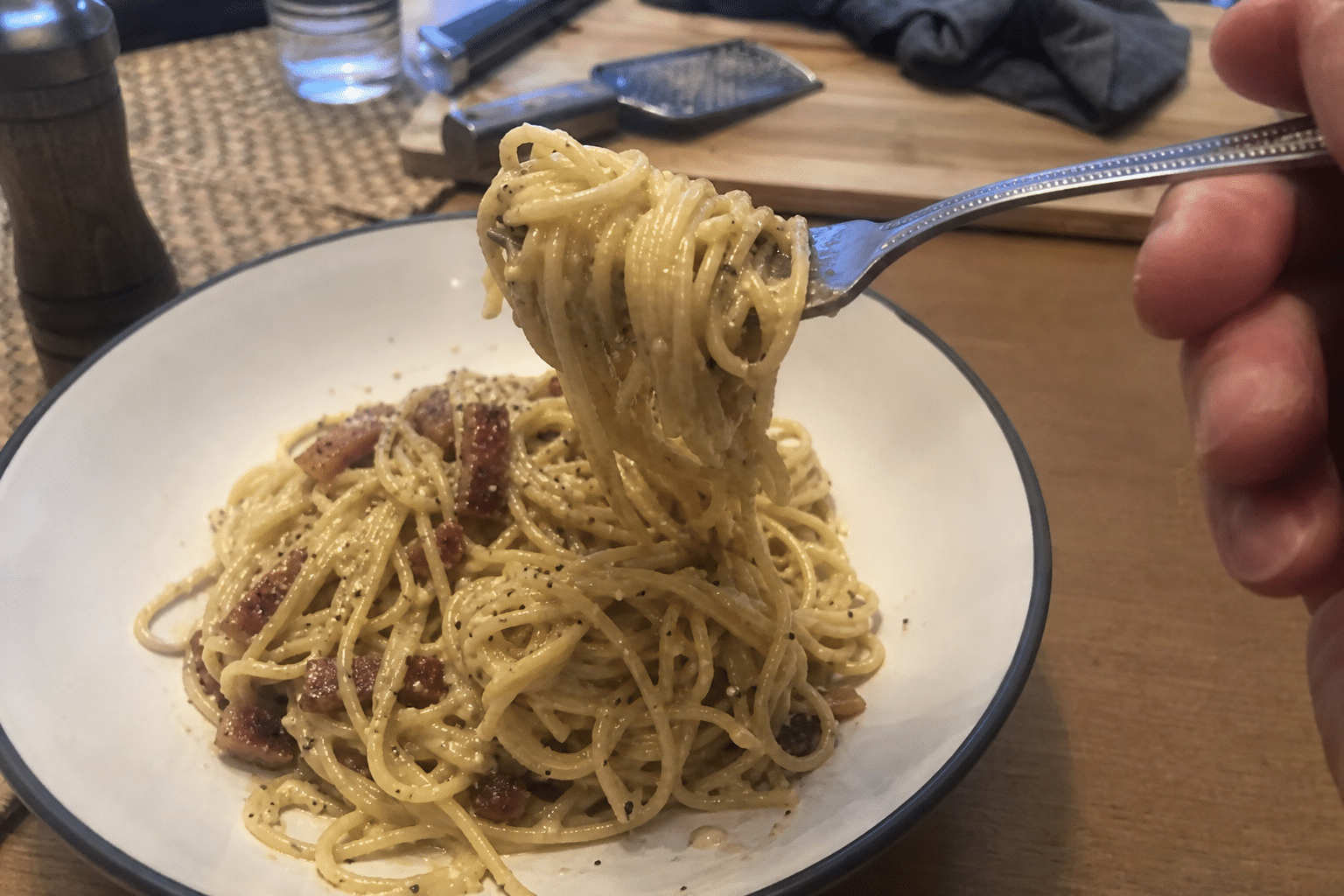

The carbonara most restaurants serve outside Rome barely resembles the original. Cream gets added, garlic goes in, the guanciale gets traded for bacon. The result is a pasta in a heavy dairy sauce that has little to do with what Romans actually eat.
Authentic carbonara uses exactly five ingredients: guanciale, egg yolks, Pecorino Romano, black pepper, and pasta. The sauce is built through emulsification alone – fat from the rendered guanciale, lecithin from the egg yolks, and starchy pasta water bonding together into something glossy and rich, with no cream, no butter, and no direct heat on the eggs.
## Why cream isn’t needed (and what actually creates the sauce)
Cream adds weight but strips the dish of its character. It softens the sharp, salty punch of the Pecorino Romano and mutes the depth that comes from properly rendered guanciale fat. More practically: it isn’t needed to make the sauce creamy.
Egg yolks contain lecithin, a natural emulsifier. When you combine rendered guanciale fat, beaten egg yolks, and hot starchy pasta water off the heat, the lecithin bonds the fat and water into a stable, silky sauce.
The starch in the pasta cooking water also plays a role: it raises the temperature at which the eggs will set, giving you a workable window to toss everything together with hot pasta without scrambling them. According to carbonaras.com, egg yolks coagulate at 149°F (65°C) and fully set at 158°F (70°C). Diluted with pasta water, that threshold rises to around 176 to 185°F (80 to 85°C) – enough room to build the sauce using residual heat alone.
The technique is called mantecatura: vigorous tossing off the heat that keeps the emulsion moving and prevents the eggs from setting in place. No thermometer required. No dairy required.
Read more: Eggs Benedict at home: the hollandaise technique that makes it easy
## A dish younger than you might expect
Carbonara is not an ancient Roman recipe. Food historian Luca Cesari makes the point plainly, as cited by carbonaras.com: “there are no ancient progenitors of carbonara.” Origin stories connecting the dish to shepherds, charcoal miners, or ancient Roman tradition are, in his assessment, myths rather than history.
The first documented mention of the dish appeared in the Italian newspaper Il Giornale di Trieste in 1948. The first published recipe came in 1952, in a Chicago guidebook called Vittles and Vice by Patricia Bronté. The first Italian published recipe appeared in 1954 in La Cucina Italiana – and that early version called for pancetta, Gruyère, and garlic, none of which belong in the dish today.
The version Romans now treat as canonical – guanciale, Pecorino Romano, egg yolks, black pepper, pasta – was largely codified by Roman chefs in the 1990s.
## Ingredients (serves 4)
- 14 oz (400g) spaghetti (or rigatoni, or mezze maniche)
- 7 oz (200g) guanciale, cut into 1/2-inch (1cm) cubes or strips
- 4 large egg yolks plus 2 whole eggs
- 3.5 oz (100g) Pecorino Romano, very finely grated (not pre-grated)
- Coarsely cracked black pepper, applied generously
- Kosher salt, for the pasta water
## Instructions
1. Render the guanciale slowly. Place guanciale in a cold pan without oil and set the heat to medium-low. Cook for 10 to 15 minutes, stirring occasionally. The goal is pieces that are golden and slightly crisp on the outside, with the fat fully rendered and clear in the pan. That pooled fat is part of the sauce – do not drain it. Remove from heat when done.
2. Make the egg mixture. Whisk together the egg yolks and whole eggs with the finely grated Pecorino Romano and a generous amount of cracked black pepper. The mixture should be thick, smooth, and pale yellow. Set aside at room temperature.
Read more: Masoor dal with coconut milk: the creamy Indian red lentil curry ready in about an hour
3. Cook the pasta until just under al dente. Use a smaller pot than usual – concentrated pasta water is more starchy, which helps the emulsion. Before draining, reserve at least 1 cup (240ml) of cooking water.
4. Combine pasta and guanciale. Add the drained pasta directly to the pan with the guanciale and rendered fat. Toss briefly over no heat to coat.
5. Temper the eggs. Whisk 2 to 3 tablespoons of hot pasta water into the egg mixture. This brings its temperature up and reduces the chance of the eggs seizing on contact with the hot pasta.
6. Build the sauce off the heat. Pour the tempered egg mixture over the pasta. Using tongs, toss vigorously in circular motions for 30 to 40 seconds. Add pasta water a tablespoon or two at a time, tossing continuously, until the sauce is glossy and coats every strand. Loose and silky is the target. Stirring instead of tossing can break the emulsion.
7. Serve immediately. Plate at once and finish with a little more grated Pecorino Romano and freshly cracked black pepper.
Read more: Classic Wienerschnitzel with the anchovy, caper, and lemon garnish most recipes leave out
## Tips and substitutions
On guanciale. Guanciale is cured pork jowl, aged a minimum of three months. Its high fat content and mild sweetness set it apart from pancetta or bacon. Pancetta is the most practical substitute if guanciale isn’t available. Bacon introduces smoke that, as carbonaras.com notes, “can dominate the other flavors in the dish” – use it only as a last resort.
On the cheese. Grate Pecorino Romano as fine as possible – a Microplane works best. Pre-grated cheese doesn’t incorporate smoothly and can leave a grainy texture in the sauce. Some Roman cooks blend it half-and-half with Parmigiano-Reggiano for a slightly milder result; both versions are legitimate.
What stays out. No cream, no milk, no butter. No garlic, no onion, no parsley. The dish is defined as much by what isn’t in it as by what is.
If the eggs scramble. Add a splash of cold pasta water immediately to drop the temperature, then toss hard. Minor scrambling may still recover. If the eggs have set into visible curds, the sauce cannot be repaired. Keeping the pan fully off the heat during the final step is the only reliable prevention.
Leftovers. Carbonara does not reheat well. The emulsion breaks and the sauce turns into scrambled eggs. Cook only what you’ll eat.