
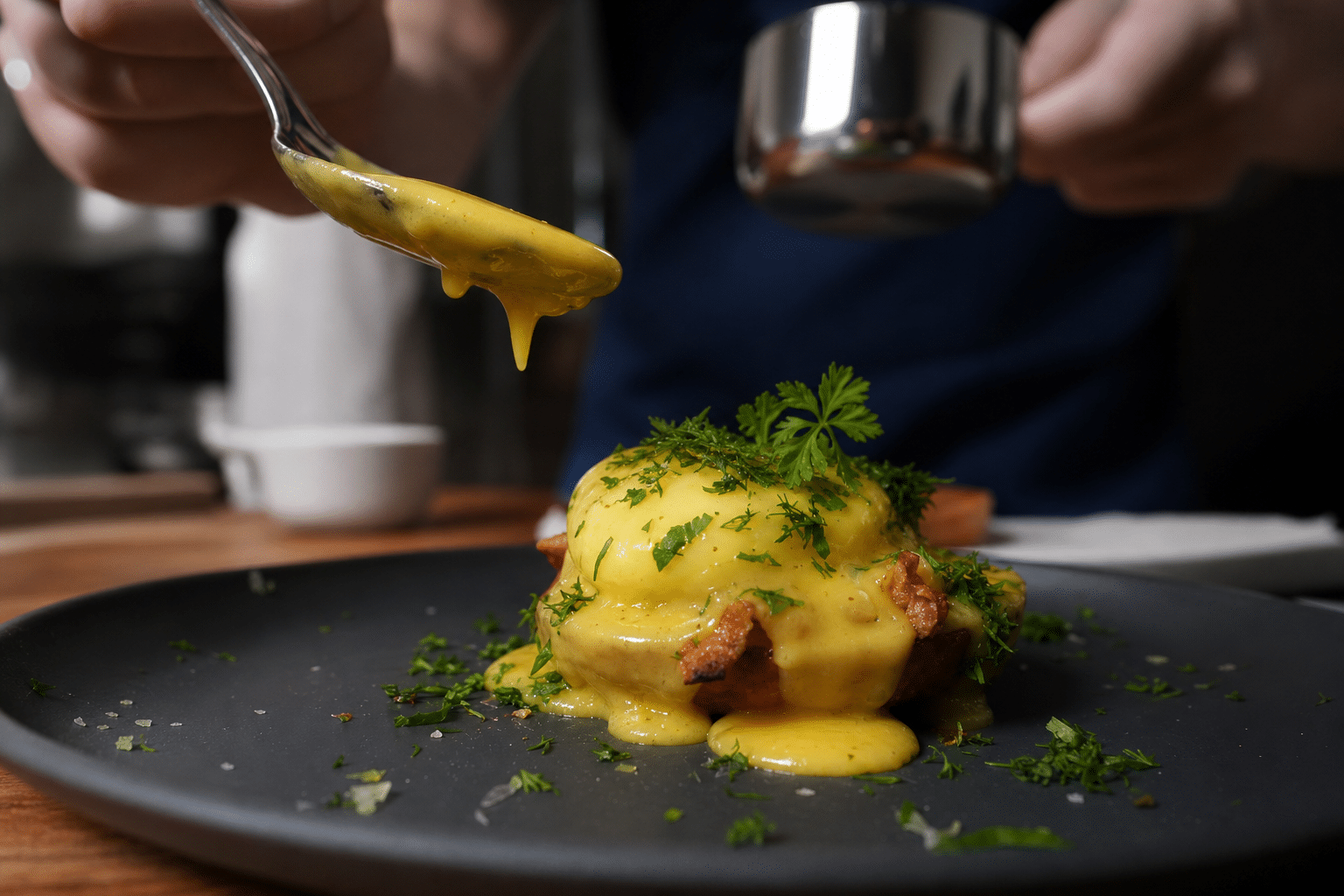

Eggs Benedict is the dish that stops most home cooks in their tracks. It is not that the components are complicated on their own. The problem is timing: hollandaise that breaks if you rush it, poached eggs that scatter into stringy wisps, and trying to get both on the plate hot at the same time. Once you understand the two techniques that hold the whole thing together, though, it becomes genuinely manageable on a weekend morning.
This recipe walks through each part in order: a from-scratch hollandaise whisked over gentle heat with butter added in a slow stream, and poached eggs dropped into a vinegar-water whirlpool. Get those two right, and the rest is just assembly.
Why this recipe works
The hollandaise is the heart of it. The technique is simple: you whisk an egg yolk with lemon juice and Dijon over very low heat until the mixture thickens and turns pale, then you add melted butter in a thin, slow stream while you keep whisking. The heat is what gets it started; the slow butter addition is what keeps it stable. Rush the butter and the sauce breaks. Take your time and it comes together into something glossy and rich.
The whirlpool trick for poaching eggs is equally reliable. Creating a gentle spin in the simmering water before you drop the egg in keeps the white wrapping around the yolk instead of drifting away into ragged threads.
Read more: Masoor dal with coconut milk: the creamy Indian red lentil curry ready in about an hour
One note on timing: start the hollandaise first, then poach the eggs while the sauce rests warm. Hollandaise holds for a few minutes off the heat; poached eggs do not wait well.
Ingredients
For the hollandaise
- 1 egg yolk
- 6 tablespoons (85 g / 3 oz) unsalted butter
- 2 tablespoons lemon juice
- 1/2 teaspoon Dijon mustard
- Salt, white pepper, and a pinch of cayenne
For the poached eggs
- 2 large eggs
- 1 tablespoon white vinegar
For serving
- 2 slices bacon
- 2 slices bread (see Tips)
Instructions
Prep: Take the eggs out of the refrigerator ahead of time and let them come to room temperature. Cold eggs make hollandaise harder to emulsify and are also more likely to break apart in the poaching water.
Read more: Classic Wienerschnitzel with the anchovy, caper, and lemon garnish most recipes leave out
Make the hollandaise:
- Melt the butter in a small saucepan over low heat, then set it aside to cool slightly. It should be warm but not hot.
- In a small heavy-bottomed saucepan or the top of a double boiler, whisk together the egg yolk, lemon juice, and Dijon mustard over the lowest heat your stove will give you.
- Keep whisking continuously. The mixture will take longer than you expect to thicken; stay patient. When it turns pale yellow and holds a ribbon for a moment when you lift the whisk, it is ready for the butter.
- Begin adding the melted butter in a very thin, steady stream, whisking the whole time. Add it slowly, especially at the start. The sauce will gradually thicken to a creamy, pourable consistency.
- Season with salt, white pepper, and cayenne. Keep warm off the heat while you poach the eggs.
Poach the eggs:
- Fill a medium saucepan with about 3 inches (7-8 cm) of water. Bring to a gentle simmer, not a rolling boil.
- Add the tablespoon of white vinegar to the water. It helps the egg white set up neatly around the yolk.
- Crack each egg into its own small bowl or ramekin. This gives you control over the drop.
- Stir the simmering water briskly with a spoon to create a steady whirlpool. Slide the first egg gently into the center of the spin. Repeat quickly with the second egg.
- Simmer for 3 to 4 minutes for a runny yolk. Lift each egg out with a slotted spoon and trim any stray wisps of white with scissors for a clean presentation.
Cook the bacon and toast:
- Fry the bacon in a dry skillet over medium-high heat until crisp. Remove and set aside on paper towels.
- Use the bacon fat left in the pan to toast the bread on one side only, until golden.
Assemble:
- Set a slice of bread, toasted side up, on each plate. Spoon a little hollandaise over it. Add the bacon, another spoon of sauce, then the poached egg on top. Finish with a final drizzle of hollandaise and garnish with fresh dill, flat-leaf parsley, or thinly sliced green onions.
Tips and variations
Bread and bacon: This recipe uses regular toast and bacon, which is how it is often made in Denmark. The classic American Eggs Benedict calls for Canadian bacon (back bacon) and English muffins. Both work beautifully; the choice is yours.
Hollandaise must be served immediately. The sauce does not reheat well. If it cools before you are ready to plate, set the pan briefly over the lowest heat and whisk to bring it back, but do not let it sit for long.
Read more: Beef wellington at home: the Christmas showstopper that is easier than it looks
If the hollandaise breaks: It has split into greasy yellow puddles. Fix it by whisking a fresh egg yolk in a clean bowl over low heat, then slowly whisk the broken sauce into it in a thin stream, treating it like a fresh emulsification.
Scaling up: This recipe serves 2. For 4 people, double every ingredient. The technique is the same; just use a slightly larger pan for the sauce.
Leftovers: Poached eggs can be made up to a day ahead. After poaching, transfer them to a bowl of cold water and refrigerate. To reheat, slide them into barely simmering water for about 60 seconds.