
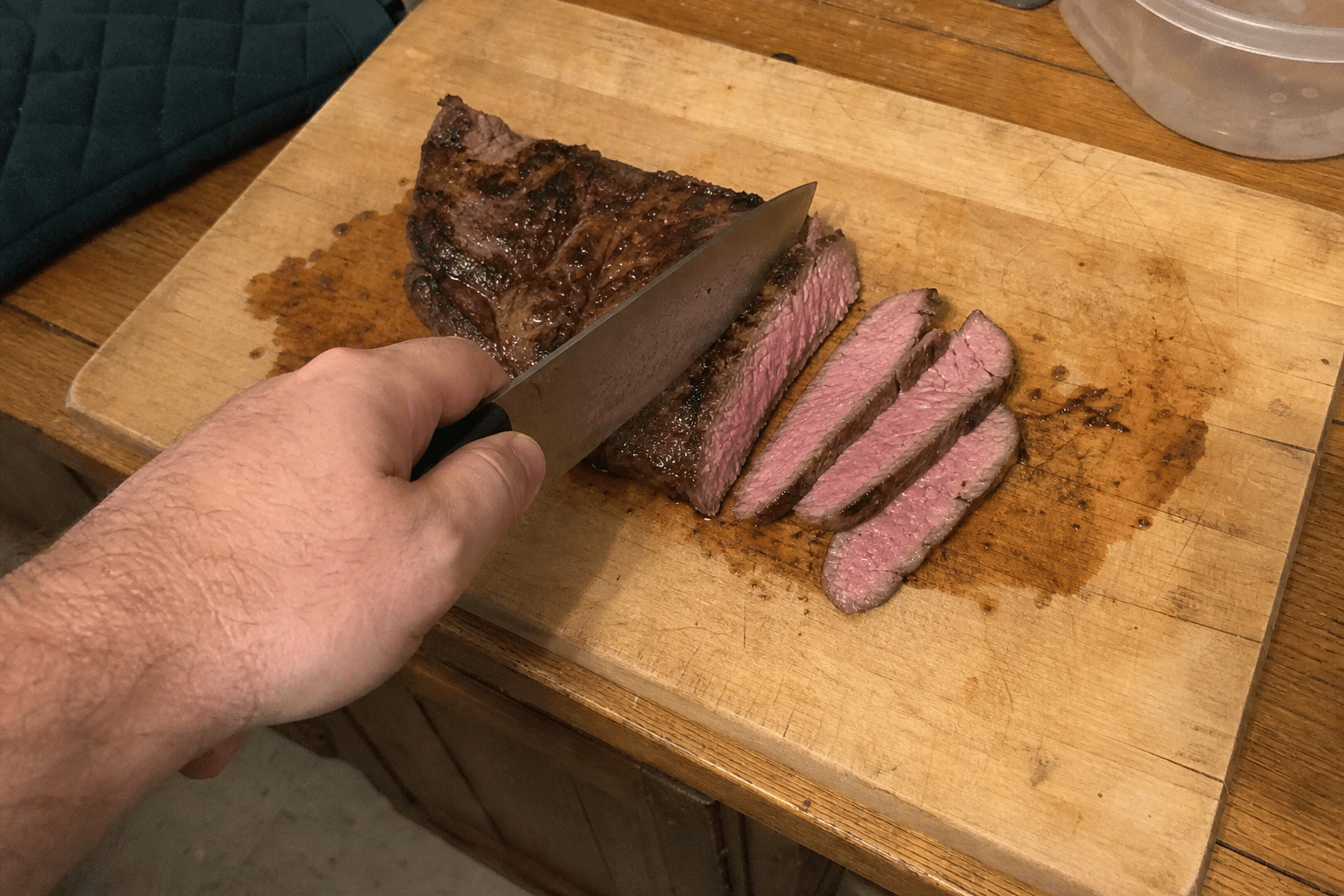

Every recipe says “let it rest” but rarely explains the cost of skipping it. For a 1-pound pork loin, cutting immediately spills roughly 10 tablespoons of juice onto the cutting board. Rest that same roast for 10 minutes and the loss drops to around 4 tablespoons, a reduction of about 60 percent, according to America’s Test Kitchen experiments as cited by Wild Country Meats. The difference is not a matter of patience, it is muscle biology.
What heat does to muscle fibers
Meat holds most of its weight in water, locked inside protein bundles called myofibrils. When heat enters the cut, two structural proteins, myosin and actin, contract and stiffen. That contraction squeezes moisture out of the muscle cells, much like wringing a wet sponge.
This process happens in stages. Transverse shrinkage across the fibers begins at around 35°C (95°F) and continues to about 62°C (144°F), according to fond.kitchen. Lengthwise shrinkage along the fibers runs from roughly 55°C (131°F) up to 90°C (194°F). The hotter the final temperature, the more moisture is displaced.
The expelled liquid does not leave the cut entirely during cooking. It migrates toward the cooler interior, pooling near the center under pressure. A just-cooked steak is essentially holding its own juice under tension.
Read more: Rinsing raw chicken spreads bacteria up to 3 feet, USDA data shows
Why resting reverses the squeeze
When you pull meat from the heat, the outer surface starts to cool while the core stays hot. That temperature gradient gradually equalizes. As the outer proteins cool and thicken, the contracted fibers begin to relax and widen, and the thickening proteins can rebind to the moisture they had displaced.
The juice that would have poured out at the first knife cut instead settles back into the relaxed muscle. The longer the rest, the more of that liquid stabilizes before slicing.
Read more: How long Thanksgiving leftovers are actually safe to eat, by food type
The numbers: how much juice a rest actually saves
The progression is striking. America’s Test Kitchen testing, as cited by fond.kitchen, tracked juice loss in a pork loin rested for increasing intervals:
- No rest: approximately 10 tablespoons lost to the board
- 10-minute rest: approximately 4 tablespoons
- 20-minute rest: approximately 2.5 tablespoons
- 30-minute rest: approximately 1 tablespoon
- 40-minute rest: approximately 2 teaspoons
Steaks follow a similar curve. America’s Test Kitchen testing found that rested steaks shed about 40 percent less drip at slicing compared to steaks cut immediately, as reported by fond.kitchen.
One caveat: a 2025 study by Agriculture and Agri-Food Canada found that resting beef roasts produced no significant difference in overall palatability scores, as noted by fond.kitchen. What resting clearly does deliver is more juice on the fork rather than on the board.
Read more: Hard brown sugar: the molasses science behind it, and how to fix it fast
How long to rest by cut size
Rest time scales with mass. A thin steak equalizes in minutes; a brisket needs an hour or more. These are practical benchmarks from Wild Country Meats:
Cut | Rest time |
|---|---|
Thin steak (1 inch) | 5-7 minutes |
Thick steak (2 inches) | 8-10 minutes |
Burger patty | 5 minutes |
Pork chop | 5-8 minutes |
Chicken breast | 5-10 minutes |
Whole chicken | 15-20 minutes |
Pork loin (~1 pound) | 10-20 minutes |
Beef or pork roast | 15-30 minutes |
Prime rib | up to 45 minutes |
Brisket or pork butt | 1-2 hours |
To tent with foil or not
For larger roasts and whole poultry, loosely draping foil over the meat during the rest helps hold temperature without letting the surface overcook. The drape must be loose: sealing the edges traps steam and softens any crispy skin or bark you built during cooking.
For steaks, chops, and other thin cuts, skip the foil entirely. These cuts cool fast, and covering them risks steaming away the crust.
A 1-pound pork loin resting uncovered for 10 minutes loses 4 tablespoons of juice rather than 10. Push that rest to 20 minutes and losses fall further to around 2.5 tablespoons.