
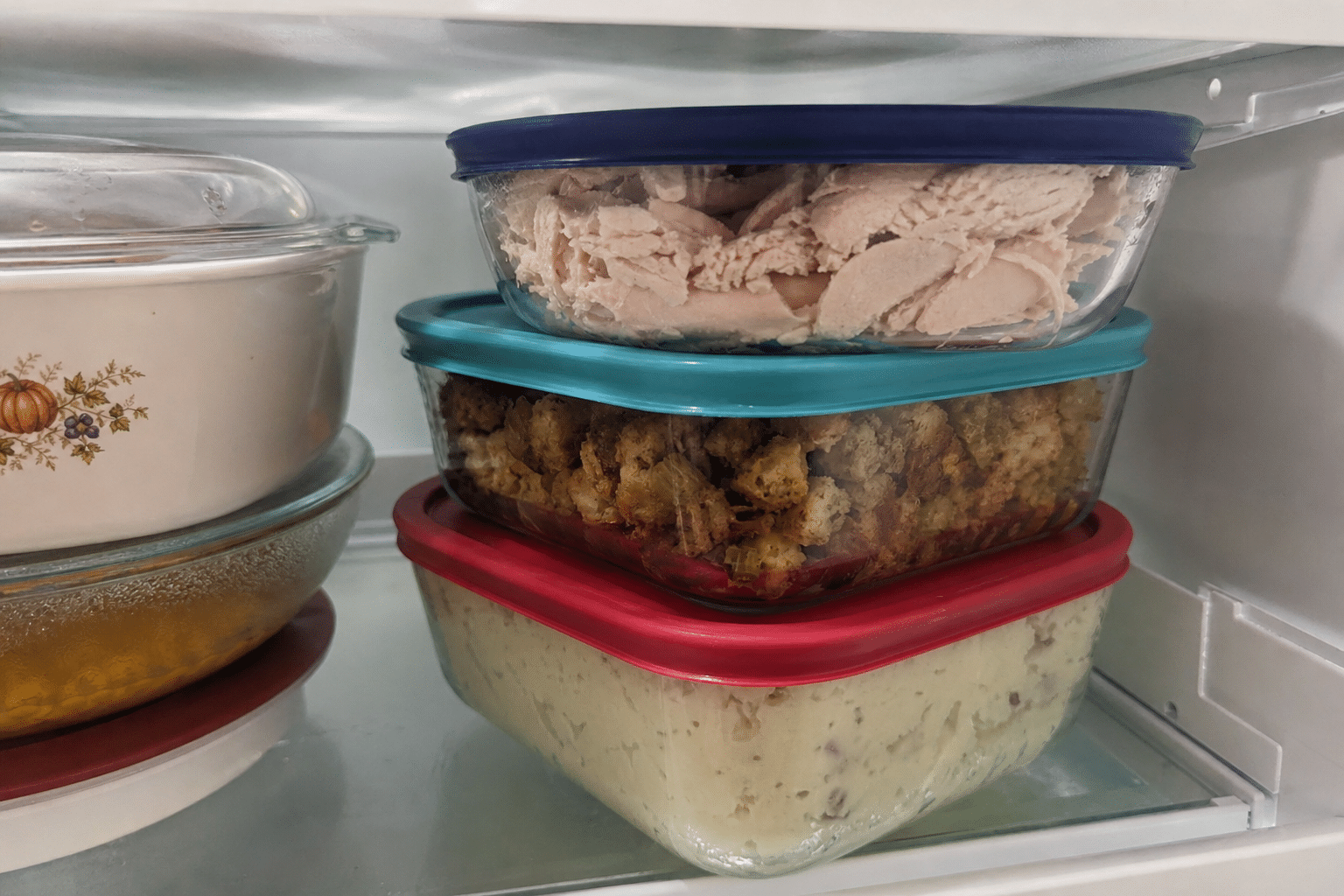

The USDA’s Food Safety and Inspection Service (FSIS) sets hard limits for every dish on the Thanksgiving table. Some foods stay safe for a full week in the refrigerator; others give you just three days. The chart below breaks it down food by food, with freezer windows for extending anything you cannot finish in time.
The 2-hour rule comes before everything else
All storage windows assume one thing happened first: leftovers went into the refrigerator within 2 hours of being served or removed from a warming appliance, per USDA FSIS guidance. Food left out longer than that should be discarded, regardless of what it is. When the room is above 90°F (32°C), the window drops to 1 hour.
Divide large quantities into shallow containers before refrigerating. A deep pot holds heat at its core far longer than bacteria need to multiply, well before the center has cooled to a safe temperature.
Read more: Hard brown sugar: the molasses science behind it, and how to fix it fast
How long each dish stays safe
The times below come from USDA FSIS guidance on handling cooked Thanksgiving dinners, the USDA FoodSafety.gov Thanksgiving blog, and the USDA FoodKeeper App, developed by FSIS with Cornell University and the Food Marketing Institute. Refrigerator means 40°F (4°C) or below; freezer means 0°F (-18°C) or below.
Food | Refrigerator | Freezer |
|---|---|---|
Cooked turkey, plain pieces or slices | 3-4 days | 4 months |
Turkey stored in broth or gravy | 3-4 days | 6 months |
Homemade gravy | 3-4 days | 4-6 months |
Stuffing (stored separately from turkey) | 3-4 days | 4-6 months |
Cranberry sauce | 7-10 days | 2-6 months |
Pumpkin or pecan pie | 3-4 days | — |
Fruit pie (apple, cherry, etc.) | Up to 1 week | — |
Cream pie | 3-4 days | — |
The USDA FoodKeeper App does not list freezer storage times for baked pies; custard- and cream-based fillings do not hold up well after freezing. According to USDA FSIS, all freezer windows are quality guidelines, not safety cutoffs. Food stored continuously at 0°F (-18°C) remains safe indefinitely, though texture and flavor deteriorate past these points.
Why the stuffing must leave the cavity first
USDA FSIS warns against putting a whole cooked turkey back in the refrigerator with stuffing still packed inside. The mass of warm stuffing cools too slowly to drop below 40°F (4°C) before bacteria can grow in the cavity.
Read more: Why adding a dark beer makes chocolate cake richer, moister, and better
The fix is simple: remove all stuffing from the bird before anything goes in the refrigerator and transfer it to a separate sealed container. It then follows the same 3-to-4-day refrigerator window as the turkey itself.
Read more: Budget beef wellington: a show-stopping holiday centerpiece using an affordable cut
Reheat to 165°F every time
FoodSafety.gov’s Thanksgiving guidance sets one reheat target for all leftovers: 165°F (74°C), confirmed with a food thermometer at the center or thickest point. For stuffing reheated in the oven, USDA FSIS specifies an oven set no lower than 325°F (163°C) until the center hits 165°F (74°C). Gravy should be brought to a rolling boil before serving.
FoodSafety.gov is direct about the cutoff: leftovers refrigerated on Thanksgiving evening must be eaten or moved to the freezer by the Monday after Thanksgiving.