
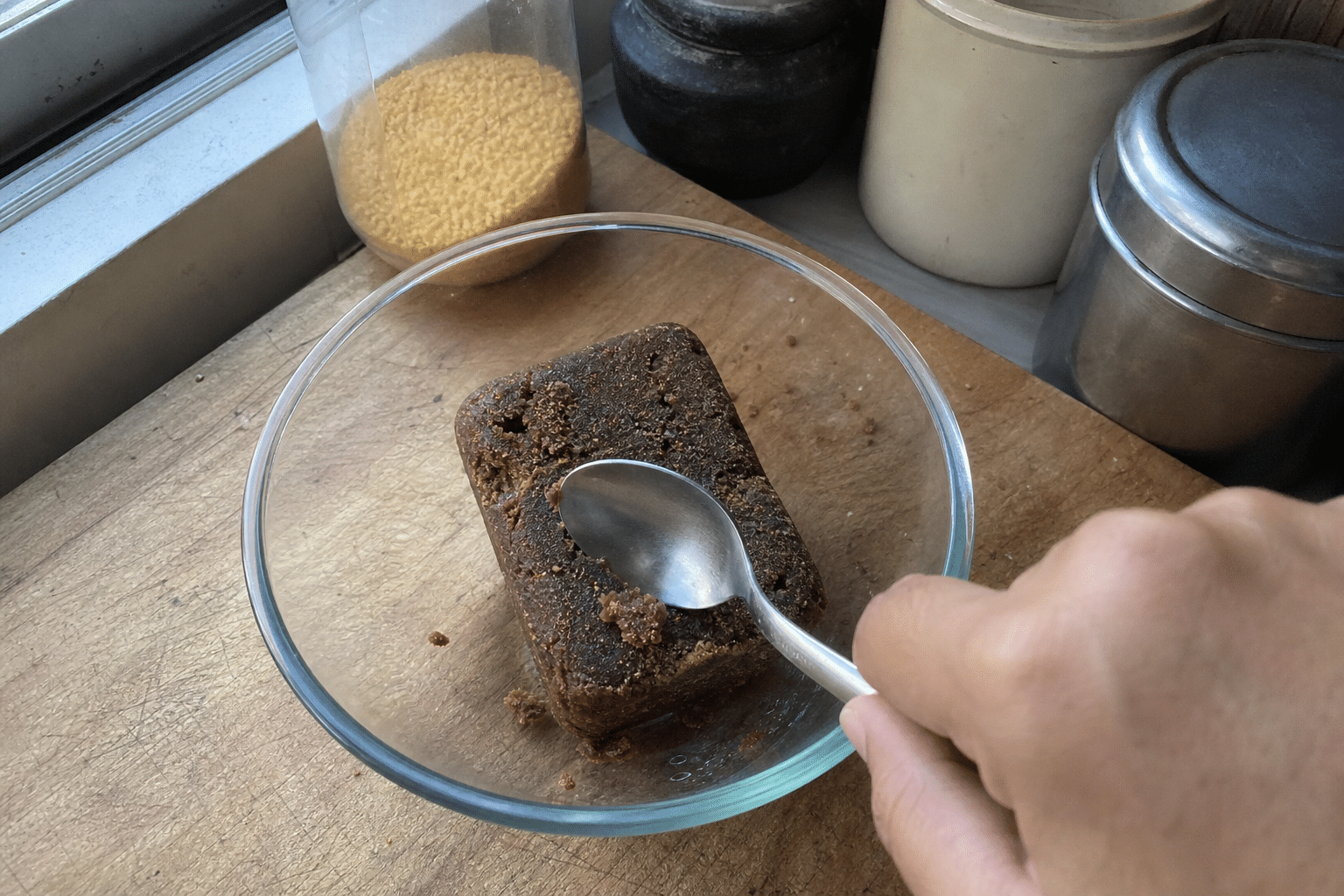

Pull open a bag of brown sugar that sat in the pantry too long and you find a dense brown brick where there used to be loose, scoopable sugar. It happens to every home baker, often in the middle of a recipe. The fix is fast, but only once you know what actually went wrong.
Why molasses is the reason it hardens
Brown sugar is not a separate ingredient from white sugar. It is refined white granulated sugar coated in a thin film of molasses: roughly 3.5% molasses in light brown sugar, and about 6.5% in dark brown sugar.
Molasses is hygroscopic, meaning it actively attracts and holds moisture from the surrounding air. When the sugar is fresh, that molasses film keeps each crystal slippery and separate, which is what gives brown sugar its soft, pliable texture. Leave the bag open (or sealed only loosely) and the molasses begins to lose that moisture to the surrounding air. As the film dries out, it stops acting as a lubricant and starts acting as glue. The crystals fuse together. According to the Sugar Association, hardening happens because “the molasses that gives it its brown color and rich flavor loses its moisture.”
This is not spoilage. Sugar does not go bad. The hardened brick is simply dehydrated sugar waiting for moisture to be added back.
Read more: Why adding a dark beer makes chocolate cake richer, moister, and better
Why dark brown sugar makes a denser brick
Light brown sugar contains about 3.5% molasses; dark brown sugar contains about 6.5%, nearly double. Because dark brown sugar starts with more molasses, it packs more densely. When it dries out, more molasses has acted as cement between the crystals, so the resulting brick tends to be denser and harder to break apart than a dried-out batch of light brown sugar.
Fix it in seconds: the microwave method
For sugar you need right now, the microwave is the fastest option. Place the hardened sugar in a microwave-safe bowl and drape a barely-damp paper towel over the top. Microwave in 20-second bursts, breaking apart any softened layers with a fork between each interval. Stop as soon as the sugar crumbles; overheating melts it, and there is no recovering from that.
Microwave-softened sugar re-hardens as it cools, so measure out what you need and use it immediately.
Read more: Budget beef wellington: a show-stopping holiday centerpiece using an affordable cut
Fix it overnight: bread or apple slice
If the recipe is tomorrow, an enclosed container with a moisture source does the work while you sleep. Place the hardened brown sugar in an airtight container and lay a slice of soft bread or a few apple wedges on top. Seal it and leave it for 24 hours. The bread or apple releases moisture slowly into the sealed space, and the hygroscopic molasses draws that vapor back in.
The bread method is the cleaner choice for most baking; the apple slice transfers a faint fruity note, which some bakers prefer for fall recipes. Either way, remove and discard the bread or apple once the sugar has softened.
Read more: Boneless pork ribs from a cheap collar cut: the low-and-slow grill trick that beats the real thing
Keep it soft for good: terracotta in an airtight container
The best solution is not letting the sugar harden at all. Store brown sugar in a true airtight container, a glass jar with a rubber gasket seal or a rigid container with a silicone seal, and add a small unglazed terracotta disc.
Soak the disc in cold water for 15 to 20 minutes, pat off any surface drips, and place it directly in with the sugar before sealing the lid. The porous terracotta acts as a slow-release humidifier, maintaining enough ambient moisture around the crystals to keep the molasses film pliable. Courtney Gaine, president and CEO of the Sugar Association, recommends this as her go-to method: store brown sugar in an airtight container with a piece of damp terracotta inside.
Remoisten the disc whenever the sugar begins to feel firm.