
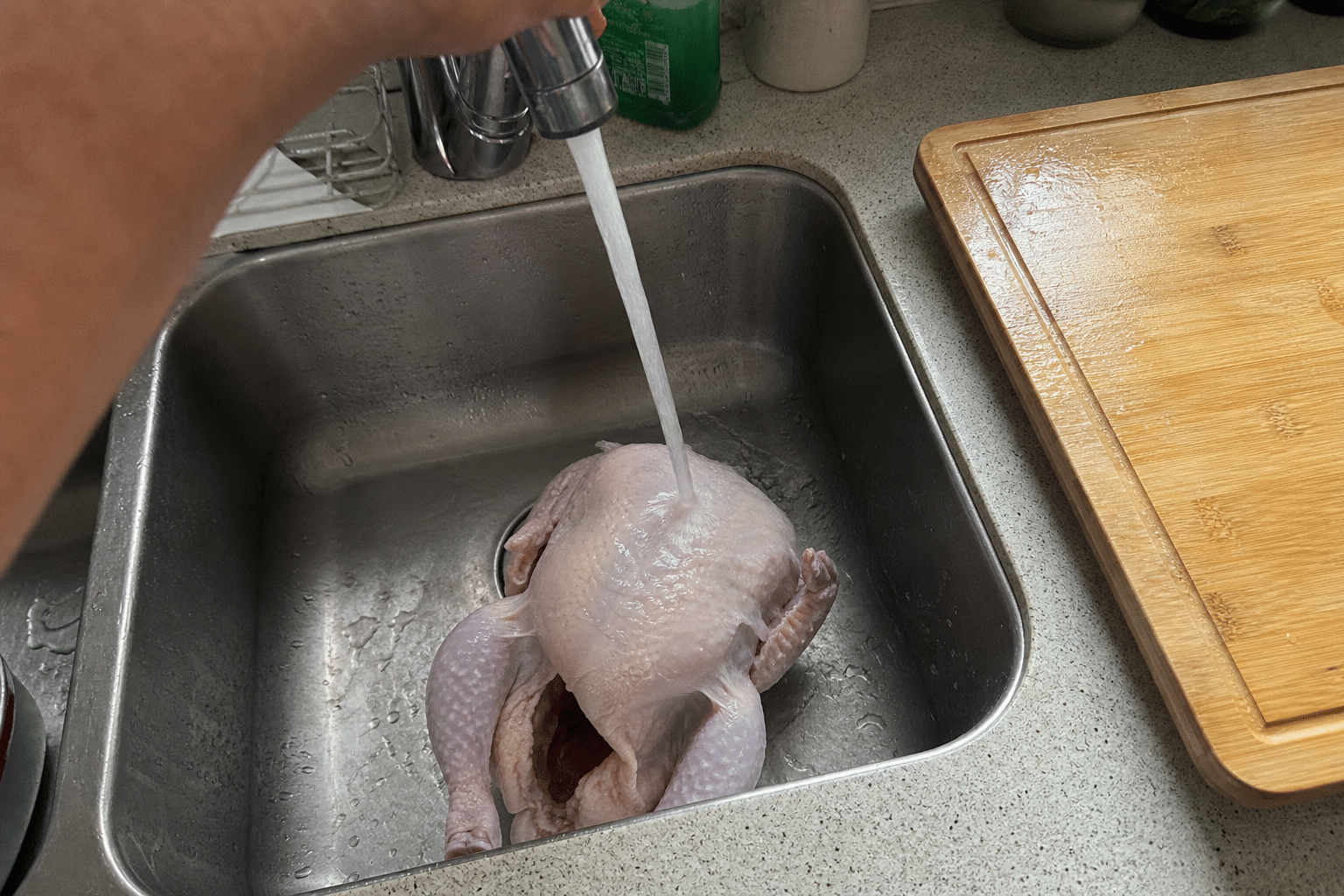

The instinct to rinse raw chicken runs deep. It feels hygienic. Many cooks learned the habit from a parent or grandparent, and the slippery surface of raw poultry only reinforces the feeling that something should be rinsed away. But the USDA Food Safety and Inspection Service has been clear for years: washing raw chicken does not remove bacteria. It moves them.
The spray from running water hitting raw poultry can reach up to 3 feet from the faucet, landing on countertops, cutting boards, produce, and utensils – all without any visible trace that contamination has occurred.
What happens when you rinse raw chicken
Raw chicken commonly carries Salmonella and Campylobacter. These bacteria sit loosely on the meat surface. Water does not kill them. When a stream from the faucet hits the chicken, tiny droplets bounce off and aerosolize, carrying bacteria to whatever is nearby.
Your sink gets contaminated first. Then the splatter travels. USDA guidance notes bacteria can spread across a 3-foot radius from the faucet. That covers most of a standard kitchen counter, any produce left out nearby, and the knives, plates, or pans staged on either side of the sink.
What USDA research found in real kitchens
USDA researchers spiked raw chicken with a harmless tracer bacterium that mimics Salmonella, then observed participants preparing meals in test kitchen conditions. Among participants who washed their raw poultry, 60% had bacteria in their sink when they finished. That alone is not surprising. What is: 14% of those sinks still tested positive for tracer bacteria even after participants cleaned the sink.
Read more: How long Thanksgiving leftovers are actually safe to eat, by food type
Bacteria did not stay confined to the sink. Of participants who washed their raw poultry, 26% transferred bacteria to their ready-to-eat salad lettuce, according to USDA data.
“Even when consumers think they are effectively cleaning after washing poultry, this study shows that bacteria can easily spread to other surfaces and foods. The best practice is not to wash poultry,” said Dr. Mindy Brashears, USDA’s Deputy Under Secretary for Food Safety, in the agency’s 2019 press release on the washing research.
The 2023 USDA kitchen behavior study
A five-year observational study completed by USDA’s Food Safety and Inspection Service and published in September 2023 tracked how consumers prepare food, using pork sausage spiked with harmless tracer bacteria to measure how safely people handled raw meat and produce.
Read more: Hard brown sugar: the molasses science behind it, and how to fix it fast
The handwashing findings were striking. Of participants, 87% said they washed their hands before cooking, but only 44% were actually observed doing so. Handwashing was skipped 83% of the time it was needed – for example, after touching raw meat and before handling fresh produce. Among handwashing attempts that did occur, 96% were missing at least one necessary step, such as adequate duration or soap. The kitchen sink was contaminated in 34% of meal preparations overall.
Thermometer use was similarly inconsistent: only 50% of participants confirmed the sausage had reached a safe temperature using an actual thermometer.
“These studies are important for USDA to understand consumer behaviors in the kitchen,” said USDA Under Secretary Dr. Emilio Esteban in the September 2023 press release announcing the findings.
Read more: Why adding a dark beer makes chocolate cake richer, moister, and better
Why the washing habit is hard to break
The practice is partly cultural, partly sensory. In many households and culinary traditions, rinsing meat is a standard step passed down through generations before food safety research caught up. The texture of raw chicken reinforces the feeling that something needs to be washed off.
None of what rinsing removes is the concern. It does not reduce bacterial load on the meat surface in any meaningful way. Only heat accomplishes that.
What to do instead
Skip the sink entirely. Here is what USDA recommends:
- Go directly from packaging to pan. Transfer the chicken straight into your cooking vessel without letting the packaging drip across the counter or into the sink.
- Pat dry with paper towels if your recipe calls for a dry surface – for a good sear, for example. Discard the paper towels immediately afterward.
- Wash your hands with soap and water for at least 20 seconds after handling raw poultry and before touching anything else, especially produce or cooked food.
- Clean and sanitize any surface, cutting board, or utensil that made contact with raw chicken or its juices. Soap and hot water first, then a sanitizing solution.
- Use a food thermometer to confirm doneness. Visual cues – color, juice clarity – are not reliable indicators of safety.
The temperature that actually kills bacteria in chicken
Heat is the only reliable way to make chicken safe to eat. The USDA sets the safe internal temperature for all poultry at 165°F (74°C). That includes whole chickens, chicken pieces, ground chicken, and whole turkeys. At that temperature, Salmonella and Campylobacter are destroyed.
Insert the thermometer into the thickest part of the meat and make sure it does not touch bone. For a whole bird, check the innermost part of the thigh and the thickest part of the breast. With Thanksgiving on November 26 less than two weeks away, that 165°F (74°C) target applies to the turkey exactly as it does to a boneless chicken breast.