
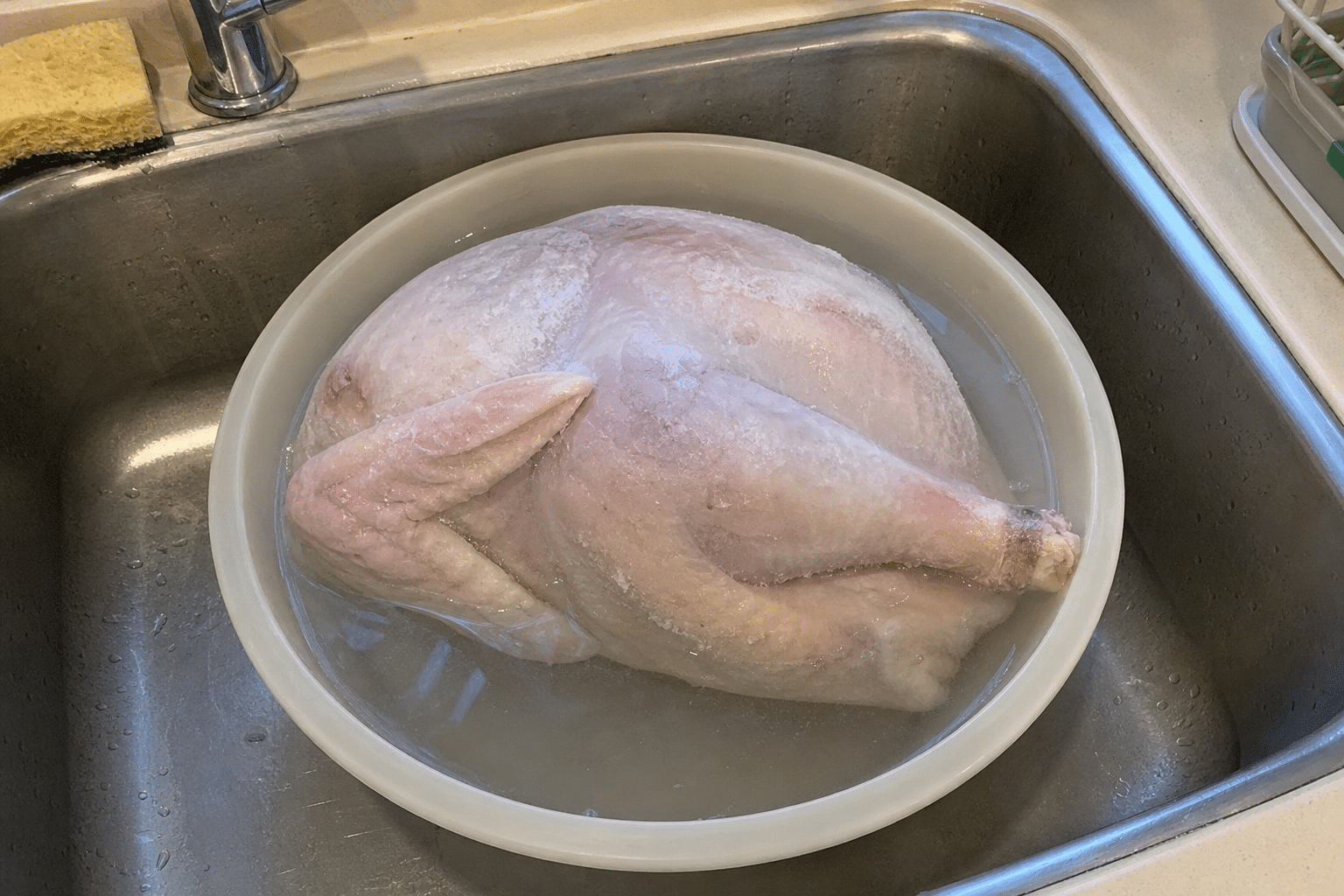

There are exactly three safe ways to thaw a frozen turkey: in the refrigerator, in cold water, or in the microwave. The USDA Food Safety and Inspection Service (FSIS) has precise timetables for each. The counter is not on the list.
Here is the full breakdown, with charts.
Refrigerator thawing: the safest method and the most time
Refrigerator thawing gives bacteria no opening. The bird stays below 40°F (4°C) the entire time, so there is no window for harmful microbes to grow.
The USDA FSIS rule: allow approximately 24 hours for every 4 to 5 pounds (1.8 to 2.3 kg) in a refrigerator set at 40°F (4°C) or below.
Turkey weight | Days to thaw in the refrigerator |
|---|---|
4-12 lbs (1.8-5.4 kg) | 1-3 days |
12-16 lbs (5.4-7.3 kg) | 3-4 days |
16-20 lbs (7.3-9.1 kg) | 4-5 days |
20-24 lbs (9.1-10.9 kg) | 5-6 days |
If Thanksgiving is Thursday, November 26, a 16-pound (7.3 kg) turkey put in the refrigerator on Saturday, November 21 will be fully thawed with one day to spare. A 20-pound (9.1 kg) bird needs to go in by Sunday, November 20 at the latest.
Place the turkey in a container or on a rimmed tray on the bottom shelf. This catches drips and keeps raw juice away from everything else in the refrigerator. Once fully thawed, the bird keeps safely for one to two more days before cooking.
Read more: Why your sauteed onions turn bitter, and the pan technique that keeps them sweet
Cold water thawing: hours instead of days
Cold water thawing is the right call when you are short on time. The rule is 30 minutes per pound, which cuts a multi-day thaw down to a single afternoon for most birds.
Before you start, make sure the turkey is in a completely leak-proof plastic bag. If water gets into the cavity, the meat absorbs it and cross-contamination risk rises. Submerge the sealed bird in cold water, then change the water every 30 minutes without fail.
Turkey weight | Cold water thawing time |
|---|---|
4-12 lbs (1.8-5.4 kg) | 2-6 hours |
12-16 lbs (5.4-7.3 kg) | 6-8 hours |
16-20 lbs (7.3-9.1 kg) | 8-10 hours |
20-24 lbs (9.1-10.9 kg) | 10-12 hours |
The water changes are not optional. Standing water warms up around the bird and starts recreating the same temperature problem as counter-thawing. Each fresh batch keeps the surface safely cold.
A turkey thawed this way must be cooked immediately. It cannot go back into the refrigerator to wait until the next day.
Microwave thawing: only for smaller birds
Most whole turkeys will not fit in a standard home microwave, so this method is best suited for turkey breasts and smaller birds.
Read more: How resting meat before slicing keeps up to 60 percent more juice in every bite
If yours fits, use the defrost setting and follow your microwave’s manufacturer recommendations for the weight of the bird. As with cold water thawing, a microwave-thawed turkey must go straight into the oven. Parts of the bird may already be approaching cooking temperature during defrosting, and that process needs to finish before bacteria have a chance to grow.
Why counter-thawing puts everyone at risk
Leaving a frozen turkey on the kitchen counter overnight is one of the most common food safety mistakes of the year. According to USDA FSIS, perishable foods should never be thawed on the counter or in hot water.
The danger is the temperature range the USDA calls the “danger zone”: between 40°F (4°C) and 140°F (60°C), where bacteria multiply rapidly. A turkey sitting on the counter will reach that zone on the outside within hours while still frozen solid in the center. As USDA FSIS explains, as soon as the surface warms above 40°F, bacteria that were present before freezing begin to multiply.
Read more: Rinsing raw chicken spreads bacteria up to 3 feet, USDA data shows
Thawing in hot water carries the same risk. The surface heats up too quickly before the inside thaws, and the same window for bacterial growth opens up. Cold running water is also not approved; the USDA specifies cold water changed every 30 minutes.
Perishable food should not be left at room temperature for more than two hours in total.
Cook it to 165°F throughout
No matter which safe method you used, the turkey is not done until it reaches 165°F (74°C) at its coolest point. USDA FSIS specifies three check spots: the innermost part of the thigh, the innermost part of the wing, and the thickest part of the breast.
The thigh is typically the last part to reach temperature in a whole bird. Place your thermometer in the innermost part of the thigh, away from the bone. Once that reads 165°F (74°C), the bird is safe to carve.