
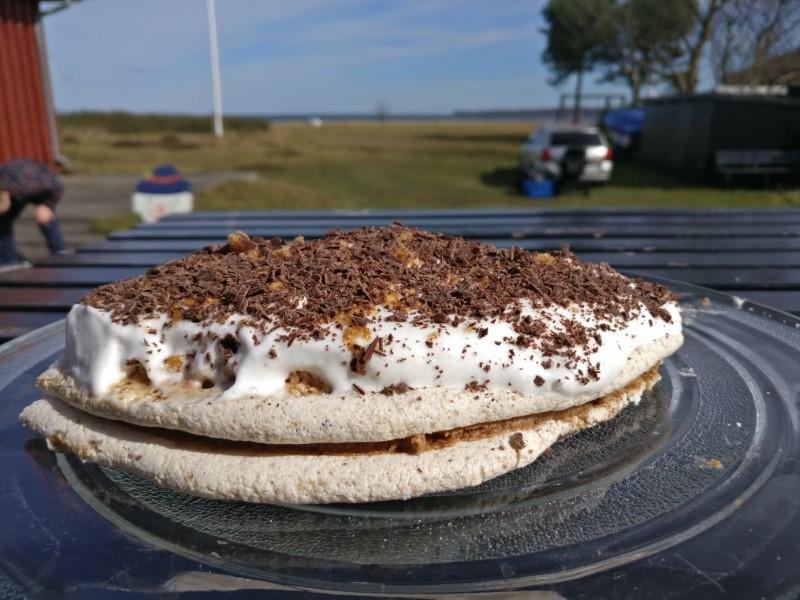

My take on a delicious vegan version of the Danish classic fragilité. Although the name sounds French, fragilité is quintessentially Danish.
Recipe for vegan fragilité
My take on a delicious vegan version of the Danish classic fragilité.
Although the name sounds French, fragilité is purely Danish. It was invented around 100 years ago by the Danish baker Johannes Steen.
There isn’t a huge difference between a regular version and this vegan one – here the eggs are replaced with aquafaba and the butter is vegan.
Enjoy!
Servings: cake
Vegan fragilité
My take on a delicious vegan version of the Danish classic fragilité. Although the name sounds French, fragilité is quintessentially Danish.
Ingredients
Bottoms
- 200 gram Hazelnuts
- 150 gram Sugar
- 240 gram Aquafaba
- 4 gram Cream Of Tartar-Tartrates cream of tartar or apple cider vinegar
- 100 gram Sugar
- 3 gram Salt
Buttercream
- 250 gram Spreadable Butter vegan
- 180 gram Powdered Sugar
- 50 gram Dark chocolate
- 100 gram Espresso strong
Instructions
Bases
- (They can advantageously be made the day before):
- Pour the nuts onto a baking tray and roast them for 12 minutes on the second highest rack in the oven at 175 degrees Celsius (347 degrees Fahrenheit).
- Take them out of the oven, toss them into a colander, and let them cool.
- Stir the nuts around with your hand or a spoon to loosen the skins – there will be some skins that stick partially, but that's okay.
- Put the nuts into a food processor along with 150 g of sugar and chop until the nuts are finely ground.
- Pour the aquafaba into a saucepan and reduce to 1/2 - 2/3 and let cool.
- Get the mixer out and attach the whisk.
- Pour the aquafaba into the bowl and whisk it completely stiff – expect it to take 10-15 minutes.
- Continue whisking and add one tablespoon of sugar at a time until you've used it all – make sure the sugar is thoroughly whisked into the aquafaba between each spoonful.
- Whisk until the meringue is glossy and firm – it should almost clump together slightly.
- Now gently fold the nut/sugar mixture into the meringue until evenly distributed.
- Preheat the oven to 95-100 degrees Celsius (203-212 degrees Fahrenheit).
- Get 3 baking trays and place a piece of baking paper on each.
- Draw a circle of 24 cm on each baking paper – use a springform or similar as a template – alternatively, you can use two baking trays and make 4 smaller bases, i.e., 2 20cm on each tray.
- Distribute the meringue evenly on the trays (if you have poor judgment like me, place the baking tray on your scale. It's about 3 x 245g). You can also fill the meringue into a piping bag without a nozzle and distribute it as a spiral on the baking paper.
- Bake the bases in the oven for 1 hour, then turn off the oven and let the bases sit in the oven for an additional 1-2 hours.
- Take the bases out and let them cool completely on a rack before removing the baking paper – if the bases are a bit chewy, that's perfect, as a fragilité should be a bit chewy!
Spreadable Cream
- Put the spreadable block in the mixer and whisk it airy with the paddle attachment.
- Add 1/3 of your powdered sugar and whisk it into the butter.
- Repeat 2 more times until you have used it all and then whisk for another 2-3 minutes.
- Chop the chocolate finely and melt it in the microwave or over a water bath.
- Add the chocolate to the buttercream while whisking.
- Now slowly add the espresso while whisking and whisk until all the espresso is incorporated into the buttercream – make sure that the spreadable block, chocolate, and coffee are at roughly the same temperature, so the cream doesn't split.
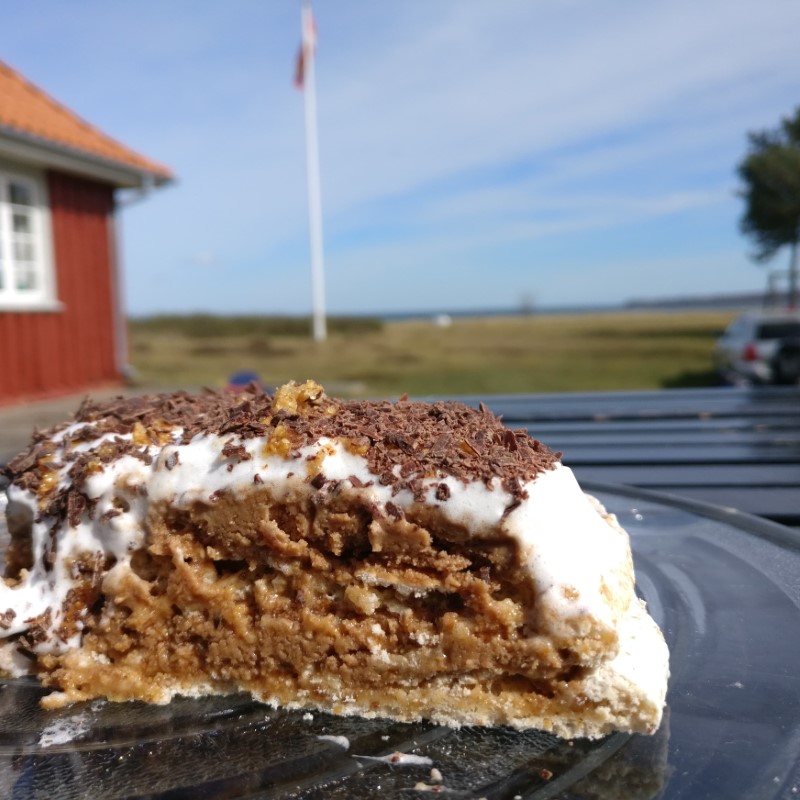
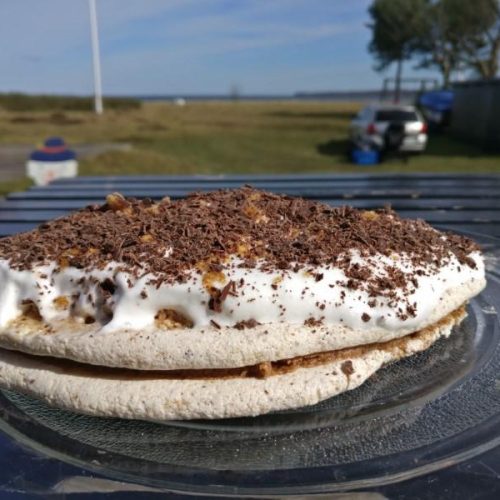
- Spread the buttercream on two (or 3 if you made 4 small bases) of the meringue bases and assemble the cake – (you can also spread a thin layer on top).
- Place the cake in the refrigerator for at least 4 hours or until serving.
- Decorate the cake, for example, with powdered sugar, freeze-dried raspberries, and hazelnuts. You can also make extra buttercream to frost and decorate with!