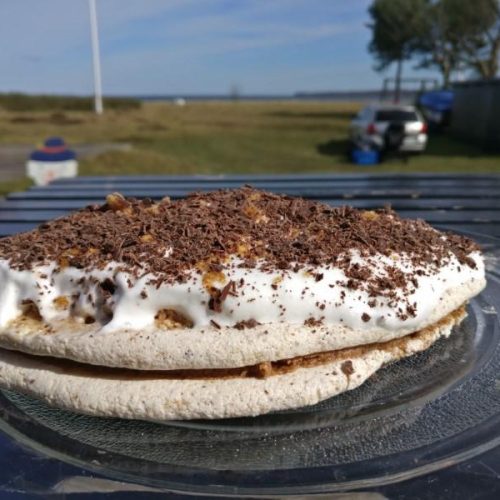
Servings: cake
Vegan fragilité
My take on a delicious vegan version of the Danish classic fragilité. Although the name sounds French, fragilité is quintessentially Danish.
Ingredients
Bottoms
- 200 gram Hazelnuts
- 150 gram Sugar
- 240 gram Aquafaba
- 4 gram Cream Of Tartar-Tartrates cream of tartar or apple cider vinegar
- 100 gram Sugar
- 3 gram Salt
Buttercream
- 250 gram Spreadable Butter vegan
- 180 gram Powdered Sugar
- 50 gram Dark chocolate
- 100 gram Espresso strong
Instructions
Bases
- (They can advantageously be made the day before):
- Pour the nuts onto a baking tray and roast them for 12 minutes on the second highest rack in the oven at 175 degrees Celsius (347 degrees Fahrenheit).
- Take them out of the oven, toss them into a colander, and let them cool.
- Stir the nuts around with your hand or a spoon to loosen the skins – there will be some skins that stick partially, but that's okay.
- Put the nuts into a food processor along with 150 g of sugar and chop until the nuts are finely ground.
- Pour the aquafaba into a saucepan and reduce to 1/2 - 2/3 and let cool.
- Get the mixer out and attach the whisk.
- Pour the aquafaba into the bowl and whisk it completely stiff – expect it to take 10-15 minutes.
- Continue whisking and add one tablespoon of sugar at a time until you've used it all – make sure the sugar is thoroughly whisked into the aquafaba between each spoonful.
- Whisk until the meringue is glossy and firm – it should almost clump together slightly.
- Now gently fold the nut/sugar mixture into the meringue until evenly distributed.
- Preheat the oven to 95-100 degrees Celsius (203-212 degrees Fahrenheit).
- Get 3 baking trays and place a piece of baking paper on each.
- Draw a circle of 24 cm on each baking paper – use a springform or similar as a template – alternatively, you can use two baking trays and make 4 smaller bases, i.e., 2 20cm on each tray.
- Distribute the meringue evenly on the trays (if you have poor judgment like me, place the baking tray on your scale. It's about 3 x 245g). You can also fill the meringue into a piping bag without a nozzle and distribute it as a spiral on the baking paper.
- Bake the bases in the oven for 1 hour, then turn off the oven and let the bases sit in the oven for an additional 1-2 hours.
- Take the bases out and let them cool completely on a rack before removing the baking paper – if the bases are a bit chewy, that's perfect, as a fragilité should be a bit chewy!
Spreadable Cream
- Put the spreadable block in the mixer and whisk it airy with the paddle attachment.
- Add 1/3 of your powdered sugar and whisk it into the butter.
- Repeat 2 more times until you have used it all and then whisk for another 2-3 minutes.
- Chop the chocolate finely and melt it in the microwave or over a water bath.
- Add the chocolate to the buttercream while whisking.
- Now slowly add the espresso while whisking and whisk until all the espresso is incorporated into the buttercream – make sure that the spreadable block, chocolate, and coffee are at roughly the same temperature, so the cream doesn't split.
- Spread the buttercream on two (or 3 if you made 4 small bases) of the meringue bases and assemble the cake – (you can also spread a thin layer on top).
- Place the cake in the refrigerator for at least 4 hours or until serving.
- Decorate the cake, for example, with powdered sugar, freeze-dried raspberries, and hazelnuts. You can also make extra buttercream to frost and decorate with!