

Recipe for fake caviar
In molecular gastronomy, the terms fruit pearls and fruit caviar/fake caviar are often used, and people frequently cannot tell the difference. We decided to address this by collaborating with Githa Bennorth, a Gastronomic Developer, cookbook author, and expert in molecular gastronomy.
The difference is simple: Fruit pearls are solid all the way through, whereas fruit caviar has a thin shell and is liquid inside.
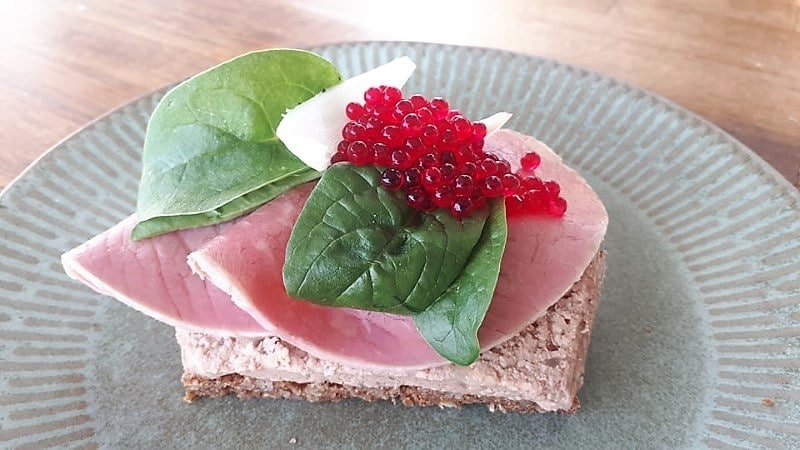
Here you get the recipe for fake caviar, false caviar, fruit caviar – a dear child has many names. It is a small ball with a flavorful liquid of your choice. They can be used as decoration on cakes, as part of a dessert, or as a flavor enhancer in a cocktail.
You create a spherification where it gets a consistency similar to real caviar, with a liquid inside and a solid membrane on the outside. This way, the individual caviar pops when you eat it.
It’s about mixing your desired liquid with agar agar, and when it cools down, it will set and become a solid and stable mass. This is done by dripping the liquid into ice-cold oil, which causes the drops to set as round balls/pearls.
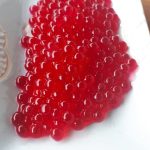
Here the fake caviar is made with beetroot juice, but there are no limits to what you can use. In the video, the juice is made by mixing beetroot powder, but you can take many different approaches if you wish.

Fake caviar
Equipment
- Immersion Hand Blender
- Mini Scale
- Slotted Spoon
Ingredients
- 100 gram Beetroot Juice
- 1 pinch Salt If the beetroot juice is a bit too sweet
- 0.5 gram Sodium Alginate
Calcium bath
- 0,5 l Water without lime, preferably spring water
- 3.25 gram Calcium Lactate
Instructions
- Start by tasting your beetroot juice. If it is too sweet, add a bit of fine salt.
- Pour the juice into an immersion blender glass.
- Add sodium alginate to the beetroot juice.
- Blend from the top down for about 30 seconds to distribute everything evenly.
- Now there is air in the liquid after blending, and the air will cause problems later. Therefore, it needs to stand and de-gas so the air can escape. It should simply stand at room temperature for 15 minutes.
Calcium bath
- Pour the water and calcium into an immersion blender glass.
- Blend it thoroughly for about 15 seconds.
- Set it aside for 15-30 minutes to let all the air escape.
Fake caviar
- You need two bowls with liquids for this: Both a calcium bath and a bath with plain tap water.
- Drop beetroot liquid into the calcium bath. You can use anything from a syringe, pipette, dropper bottle, etc.
- Let it sit for about 30 seconds, then scoop them out with a slotted spoon and place them in the plain water bath.
- They are now ready to serve.
Notes
