



Recipe for sous vide duck breast
No Christmas Eve (or Mortens Aften) without duck! At least, not if you ask the Asmussen family. But duck is truly wonderful at any time of the year, and in our home, it’s crucial that it’s perfectly tender and juicy, regardless of the season.
There are many delicious ways to prepare duck: It can be roasted, confit, smoked… you name it, but if you’re not the biggest fan of whole roast duck, then duck breast is absolutely perfect.
And what makes more sense than preparing them sous vide? Often, there are many other elements to handle during the Christmas meal, and it’s nice not to worry too much about the duck, whether it’s overcooked, etc. It simply takes care of itself in the water bath and becomes perfect every single time.
Here, I’ll guide you to the perfect duck breast prepared sous vide. I’ll cover recommended times and temperatures and also take a closer look at the different duck varieties you might encounter at the supermarket.
You can buy delicious duck from our sponsor Mr. Beef here.

Which Duck to Choose?
As Mortens Aften and Christmas Eve approach, suddenly there are ducks everywhere. You’ll typically encounter Peking duck and Muscovy duck, but there are also some more “special” breeds like Moulard duck and Musk duck.
Peking Duck: Peking duck originates from China (hence the name), and it’s the most common duck we find here, both in farm shops and supermarkets.
Peking duck is a swimming bird, which means it has a nice thick layer of fat. This has both advantages and disadvantages. Some might be disappointed that the duck loses a lot of weight during cooking (due to the fat melting), but on the other hand, the fat helps make the skin wonderfully crispy.
Muscovy Duck: The French Muscovy duck is very popular here as well. Muscovy ducks are primarily bred in France where they often trim the ducks’ beaks and claws. Muscovy ducks tend to be quite aggressive by nature. In our country, we don’t trim the beaks or claws, so if animal welfare is particularly important to you, we recommend sticking with the domestically bred varieties.
The Muscovy duck is a flying bird that originates from a warmer climate than the Peking duck, and therefore doesn’t need as much body fat. Although Muscovy ducks are smaller than Peking ducks, you get more meat for your money.
Musk Duck: Musk duck is actually the same species as Muscovy duck, but the difference is that the musk duck is wild, while the Muscovy duck is “domesticated” (bred). If you come across a musk duck, you can be certain its beak and claws haven’t been trimmed. Wild duck meat is less fatty.
Moulard Duck: Moulard duck is a “hybrid” between Peking duck and Muscovy duck. Like Muscovy and musk ducks, they have claws but primarily live as swimming birds—like the Peking duck. However, Moulard duck meat is leaner than Peking duck.
Roast Duck vs. Duck Breast
It varies greatly from family to family how particular one is about duck. Some swear by whole roast duck while others are completely fine with duck breast.
One of the challenges with a whole roast duck can be that not all parts of the duck require the same cooking time. Therefore, the wings often turn out much drier compared to the breast.
If you’re not hosting a large gathering, a whole duck can also seem a bit much. And that’s where duck breasts are ideal.
Duck Breast Sous Vide
Sous vide is the easiest way to get perfectly tender and juicy duck breasts. Period.
By cooking the duck breasts sous vide, you’re always guaranteed to have them deliciously tender and the meat will have the rosy color it deserves!
When you cook duck sous vide, the meat retains its juices in a completely different way than you’re used to. The brilliant thing about sous vide is that all the juices are preserved inside the bag and almost embedded into the meat. The duck breast becomes perfectly pink from the inside out.
Sous Vide Times and Temperatures for Duck Breast
You’ll encounter a few different recommendations when it comes to the time and temperature for sous vide duck breast. Time and temperature are the only things we focus on when we talk about sous vide. After that, the meat just takes care of itself.
The temperature depends greatly on how you prefer your duck breast: Whether you want it pink, or if it should be more “well-done.”
Personally, I prefer a pink result. I think the meat becomes significantly more delicate and juicy this way. If you find my duck breast to be a bit too pink, I recommend increasing the temperature by a couple of degrees, but no higher than 62 degrees Celsius (143.6 degrees Fahrenheit). Increase it by a few degrees, and the meat will become firmer, but the result will still be really delicious.
Searing Sous Vide Duck Breast
The “disadvantage” of sous vide is that the meat doesn’t get a sear, and it’s often the sear that gives it that extra touch. Especially with duck breast! Who doesn’t love crispy duck skin? Fortunately, there’s a solution for that.
When I work with sous vide, I generally prefer to fry in ghee, which is clarified butter, but if you don’t have ghee, I recommend using a mixture of equal parts butter and oil. This provides a high temperature on the pan and prevents splattering. If you have duck fat, you can of course also choose to fry in that.
I usually use a regular frying pan, but you can also throw the duck breasts on the grill or give them a go with a blow torch. The blow torch is particularly brilliant for meat with an uneven surface, so if you think it would be easier with a blow torch, don’t hesitate. It works just as well as anything else.
The most important thing when giving a sear is simply that the temperature is high! So, no half-warm grill or pan. It needs to be full throttle.
The duck breasts are already cooked and ready to eat, so it’s just the surface that needs a quick sear. We don’t want the breasts to continue cooking inside.
Sauce for Sous Vide Duck Breast
When you take the bag out of the water bath and unpack the duck breasts, it’s a good idea to save the meat juices. They can be used to make a delicious sauce!
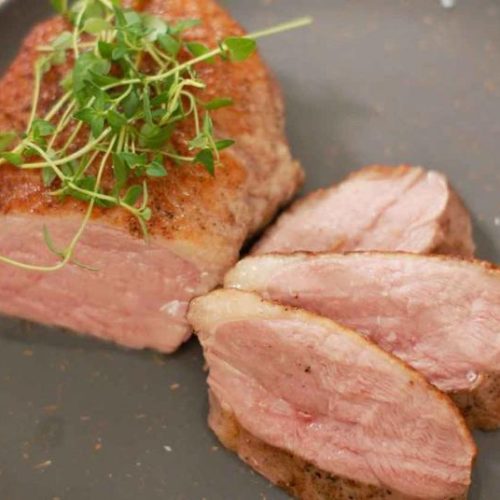
Sous Vide Duck Breast
Equipment
- Chef'S Knife
- Sous Vide
Ingredients
- 2 pcs. Duck Breast
- Salt and Pepper from the grinder
- 28.4 gram Duck Fat optional
- Ghee alternatively duck fat or a mixture of butter and oil
Instructions
- Start by scoring the skin of the two breasts diagonally.
- Season them with a good amount of pepper and a little salt.
- Vacuum seal the breasts. Feel free to add 1 tablespoon of duck fat per breast before vacuuming them.
- Cook the breasts in the sous vide/water bath at 58 degrees Celsius (136 degrees Fahrenheit) for 2 hours.
- Take the meat out of the bag and dry it thoroughly - either with a dishcloth or paper towels. The meat juice can be used to make sauce.
- Place fat in a smoking hot pan. You can use ghee, duck fat, or a 1:1 mixture of butter and oil.
- First, fry the duck breasts for 3 minutes on the skin side.
- Then turn the breasts and give them 1 minute on the meat side.
- Serve immediately, preferably in a preheated ovenproof dish.