
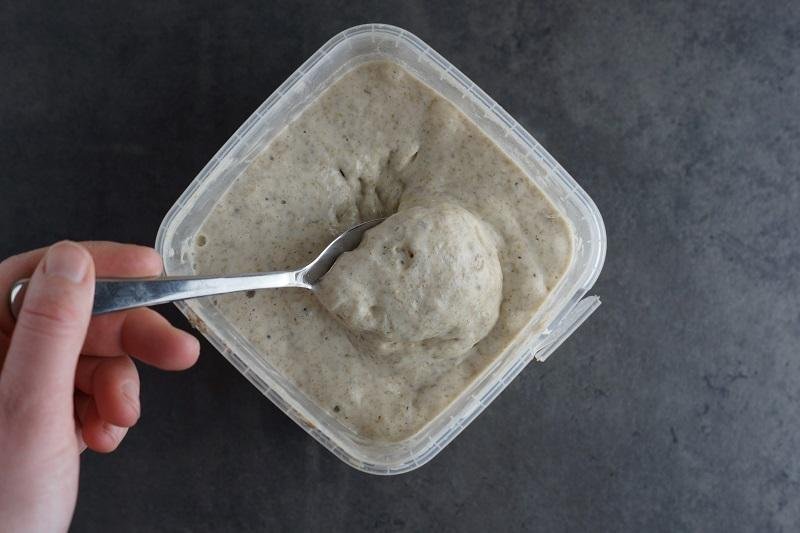


Recipe for sourdough for beginners
I have tried several different sourdough starters with varying degrees of success.
But this time, I have hit a sourdough starter that works – so far.
Therefore, I started researching a lot online, where especially Trevor J. Wilson and Bagvrk.dk have been great in introducing me to a good approach to sourdough. I would like to share that with you here:
So far, it has been sitting on the kitchen counter and has been fed twice a day.
Today, after baking with it, I have moved it to the fridge. So now I can get by with feeding it once a week. And then wake it up with two feedings before I need to bake again.
And yes, my sourdough has been given a name, and she’s called Maude, and yes, it is after Maude Varnæs.
At the time of writing, I have baked a few times with this sourdough starter with various results. But I will link to the recipe that has given the best result so far – you can find it here.
When starting the sourdough, you will need to discard some of it regularly to maintain a good acid balance. I have used the discarded sourdough in other bread doughs when I was baking anyway. The sourdough has not been active yet, but it has given the bread a good flavor.
From the time I started my sourdough, it took 8 days before I could bake with it. But it may be ready as early as the 6th or 7th day or as late as the 10th day.
This is one of the things you need to check regularly with a sourdough test to see if the dough is multiplying as it should.
To create a well-functioning sourdough starter, you will need some equipment:
- A good baking scale
- A container for your flour mixture of about 1 liter
- A jar with a lid or a clear container with a lid
Ingredients
Flour Mix
- 400 gram Wheat Flour
- 200 gram Rye Flour preferably coarse
Day 1
- 100 gram Flour Mix
- 100 gram Water lukewarm
Day 2, morning
- 75 gram Sourdough
- 75 gram Flour Mix
- 75 gram Water lukewarm
Day 2, evening
- 75 gram Sourdough
- 75 gram Flour Mix
- 75 gram Water lukewarm
Instructions
- This is how you start your sourdough:
Day 1:
- Mix 100g flour mixture with 100g lukewarm water. Stir until there are no more lumps in the mixture.
- Scrape the edges free of dough residues so there is no dough that can dry out or form mold, which will ruin your sourdough.
- Let your sourdough stand on the kitchen counter without a lid for 4 hours. This way the yeast bacteria will find their way into the container and start your sourdough. After the 4 hours, put the lid on and let the sourdough sit until the next day on the kitchen counter.
Day 2, morning:
- Weigh out 75 grams of your starter dough; this is the part you will continue to work with. Discard the rest.
- Also weigh out 75 grams of flour mixture and 75 grams of lukewarm water.
- Mix the starter dough with the flour and water, and stir gently to ensure there are no dry flour lumps.
- Place the lid back on and let the container stand on the kitchen counter.
Day 2, evening:
- Repeat the morning process and let the container stand on the kitchen counter again.
Day 3:
- You may have guessed it by now, but yes, continue as on day 2. Your sourdough will need to be fed twice a day for the next several days.
- A good sourdough requires time and care, but I promise it is worth it.
- The sourdough is now well on its way, and there are good bubbles in it. But it is also around this time that it might take a little pause and may seem like it's stalling. Keep going; it will come back.
- Around day 5-7, it starts to get really exciting.
- By now, the sourdough is so active that it smells and tastes a bit sour. This is a very good sign.
- Try marking or using an elastic band on the container where the sourdough reaches just after you have fed it, and then about twice as high. You really get to see how much the sourdough works.
- When the sourdough doubles in size, it is almost ready to bake with.
- Mine was ready on the 8th day, but it varies greatly from sourdough to sourdough. And I suspect that temperature and humidity also play a role here 🙂
- Test if your sourdough is ready by filling a glass with lukewarm water and adding a bit of your sourdough when it has doubled in size. If it floats, it is ready.

- If it sinks to the bottom, it needs a bit more time.
- Here you will find the recipe for my first successful sourdough bread and the video I followed myself.
- My sourdough is now in the fridge and now needs only to be fed once a week, and then fed twice with 12-hour intervals just before use.

