



Recipe for sole d’albert (oven-baked)
My take on the classic Sole d’ Albert – steamed sole baked in the oven.
The dish is said to be named after a chef (Albert) at the French restaurant Maxim (in Paris).
A few days ago, I had never heard of the dish, but I love talking to professionals and learning about their cooking methods and recommendations. Here, I got a whole sole from my local fishmonger at our market. I love the idea of just going up to him and asking what we should eat and how many people it’s for. I don’t have to stand there thinking if I need to eat 150 or 250 grams of a given fish (which typically would be salmon or cod), but rather have a conversation and then bring home a recommended cooking method – I love it.
Here the recommendation was sole, and even though I generally prefer eating fillets and using the rest for flavoring, I got the best of both worlds here.
I made the dish on a somewhat stressful Monday afternoon when I came home late, my youngest son wouldn’t sleep, and my wonderfully impatient (almost 4-year-old) daughter wanted to help make the food. So, in general, all the odds were against me – but my goodness, did it turn out great. An outstanding and insanely delicious dish that certainly deserves a spot on the menu again.
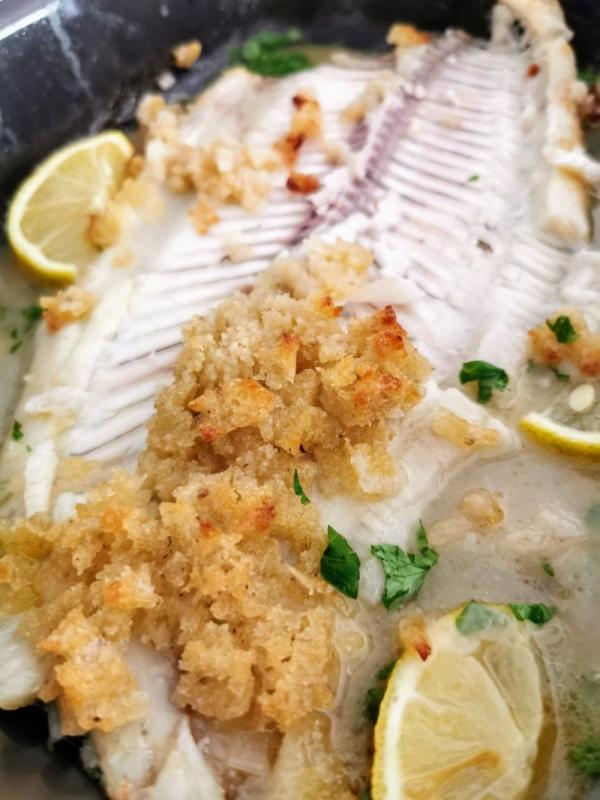
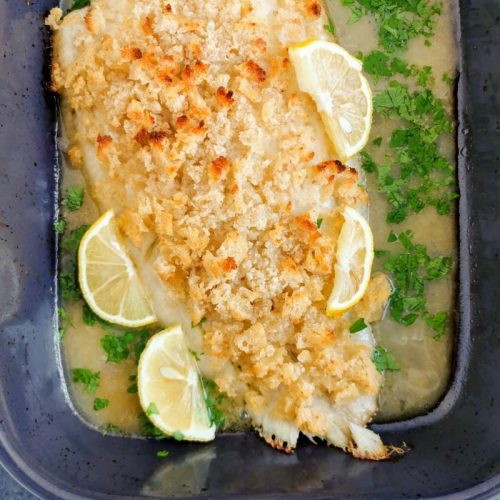
Sole d'Albert (oven-baked)
Equipment
- Oven
- Cutting Board
- Chef'S Knife
- Frying Pan
- Ovenproof dish
- Pot
- Sieve
- Bowl
- Palette Knife
Ingredients
- Salt
- Sugar
- 1 pcs. Sole whole
- 1 pcs. Shallots use 2 if they are small
- 300 gram Noilly Prat or another Vermouth
- 200 gram stock I used chicken stock
- 1 pcs. Carrots small
- 150 gram Bread grated and without crust - the amount is approximately
- 30 gram Melted butter
- Broad leaf parsley chopped
Instructions
- If you have been lucky enough to get a whole sole, then you just need to skin it, cut off the head, fins, and tail. If you got it without the head and tail, just use some fish stock or more chicken stock for the recipe.
Sole
- The fillets should remain on the skeleton. Add salt and sugar on both sides. It "cures" the fish and removes some moisture, making it slightly firmer. The fish should sit for about 50-60 minutes and then be rinsed under a cold water tap. Dry it well with a clean tea towel afterward.
- Melt butter and grate the bread. It doesn't matter if it's a couple of days old. I used bread from the day before and it was still quite fresh. Next time, I'll use slightly older bread. Mix it together with your hands to make a kind of breadcrumb mixture. Place the fish in an ovenproof dish and spread the bread mixture on top, covering as well as possible. Pour 1 dl Noilly Prat at the bottom of the dish.
- Bake the fish at 200 degrees Celsius (392 degrees Fahrenheit) convection until it is nicely golden on top – this takes anywhere from 8-15 minutes, depending on your oven. If you are worried that your fish hasn't cooked enough, you can always use the "trick" of inserting a meat skewer to see if it has gained some temperature. If not, give it a bit longer.
Sauce
- Chop the onion and carrot and put them in a pot along with the fish head and tail.
- Add stock and 2 dl Noilly Prat and bring to a boil. Reduce the heat and let it simmer for about 15 minutes.
- Strain the stock into another pot. Continue boiling until you have about 1.5-2 dl left.
- Add the liquid from the ovenproof dish with the fish.
- Make a butter roux (1 tbsp. flour and 1 tbsp. butter) and whisk it into the sauce. Season the sauce with salt and pepper, and if it is still too thin, add small pieces of cold butter from the fridge and whisk it in over high heat. This will also thicken it. Chop a lot of parsley and add it to the sauce at the end.
Serving
- Use a palette knife to separate the fish from the bones. Start in the middle at the backbone and slide the knife outwards to get a whole piece of fish without bones. When all the fish from the top of the skeleton has been eaten, you can just remove the skeleton with your fingers (see the picture below).
- Serve the fish with the sauce, but avoid pouring the sauce over the crispy fish – it ruins part of the dish.
- The dish can stand on its own, but it is the season for new Danish potatoes, so of course, we got that on the side.