
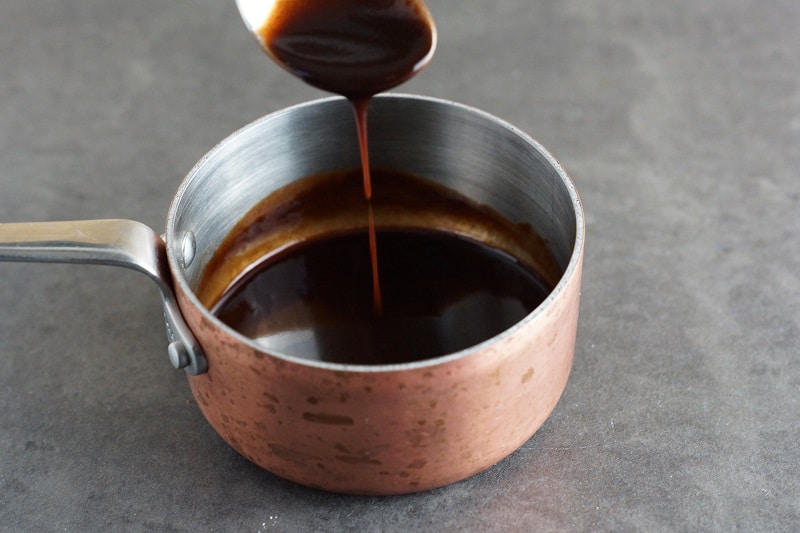

Red wine glaze is a beautiful and intense sauce that pairs perfectly with a good steak. The recipe shows how few ingredients are needed and what the key is to achieving a successful and flavorful glaze.

Recipe for red wine glaze
Most people know how a good red wine glace should taste – do you know how to make it?
Here, you get a detailed guide on how you can achieve a delicious, intense red wine glace (demi-glace). It pairs perfectly with Beef Wellington or richly flavored meats, such as Iberico pork, game, or beef. Our recipe shows how few ingredients are needed and what the key is to achieving a successful and flavorful glace.
The red wine glace is a great trick to pull out of your hat when you have guests over. It’s perfect for adding the finishing touch to the meat you’ve worked hard to prepare. Enjoy!
Servings: Servings
Red Wine Glaze
Red wine glaze is a beautiful and intense sauce that pairs perfectly with a good steak. The recipe shows how few ingredients are needed and what the key is to achieving a successful and flavorful glaze.
Equipment
- 1 Stove
- 1 Saucepan
Ingredients
- 1 pcs. Onion
- 1 clove Garlic
- 4.5 gram Oil Flavour neutral
- 300 gram Red Wine
- Fresh thyme Can be replaced with rosemary
- 400 gram stock
- 5 gram Lemon Juice
- 2.5 gram Vinegar Apple cider vinegar
- 30 gram Butter Ice cold and cut into tiny pieces
Instructions
- Finely chop onion and garlic and sauté both in flavour neutral oil over medium-high heat in a heavy-bottomed pot. They should not take on any color. After a few minutes, add the red wine and thyme sprigs.
- Let the pot simmer for 20 minutes, then gradually add 4 dl. of stock. Feel free to use boiled water and a few pieces of meat/trimmings from dry-aged beef, as it gives a deep and intense meat flavor. Otherwise, you can use a good stock. Add a little lemon juice and vinegar.
- When the sauce has reduced to 1-2 dl., it needs to be mounted. Mounting is to thicken the sauce using butter. The key to succeeding with this is the right temperature and vigorous whisking. Make sure the sauce is boiling vigorously and the butter is as cold as possible. It's a good idea to cut the butter into thin slices and freeze it for 10 minutes before the sauce is brought together.
- Add one piece of butter at a time while whisking vigorously until the sauce reaches the desired thickness. More butter is needed than you might think.
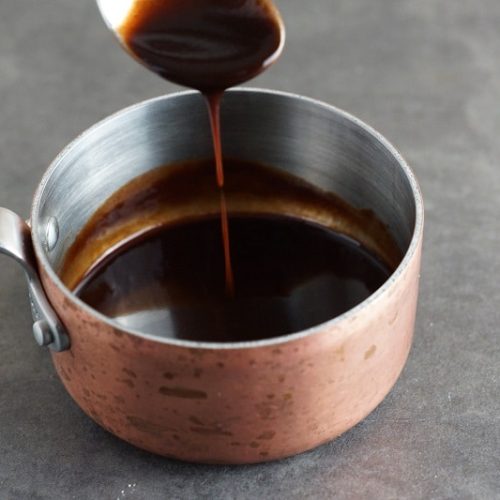
- The sauce becomes thick, viscous, and beautifully smooth while being incredibly intense in flavor.
- The most challenging part of seasoning a glaze is if you use salted butter (as most Danes do daily) to mount it. If you do, you must not add salt, as the salt in the butter will significantly change the flavor. We always use salted butter and have gotten used to it.
Notes
Are you more into a red wine sauce? We have a recipe for that here.