
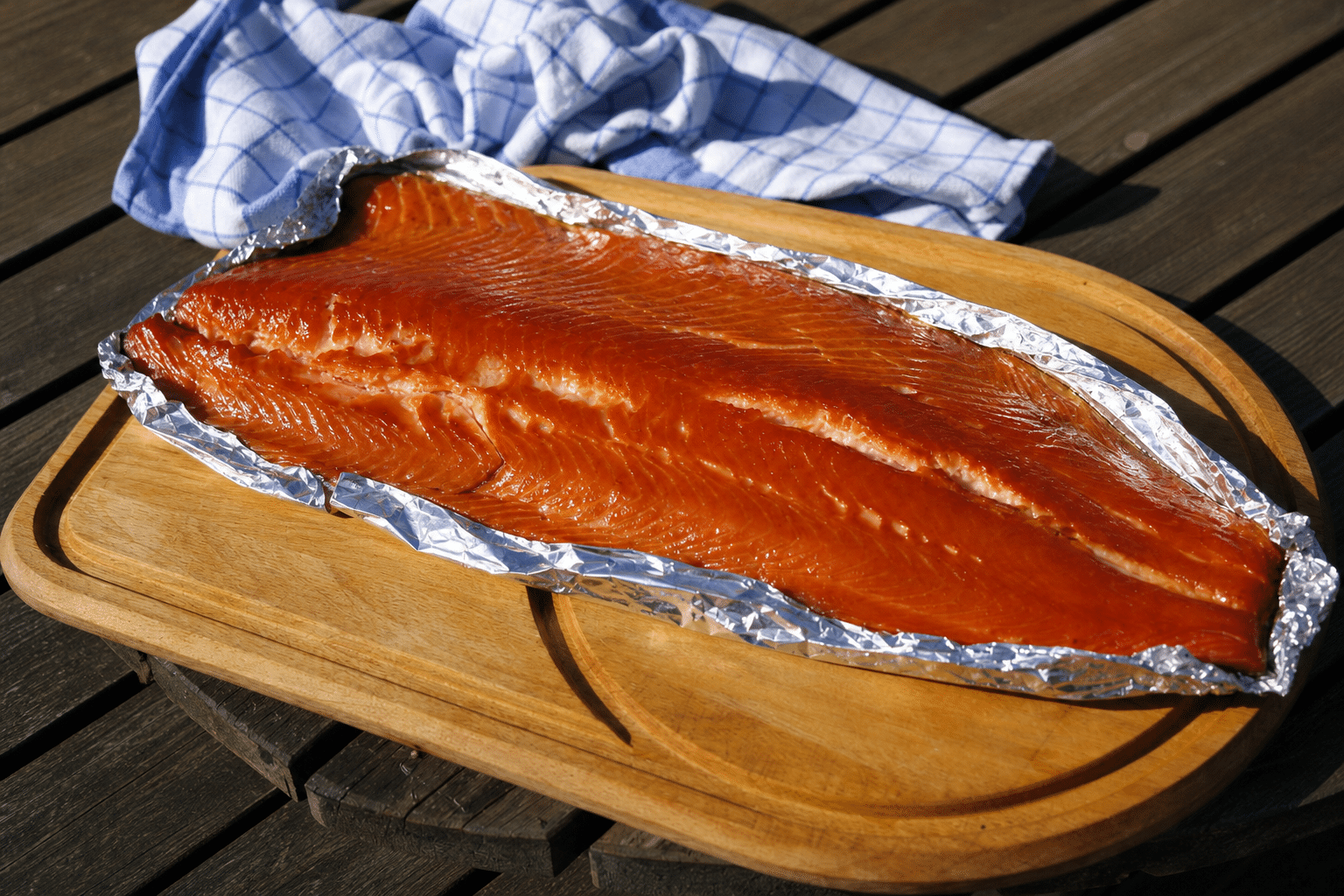

The first time I made home-smoked salmon, I was convinced I needed a dedicated smoker and a firebox setup. I did not. All it took was a standard kettle grill, a bag of wood chips, and the patience to let low heat do its slow work. The result was a whole fillet with genuine depth of smoke, a silky texture, and a flavor that is genuinely difficult to find at the grocery store at any price.
It is also one of the more naturally social ways to spend a few hours. Once the salmon is on and the lid is down, there is nothing to do but refill drinks and wait together.
The process is not fast. Between brining, air-drying, and smoking, you are looking at about 17 hours total – but almost all of that is hands-off time. Plan to start the brine the evening before and smoke the following afternoon.
What you need
- Kettle grill with a lid vent
- Charcoal chimney starter or electric charcoal starter
- Wood chips or chunks: alder, apple, or hickory (all widely available at hardware and outdoor stores)
- Foil drip pan
- Instant-read or probe thermometer (not optional)
- Spray bottle filled with water
- Large container or pot for brining
The brine
The brine firms up the fish and seasons it through before any smoke is involved. The ratio is straightforward: 3.5 oz (100 g) of salt and 3 tablespoons of sugar per 4 cups (1 liter) of cold water. Use about 6 cups (1.5 liters) of brine per 2.2 lbs (1 kg) of fish.
For a whole fillet from a salmon weighing 9-11 lbs (4-5 kg), mix a large batch and submerge the fillets completely. Keep in the refrigerator for 10 hours.
Read more: The hakkeboef: Denmark’s pan-fried beef patty with parmesan and Worcestershire that beats any burger
After brining, rinse the fillets briefly and pat dry.
The air-dry step (don’t skip this)
Dry the salmon on a rack, uncovered, for at least 5 hours in a cool spot or the refrigerator. This forms a tacky surface layer – the pellicle – that helps smoke cling and develop that characteristic amber color. Skip it and the smoke slides off; do it and the finished fish looks as good as it tastes.
Setting up the grill
Place your wood chips or chunks in a foil drip pan. Light a small amount of charcoal in a chimney starter, let it ash over completely, then add the foil pan of wood directly on or beside the charcoal on the lower grate. The salmon fillets go on the top grate, skin-side down, positioned away from direct heat.
Read more: The prettiest snowflake cookies to bake this Christmas, and they are easier than they look
Put the lid on and thread a probe thermometer through the top vent so you can monitor the grill temperature without opening the lid.
Temperature control: the key to the whole thing
Smoking is largely about managing temperature and smoke volume. The grill should climb to 158-167°F (70-75°C) at the start, then be held steady in the 122-140°F (50-60°C) range through most of the cook.
If the temperature climbs too high, spray a little water directly onto the coals and chips to bring it back down. If it drops, add a small handful of fresh wood chips. Keep the lid closed as much as possible – every time it comes off, you lose heat and smoke. If the temperature runs away and nothing else is working, briefly switch off or pull out the charcoal starter.
The salmon is done after 1-2 hours, when the fillets have turned a deep golden amber and small white droplets appear on the surface. Those are coagulated proteins and a reliable sign that the heat has worked through to the center.
Food safety: use a thermometer
Color is a guide, not a guarantee. Before serving, use an instant-read thermometer to check the internal temperature at the thickest part of the fillet. According to USDA FSIS, the safe minimum internal temperature for fish is 145°F (63°C). If that spot has not reached 145°F, close the lid and continue smoking until it does.
Serving
I personally love it the classic way: thick slices on rye crackers or a toasted bagel with a smear of cream cheese. It is also excellent with a simple green salad, capers, thinly sliced red onion, and a dill dressing. Crusty sourdough works just as well.
The fish keeps refrigerated for up to a week, though in my experience it rarely lasts that long once people know it is there.