
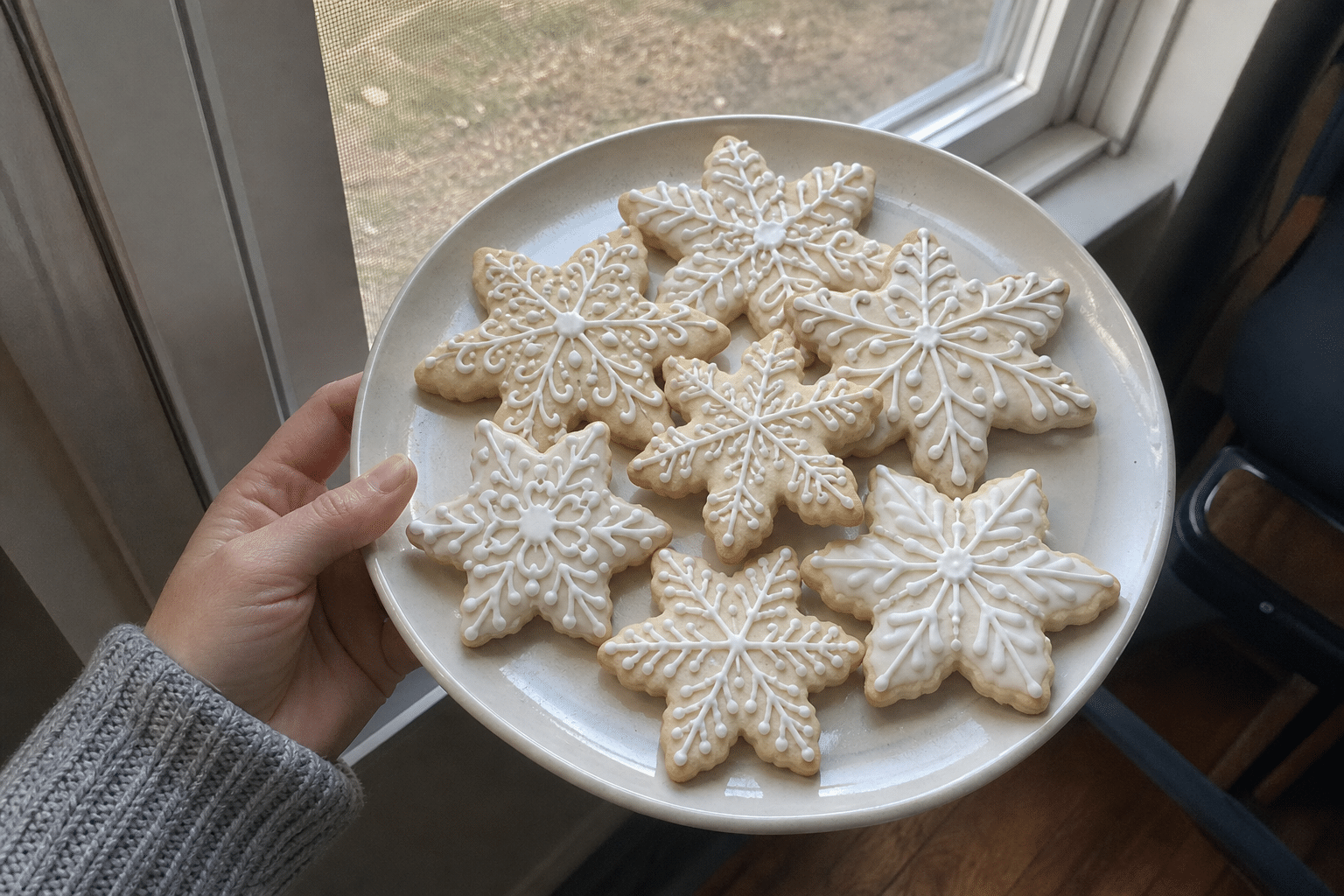

There’s a reason these little rounds always disappear first from a holiday cookie plate. After baking, a generous drift of powdered sugar settles into every groove left by the fork, turning them into something that looks like a lot of effort. It is not.
The dough is a classic melt-away blend – heavy on cornstarch, light on flour – that takes about 15 minutes to put together. Add a short chill and a quick bake, and you have around 30 cookies that look like they came from a professional bakery.
Why this recipe works
The secret is the cornstarch-to-flour ratio. Cornstarch blocks gluten development the way flour cannot, and when you use nearly twice as much cornstarch as flour, the finished cookie is fragile and silky – it dissolves on the tongue rather than chewing. It is the same principle that makes shortbread so tender, pushed one step further.
The 30-minute chill is not optional. It firms the butter back up so the dough balls flatten cleanly under a fork without spreading into puddles. Skip it and your cookies will spread too thin and lose the fork pattern.
The powdered sugar finish is what makes them look like snowflakes. Dust them while they are still slightly warm and the sugar catches in the crosshatch ridges and stays put.
Ingredients
Makes about 30 cookies
For the dough:
- 1 cup (120g) cornstarch
- 1/2 cup (60g) all-purpose flour
- 6 tablespoons (50g) powdered sugar
- 9 tablespoons (125g) unsalted butter, softened (about 1 stick plus 1 tablespoon)
- 1 teaspoon pure vanilla extract
For finishing:
– Powdered sugar for dusting (generous amount)
Instructions
- Whisk the cornstarch, flour, and powdered sugar together in a large bowl until evenly combined.
- Add the softened butter and vanilla extract. Work the mixture by hand, pressing and folding, until it comes together as a smooth, uniform dough with no streaks of dry flour.
- Shape the dough into a ball, wrap it tightly in plastic wrap, and refrigerate for 30 minutes.
- Preheat the oven to 350°F (175°C) and line two baking sheets with parchment paper.
- Pinch off pieces of dough and roll them into about 30 balls of equal size, roughly 1 inch (2.5cm) across.
- Place the balls on the prepared baking sheets, spacing them about 1 inch (2.5cm) apart. Press each ball flat with the back of a fork in one direction, then again at a right angle, so the crosshatch creates a snowflake-like pattern.
- Bake for 12 to 15 minutes, until the edges look set and the bottoms are barely golden. The tops will stay pale – that is correct.
- Let the cookies rest on the baking sheet for 5 minutes before transferring to a wire rack. Dust generously with powdered sugar while still slightly warm so it clings and fills the ridges.
Tips and variations
Vanilla extract vs. vanilla sugar: The original recipe calls for one packet of German vanilla sugar (about 8g). Pure vanilla extract is the cleanest American substitute, giving the same warm flavor without any added grit. Use 1 teaspoon.
Read more: Cranberry orange quick bread for the holiday table: tangy, tender, and done in an hour
Log and slice variation: Instead of rolling the dough into individual balls, shape it into a log about 6 inches (15cm) long and slice it into 1/2-inch (1cm) rounds before baking. It is faster, produces a neater uniform shape, and skips the fork-pressing step.
Do not overbake: These cookies are designed to stay very pale. The moment the edges look dry and the bottom shows the faintest hint of gold, they are done. Even two extra minutes will push them from melt-in-your-mouth to brittle.
Read more: Roast Brussels sprouts at 425°F and even Thanksgiving skeptics ask for seconds
Double the powdered sugar finish: For the snowiest look, let the cookies cool completely, dust them once, let that layer set for a few minutes, then dust again. The second coat shows up as a bright white.
Storage: Layer the cooled cookies between sheets of parchment in an airtight tin. They keep well at room temperature for up to 2 weeks, which makes them a good candidate for baking well ahead of Christmas.
Allergens: Contains gluten (flour) and dairy (butter). A high-quality vegan butter block (not a soft spread) can stand in for regular butter with similar results.