
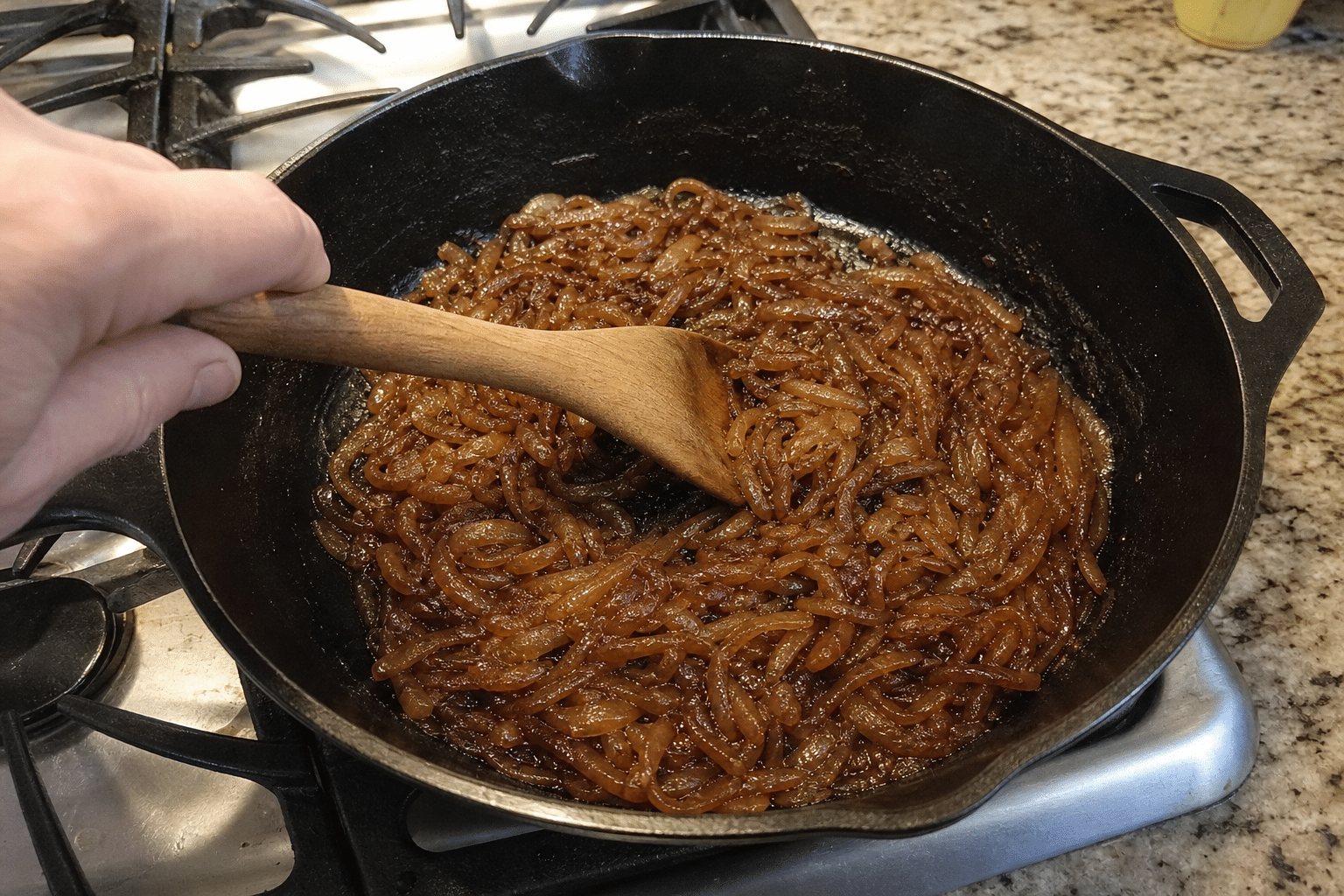

The instructions always look the same: cook the onions over medium heat for five or ten minutes until they go golden and sweet. Home cooks follow those instructions, end up with pale, limp onions, and assume they did something wrong. They didn’t. The timeline in the recipe is simply wrong.
The reason is basic chemistry. Once you understand it, every past failure stops being a skill problem and starts being a timing problem.
Water keeps the pan locked at 212°F
A raw onion is roughly 89% water. That figure matters because water has a fixed boiling point of 212°F (100°C). While significant moisture remains in the pan, the temperature at the onion’s surface cannot climb above that ceiling. The water evaporates and pulls the heat away with it. No amount of extra flame gets through it.
Both reactions responsible for caramelized onions’ color and flavor require temperatures well above 212°F. The Maillard reaction, where amino acids and reducing sugars combine to form complex flavor compounds, needs heat in the range of 280°F to 330°F (140°C to 165°C). True sugar caramelization, the breakdown of fructose in particular, requires temperatures above that boiling-point ceiling, impossible to reach while the pan is still steaming.
Read more: Angelo’s Pizzeria tops Yelp’s Philadelphia cheesesteak ranking as Pat’s and Geno’s finish last
For the first 15 to 20 minutes, the pan is essentially a steamer, not a browning device.
What fructans have to do with it
Onions don’t store their sugar as free, ready-to-react fructose. They store it in long chains of linked fructose molecules called fructans. Gentle heat slowly cleaves those chains apart, releasing free fructose. This is what the long early minutes of cooking are actually building.
But even that liberated fructose cannot brown until most of the water has cooked off. When browning does finally begin, two reactions run simultaneously. The Maillard reaction accounts for most of the flavor complexity and color. True fructose caramelization contributes an estimated 10 to 36 percent of the brown color on top of that. Together they build the deep, sweet, savory result that makes the dish worth the effort.
Read more: Why everything sticks to stainless steel pans, and the one preheating trick that fixes it
The full process takes around 45 minutes over medium-low heat.
The baking soda shortcut
One ingredient makes a real dent in that timeline, with one tradeoff.
Read more: Why your scrambled eggs turn rubbery, and the two fixes that actually work
Adding about one-eighth of a teaspoon of baking soda per pound (450g) of onions shifts the cooking surface from mildly acidic to alkaline. The Maillard reaction is sensitive to pH, and a higher pH lowers the activation energy required for browning, accelerating it even before all the water is gone.
The National Onion Association tested the method and found the onions were soft and caramelized in about 13 minutes compared to the standard 45. The tradeoff is texture: the same alkalinity that speeds browning also breaks down cell-wall pectin faster, leaving onions creamy and soft, closer to onion jam than distinct slices.
For applications where the onions are going into a sauce, a blended soup, or a spread, that soft texture works fine. For a pizza topping, a burger, or a tart where you want visible pieces with some body, skip the baking soda and give them the full 45 minutes.