
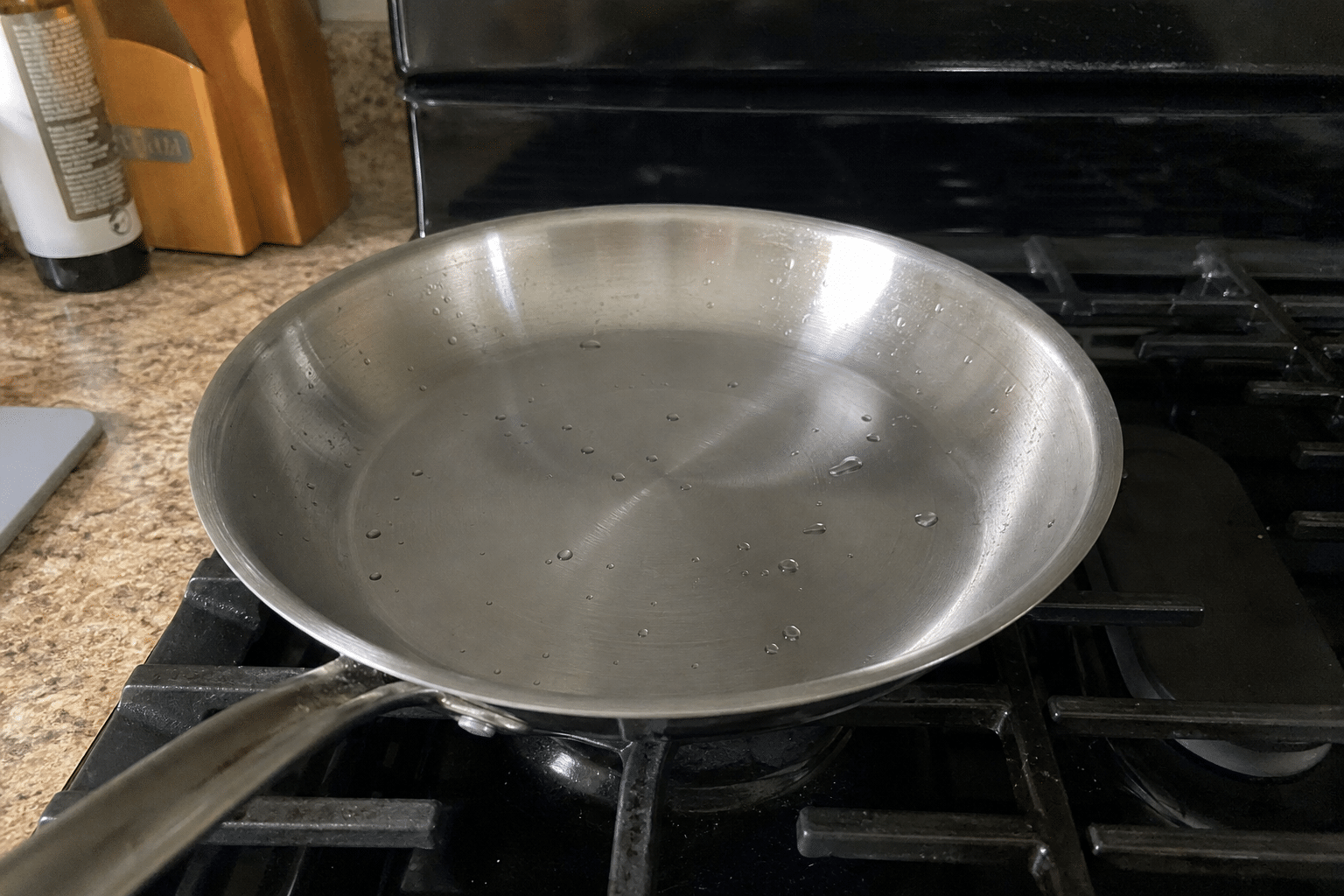

That temperature is not simply “hot” or “medium-high.” It is a precise physical state you can confirm with a few drops of water, and once you know it, sticking on stainless steel stops being a problem.
Why stainless steel grabs food like glue
The pan looks smooth, but under a microscope the surface is a terrain of hills, valleys, and cave-like pits. When you place food on a cold or under-heated pan, those pits do real damage: the food’s proteins seep in and form chemical bonds directly with the iron atoms in the metal. According to scienceofcooking.com, protein-rich foods are especially susceptible because proteins can create complexes with metal atoms like iron in the pan.
Eggs, fish, chicken, steak, all high-protein foods, all notorious for sticking on stainless steel. That bonding mechanism is why.
The Leidenfrost effect: the physics behind the fix
At the right temperature, something changes. Water in the food hits the pan surface and vaporizes so fast it forms a thin cushion of steam between food and metal. This is the Leidenfrost effect: that steam layer physically lifts the food slightly off the surface, cutting contact between food and pan before any chemical bonding can begin.
Read more: Why your scrambled eggs turn rubbery, and the two fixes that actually work
No contact means no bond. The food floats, cooks, and releases.
The water-drop test: how to know when the pan is ready
Flick a few drops of water from your fingertips into the dry, heating pan. What you want to see: the drops form tight, rounded beads and skitter across the surface rather than spreading flat or evaporating on contact. That skittering is the Leidenfrost effect in action, the drops are vaporizing fast enough to lift themselves off the surface on a cushion of their own steam.
Read more: Tartiflette: the French alpine potato and cheese bake for cold nights
If the drops spread out and sizzle flat, the pan is not hot enough yet, wait 30 seconds and test again. If they vanish the instant they land, the pan is over-heated; pull it off the burner for a moment before testing again.
Why oil goes in after the pan is hot
Most home cooks pour oil into a cold pan and heat both together. On stainless steel, that is the wrong order.
Oil poured into a cold pan seeps into those microscopic surface pits and starts breaking down under prolonged heat before the food even arrives. The result: an uneven layer, hot spots, and food that bonds to degraded oil rather than gliding on fresh oil.
Adding oil to an already-hot pan works differently. According to scienceofcooking.com, hot oil “fills in the valleys and caves of the pan surface,” creating an even coating instantly. It also heats so quickly that it spends far less time degrading before food arrives.
The sequence, start to finish
- Heat the dry pan over medium to medium-high heat. No oil.
- Flick a few water drops in. When they form beads and skitter without immediately evaporating, the pan is ready.
- Add oil. Let it spread and begin to shimmer.
- Add the food and leave it alone.
That last step is the most important: even in a properly preheated pan with hot oil, protein-rich foods will grip the surface slightly while the crust forms. Do not force a spatula underneath. When enough of the surface has seared, the food releases cleanly on its own. If it resists when you push gently, it needs more time, not more force.