
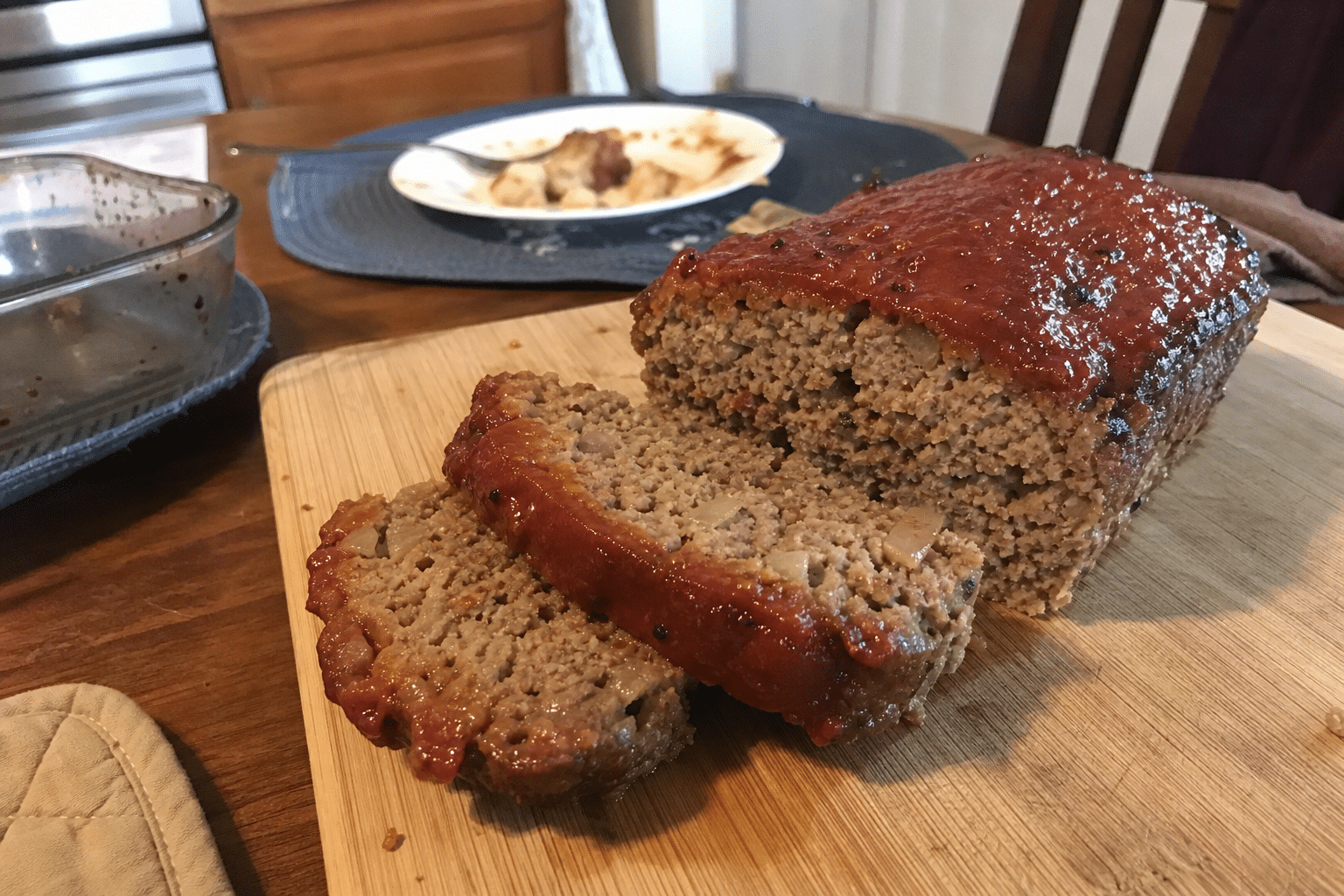

Most meatloaf fails at the mixing stage, not the baking one. Too much dry binder makes it gritty. Overworking the meat makes it rubbery and tight. And a ketchup glaze slapped on at the start scorches while the center is still raw. All three problems have straightforward fixes, and once you understand why each step works, you will not need to look up a recipe again.
This version uses a panade – bread soaked in milk until it softens into a paste – instead of dry breadcrumbs, keeps mixing to a minimum, and builds the glaze in two stages so it caramelizes rather than burns. It bakes free-form on a sheet pan rather than in a loaf pan, so the sides brown, the fat drains away, and the glaze coats the whole exterior.
Why this recipe works
The panade keeps it moist and cohesive. When you soak bread in milk and mash it into a paste, it distributes through the meat mix as a binder that holds onto moisture. Dry breadcrumbs do the opposite: they compete for moisture as the loaf bakes, and the result is a texture that is simultaneously dry and crumbly. The panade also acts as a shock absorber between the protein strands, which is part of why the loaf slices cleanly rather than falling apart.
Short mixing time keeps it tender. Ground beef has proteins that behave a lot like gluten: the more you work them, the tighter and denser they bind. A fully mixed meatloaf that has been squeezed and worked for two or three minutes will bake up firm and rubbery, with a texture closer to a compressed patty than a tender loaf. Mix until things just come together – about 30 seconds with your hands – and stop.
Two-stage glazing prevents burning. A sugary glaze applied at the beginning of a 45-minute bake will blacken and turn bitter before the inside reaches a safe temperature. Applying half the glaze around the midpoint and the rest in the last 20 minutes gives the first coat time to set and lightly caramelize, while the second coat finishes glossy and sticky rather than charred.
Ingredients
For the loaf (serves 6):
- 2 pounds (900 g) ground beef, 80/20
- 2 slices white sandwich bread, crusts removed
- 1/3 cup (80 ml) whole milk
- 2 large eggs, lightly beaten
- 1 medium yellow onion, grated on the large holes of a box grater
- 3 garlic cloves, minced
- 2 tablespoons Worcestershire sauce
- 1 teaspoon Dijon mustard
- 1 teaspoon kosher salt
- 1/2 teaspoon black pepper
- 1/2 teaspoon dried thyme
For the glaze:
- 1/2 cup (120 ml) ketchup
- 2 tablespoons packed brown sugar
- 1 tablespoon apple cider vinegar
- 1 teaspoon Worcestershire sauce
Instructions
1. Preheat your oven to 350°F (177°C). Line a rimmed baking sheet with aluminum foil and set it aside.
Read more: The perfect roast chicken with crispy skin and herb butter, done in under 90 minutes
2. Tear the bread into rough pieces and place them in a large bowl. Pour the milk over the bread and let it soak for 5 minutes, then mash the mixture with a fork until it forms a soft, shaggy paste.
3. Add the grated onion, minced garlic, Worcestershire sauce, Dijon mustard, salt, pepper, and thyme to the bowl. Stir with a fork to combine everything into the paste.
4. Add the beaten eggs and stir once more until incorporated.
5. Add the ground beef. Using clean hands, mix by folding and pressing – not squeezing or kneading – just until no streaks of plain meat remain, about 30 seconds. The mixture will look slightly rough; that is correct.
6. Turn the meat out onto the prepared baking sheet and shape it into a loaf roughly 9 by 4 inches (23 by 10 cm) and about 2 inches (5 cm) tall. Smooth the top and tuck the ends in gently.
Read more: How to roast a whole turkey for Thanksgiving and get it right every time
7. In a small bowl, whisk together the ketchup, brown sugar, apple cider vinegar, and Worcestershire sauce until the sugar dissolves.
8. Spoon about half the glaze over the top and sides of the loaf, spreading it in an even layer. Bake for 45 minutes.
9. Remove the loaf from the oven and spread the remaining glaze over it. Return to the oven and bake another 20 to 25 minutes, until the glaze is bubbling and lightly caramelized and a meat thermometer inserted into the center reads 160°F (71°C). The USDA Food Safety and Inspection Service sets 160°F as the safe minimum internal temperature for ground beef.
10. Let the loaf rest on the pan for 10 minutes before slicing. This allows the juices to redistribute and the structure to firm up enough to hold clean slices.
Tips and variations
Use a baking sheet, not a loaf pan. A loaf pan traps fat and steam underneath the meat, which can make the bottom soggy and the texture waterlogged. A free-form loaf on a sheet pan drains cleanly, browns on the sides, and the glaze can reach the whole surface.
Read more: Crispy homemade chicken parmesan: the technique that keeps the crust from going soggy
Grate, don’t chop, the onion. A grated onion breaks down into fine shreds that disappear into the meat during baking, adding moisture and flavor without creating chewy onion chunks. Finely diced onion works, but the texture difference is noticeable.
80/20 is the right fat ratio. Lean ground beef (90/10 or higher) tends to bake up dry and compact. The fat in 80/20 bastes the loaf from within as it cooks and contributes to the texture. If you are using a leaner blend, add a tablespoon of olive oil to the mix.
Check the temperature, not the color. The interior of a meatloaf can appear cooked through – no pink, juices running clear – while still below 160°F (71°C). A meat thermometer is the only reliable check.
Make-ahead and storage. The raw loaf can be shaped, wrapped tightly, and refrigerated overnight before baking. Leftovers keep in the fridge for up to 3 days. Cold slices reheat well in a skillet over medium heat with a small splash of water and a lid; about 3 minutes per side until heated through.
Swaps and add-ins. A mixture of half beef and half ground pork gives a slightly richer result and bakes at the same 160°F (71°C) target temperature. Finely diced bell pepper or a tablespoon of tomato paste stirred into the meat mixture both work well. For a smoky glaze, replace the apple cider vinegar with a teaspoon of smoked paprika and a few drops of hot sauce.