
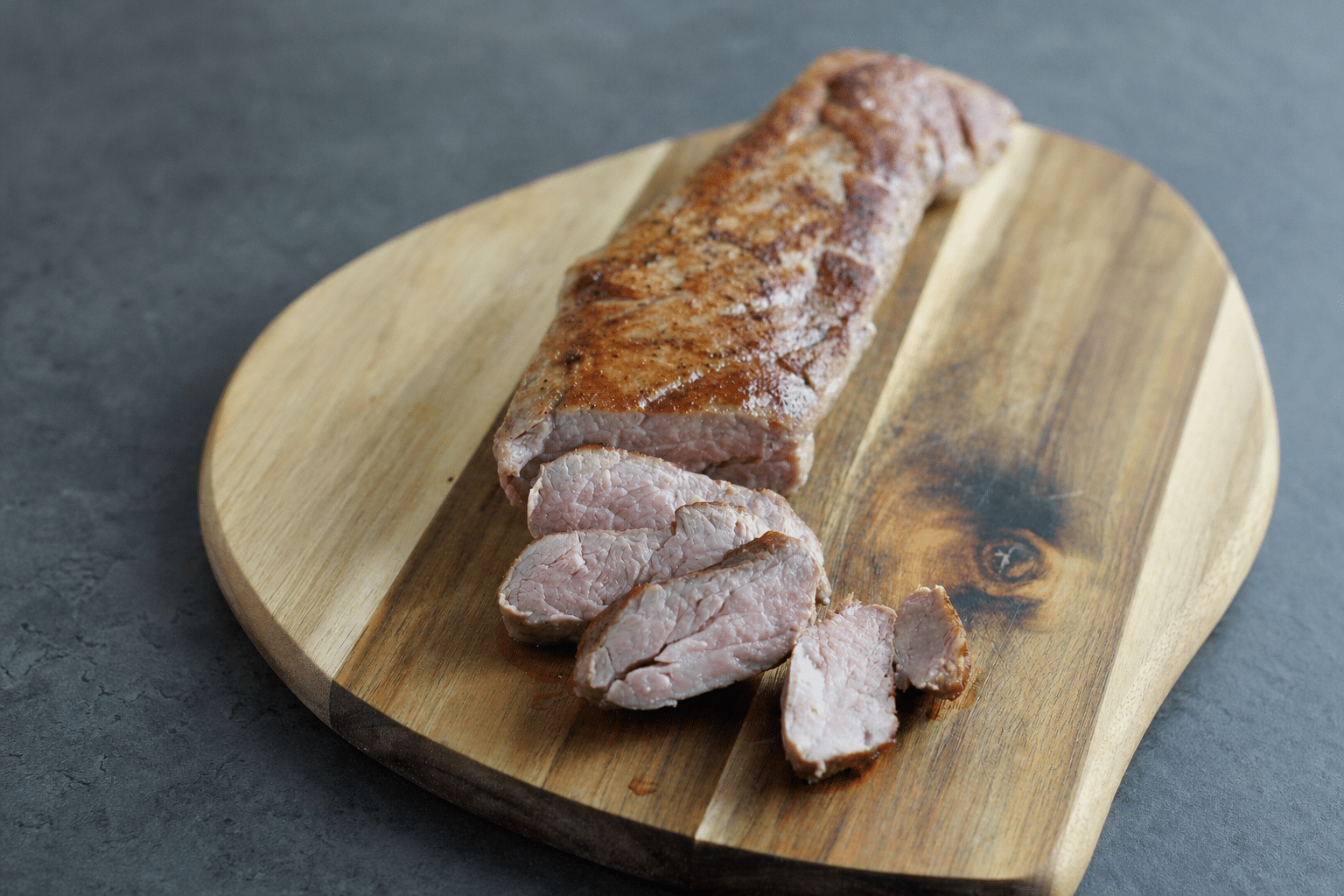

It sits against the inside of the spine and barely works during the animal’s life, which makes it naturally tender – but that leanness is also its weakness. A few extra minutes in a hot oven pulls the moisture out and leaves you with something dry, tight, and disappointing.
There are many ways to prepare a pork tenderloin, but if you ask a chef what the simplest method is for a perfect result every single time, one answer comes up again and again: sous vide. It takes the guesswork out of a cut that punishes guesswork.
Why sous vide works for this cut
The water bath holds a precise temperature from edge to edge, and because the meat cannot exceed that temperature, it cannot overcook. You set it and walk away. The tenderloin reaches exactly the doneness you want and stays there until you are ready to sear and serve.
The result is a tenderloin that is juicy all the way through, with a slightly pink center that is intentional – and fully safe. The USDA has confirmed that whole cuts of pork are safe even when pink at the center, as long as the minimum safe temperature is reached. Sous vide achieves that through the time-temperature combination: 90 minutes at 138°F (59°C) is enough to fully pasteurize the meat all the way to the center of a standard-width tenderloin.
Read more: Homemade gyoza with the crispy bottom and steamed top that restaurants serve
Prep: get the tenderloin even before it goes in the bag
Before anything goes into the vacuum bag, there is one job to do: remove the silver skin. This is the thin, pearlescent membrane running along one side of the tenderloin. It does not break down during cooking – it only tightens and pulls the meat out of shape. Take a sharp knife, work the tip under the silver skin at one end, angle the blade slightly upward, and slide it along while the membrane peels free.
There is also a small side muscle running alongside the main loin. Remove that too, plus any ragged end pieces, so you end up with a neat, even cylinder that cooks uniformly. The trimmings are good cubed into a quick pork stew.
The recipe
Serves 3 | Prep: 5 minutes | Cook: 1 hour 35 minutes
Read more: The moist cocoa sheet cake that feeds a crowd, made with buttermilk
Ingredients
- 1 pork tenderloin
- Salt and freshly ground black pepper
- Ghee, or neutral oil blended with a knob of butter, for searing
- Fleur de sel, to finish
Method
- Prep the meat. Remove the silver skin, the side muscle, and any uneven end pieces so you have a uniform cylinder.
- Season and seal. Season all over with salt and pepper, then vacuum-seal.
- Into the water bath. Cook at 138°F (59°C) for 1 hour 30 minutes. For a tenderloin you have doubts about in terms of quality or freshness, give it up to 2 hours.
- Pat it completely dry. Remove from the bag and pat every surface dry with paper towels. Any moisture left on the meat will steam before it can brown, and the sear will not form.
- Sear hard and fast. Get a heavy pan as hot as it will go. Add ghee or the oil-butter blend and sear the tenderloin for about 30 seconds per side, rolling it to get color across the whole surface.
- Slice and finish. Cut into slices about 3/4 to 1 inch thick (2-3 cm). Lay them on the plate and add a few flakes of fleur de sel.
- Serve immediately. The crust softens fast.
The sear is not a finishing touch – it is half the dish
After 90 minutes in the water bath, the tenderloin is cooked through, but it looks pale and colorless. The sear is what turns it into something worth eating. Brief, intense contact with high heat creates the browning that the water bath cannot give you, and that is where most of the flavor lives.
The two things that kill a sous vide sear are wet meat and a pan that was not hot enough. Get the pan screaming hot before the meat goes in, and make absolutely sure the surface is dry. The sear is fast – about 30 seconds per side. Done.
The pink center is the whole point
The tenderloin will be slightly pink. It should be. That is not underdone; that is the temperature you cooked it to.
Read more: Better-than-takeout teriyaki chicken with a glossy glaze, done in one pan in 30 minutes
At 138°F (59°C) for 90 minutes, the meat achieves full pasteurization through the time-temperature combination – the same level of reduction of Listeria, Salmonella, and E. coli as a higher-heat cook that gets there in seconds. Douglas Baldwin’s sous vide safety tables show that at 59°C, pasteurization takes 1½ hours for a 1-inch (25mm) piece and rises to 2¾ hours for a 2-inch (50mm) piece – so if your tenderloin is on the thicker side, extend the cook time accordingly. The USDA’s standard guidance for whole pork cuts is 145°F (63°C) with a 3-minute rest, and even at that temperature the meat may remain pink – which is safe.
The slight blush at the center of a sous vide tenderloin is a sign of control, not carelessness.
What to serve alongside
Creamed potatoes and crispy fries are the classics, and they work every time. A good salad with a sharp vinaigrette cuts cleanly alongside. For a lighter plate, quickly sautéed pointed cabbage or simply prepared green vegetables keep the dish feeling fresh rather than heavy.