
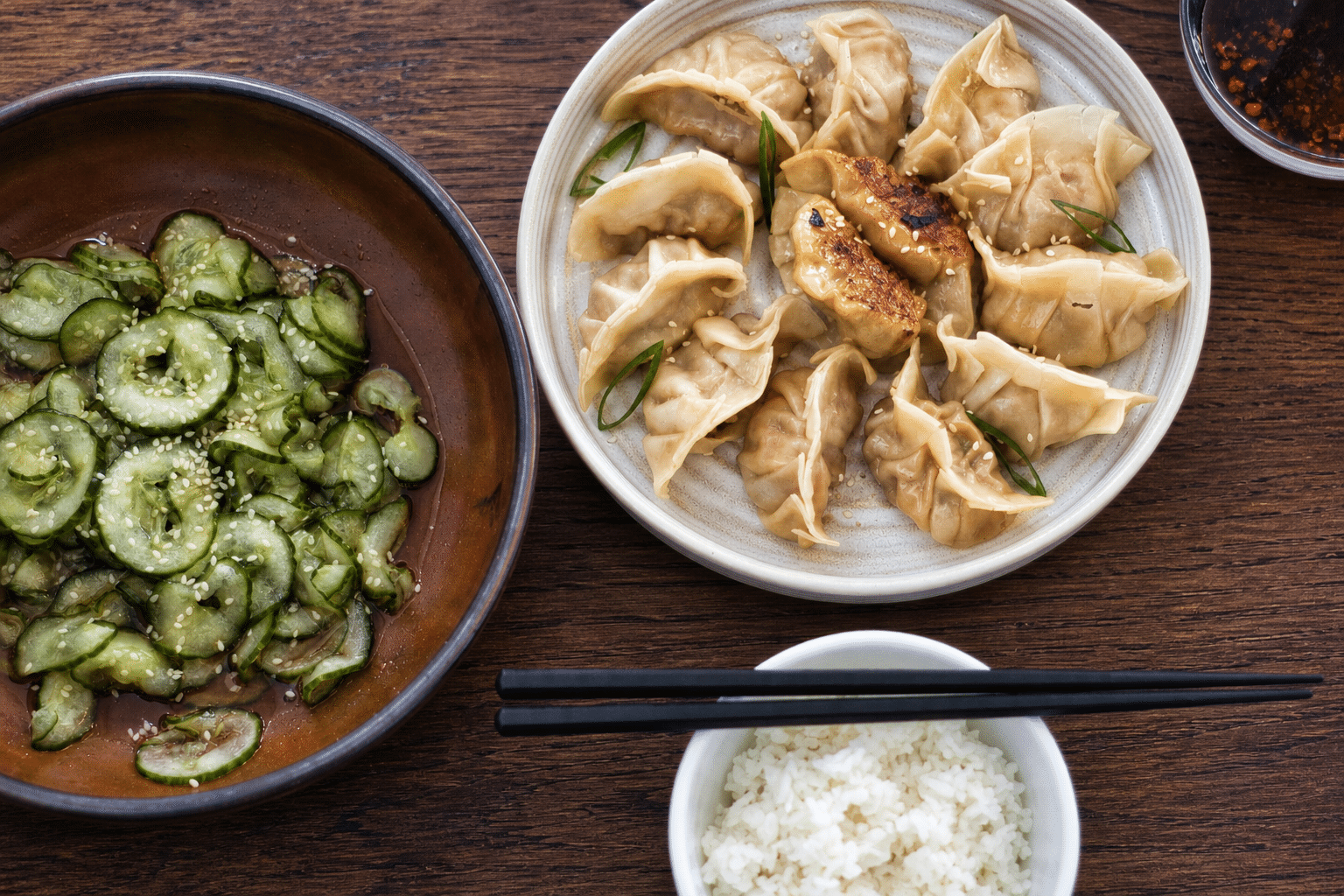

Gyoza are one of those dishes I put off making for far too long, convinced they had to be harder than they looked. They are not. The dough needs only flour, salt, and boiling water. The filling comes together in minutes. The shaping takes a little practice, but after the first batch you’ll wonder what you were waiting for.
What you end up with is a dumpling that has everything: a genuinely crispy, golden-brown base and a tender, slightly chewy top, with a juicy pork-and-cabbage filling inside. The secret to getting both textures in the same dumpling is a three-stage cook – pan-fry, steam, then pan-fry again – and once you understand why it works, you’ll use this method every time.
If you want to skip the dough entirely, store-bought gyoza wrappers are sold at most Asian grocery stores and make this a much quicker weeknight project.
Why this recipe works
Two things separate good gyoza from ones that disappoint.
The first is salting the cabbage before it goes into the filling. Cabbage holds a lot of water, and if you skip this step, that water releases during cooking and makes the filling soggy. Salt the shredded cabbage, let it sit for 15 minutes, then squeeze out the liquid as thoroughly as you can. What stays behind is concentrated in flavor and firm in texture.
The second is mixing the filling until it becomes cohesive and slightly sticky, about 2 minutes of vigorous stirring. This binds the meat and vegetables together so the filling holds its shape and the texture inside each dumpling is springy, not crumbly.
The three-stage cook is non-negotiable if you want that textural contrast. Pan-frying first gives you the golden crust. Steaming cooks the filling through and softens the wrapper. The final uncovered fry drives off the remaining water and brings the bottom back to a crackle.
Read more: The moist cocoa sheet cake that feeds a crowd, made with buttermilk
Ingredients
For the dough:
- 2 cups (250 g) all-purpose flour
- 1/2 tsp fine salt
- Just over 1/2 cup (140 ml) boiling water
For the filling:
- 10.5 oz (300 g) white cabbage, very finely shredded
- 1 tsp fine salt (for the cabbage)
- 3.5 oz (100 g) scallions, thinly sliced
- 4 cloves garlic, finely grated
- 1 Tbsp finely grated fresh ginger
- 14 oz (400 g) ground pork
- 1½ Tbsp soy sauce
- 1½ Tbsp sesame oil
- 2 tsp sake
- 1½ tsp black pepper
For cooking:
- 1½ Tbsp canola oil
- 2/3 cup (150 ml) water
Makes about 30 gyoza. Serves 4.
Instructions
Make the dough:
1. Combine the flour and salt in a large bowl. Gradually pour in the boiling water while stirring with a fork or chopsticks. Once cool enough to handle, turn the dough out and knead by hand for 10 minutes until smooth and elastic. Shape into a ball, cover with a damp cloth or plastic wrap, and rest for 30 minutes.
Prepare the filling:
2. Toss the finely shredded cabbage with 1 tsp of fine salt and let it sit for 15 minutes. Take handfuls and squeeze out as much liquid as you can – this step matters, so do not rush it.
3. Combine the pressed cabbage with the scallions, garlic, and ginger. Add the ground pork, soy sauce, sesame oil, sake, and black pepper. Stir vigorously for about 2 minutes until the mixture is cohesive and slightly sticky. Set aside.
Shape the gyoza:
4. Divide the rested dough into 30 equal pieces. Keep them covered while you work so they do not dry out. Roll each piece into a circle about 4 inches (10 cm) across, as thin as you can get it without tearing.
5. Place about 1 tablespoon (15 g) of filling in the center of each wrapper. Dip a finger in water and run it along the outer edge. Fold the wrapper in half to form a half-moon shape and press the edges at the center point to seal. Working from the center outward on the front side, create 3 to 4 small pleats, pressing each one firmly against the smooth back side to seal. The bottom should lie flat – that flat side is what will sear.
Read more: Better-than-takeout teriyaki chicken with a glossy glaze, done in one pan in 30 minutes
Cook the gyoza:
6. Heat the canola oil in a large skillet over medium-high heat. Arrange the gyoza flat-side down in a single layer without crowding – cook in batches if needed. Fry undisturbed for 3 minutes, until the bottoms are deep golden brown.
7. Pour in 2/3 cup (150 ml) of water – it will spatter, so stand back. Immediately cover the pan with a tight-fitting lid and let the gyoza steam for 6 minutes.
8. Remove the lid and let the gyoza cook uncovered for another 2 minutes until all the water has evaporated and the bottoms are crackling and crisp again.
9. Slide onto a plate golden-side up and serve immediately with soy sauce and rice vinegar for dipping.
Tips and variations
Use store-bought wrappers. Fresh or frozen gyoza wrappers from an Asian grocery store are a perfectly good shortcut that cuts the prep time roughly in half. If you’re making gyoza on a weeknight or for the first time, start here.
A pasta machine speeds things up. If you own a pasta machine, it makes rolling the wrappers much faster. Roll to the second-thinnest setting and stamp out circles with a round cookie cutter.
Get everyone involved. The shaping is the longest part, and it is genuinely fun to do with kids or friends. It goes faster with more hands, and a few uneven pleats are not going to hurt the flavor.
Try the soup version. Make a simple broth with chicken stock, a splash of sesame oil, and a splash of soy sauce. Drop uncooked gyoza directly into the simmering broth and cook for 5 minutes. Same filling, completely different dish.
Freeze them. Shape the full batch and freeze any you are not cooking right away on a lined baking sheet. Once solid, transfer to a zip bag. Cook from frozen using the same three-stage method, adding a couple of extra minutes to the steaming step.
Dipping sauce. Mix soy sauce with a splash of rice vinegar. A few drops of chili oil is a good addition if you want some heat.