
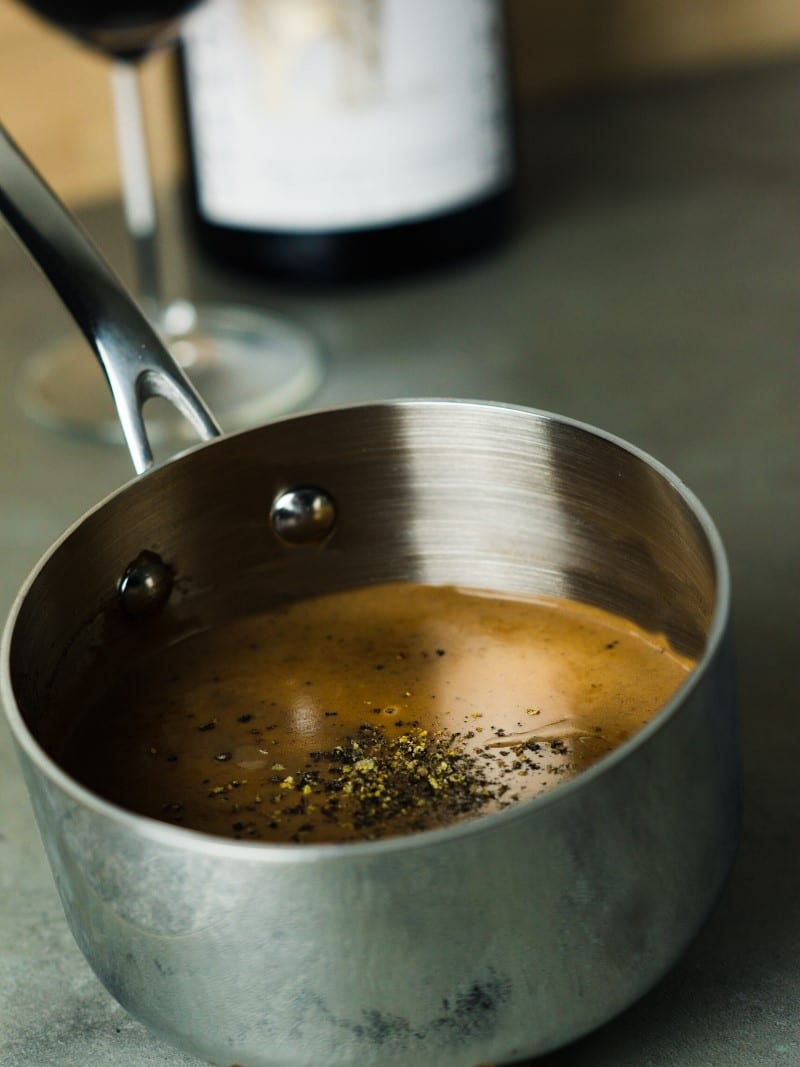


Recipe for red wine sauce
Homemade Red Wine Sauce
A perfect red wine sauce can work WONDERS in a sea of dishes and is especially a guaranteed hit for the New Year’s Eve menu.
Conversely, a dull red wine sauce can really bring down the entire taste experience.
So, how should a perfect red wine sauce taste? It naturally depends on the individual, but it should neither be too acidic nor too bitter.
The purpose of the red wine is to enhance and complement the flavors and aromas of the other elements in the dish. A good red wine sauce should be round and full-bodied with a hint of red wine flavor that isn’t overpowering—it should not taste like alcohol!
Why Red Wine Sauce?
A bit of red wine in a sauce enhances the individual flavors in the whole dish. The alcohol evaporates while the sauce cooks, leaving only the red wine flavor. When the red wine is reduced, its flavor becomes more intense with both acidity and sweetness.
Red wine sauce is generally perfect for a really good piece of meat, for example, if you’re having a whole roasted beef tenderloin or hanger steak. It’s also ABSOLUTELY superb for the classic Beef Wellington, and in this recipe, I actually made a sous-vide Beef Wellington that turned out remarkably well!
In short, the red wine sauce is a classic that is inextricably linked with a range of classic cuts and dishes.
Amazing and Easy Red Wine Sauce
You might now feel that there is quite a bit of pressure on you and your gastronomic skills. In a way, there is, because the red wine sauce needs to be balanced to be truly delicious and flavorful.
And you’re probably thinking that something that needs to be so “perfect” and tasty must be VERY difficult to handle.
– This is where I can reassure you that a perfect red wine sauce is NOT difficult or time-consuming to whip up, as long as you keep a few things in mind.
Here, I will try to give you my recipe for a “quick version” of a good, homemade red wine sauce that tastes amazing but doesn’t require hours of preparation in the kitchen.
Even though it takes no more than half an hour to make, I can guarantee that it doesn’t taste like bouillon cubes or instant sauce!
Beef broth, onions, rosemary, and gastrique are among the ingredients in this red wine sauce that tastes like it was made with a lot of beef bones, herbs, and hours of cooking.
Which Red Wine Should You Choose?

You might be tempted to think that the red wine sauce can just get a splash of the cheap box wine. You know, the kind sold in 1-liter cartons for about 30 kroner, which could easily be mistaken for a juice carton. Don’t do it!
A poor-quality red wine cannot be offset by a good stock/broth, just as a good red wine cannot save a dull stock/broth. Be critical of both – and avoid the thin, cheap stuff. If the red wine is thin in flavor, the red wine sauce will be thin in flavor too.
Therefore: Choose a red wine you actually like to drink! If the red wine tastes delightful on its own, it will probably also taste delightful in your sauce.
You seldom go wrong with either Pinot Noir, Merlot, Chianti, or other common, popular grape varieties.
So, it isn’t necessary to open the Amarone (although Jamie Oliver might disagree). A good quality wine will give just as good a flavor to the sauce as the fine premium wine.
As for any added sulfites in the red wine, they evaporate just like the alcohol. It’s not something you need to give much thought to.
My Best Tips
Don’t wait until the last minute to add the red wine. If the red wine is added too late, it can give that bitter taste we don’t want in the sauce. The red wine needs time to develop in the sauce, so you should also wait 10 minutes before adding more wine. Give it time! And it’s better to add too little wine initially.
If you have plenty of time, cook the sauce slowly over low heat so the flavors really develop.
Has the sauce become too thin? Whisk in some small pieces of cold butter or add a little cornstarch to the simmering sauce – just a little at a time!

Red Wine Sauce
Equipment
- Sauté Pan
- Saucepan
- Sieve
Ingredients
- 14.2 gram Butter
- 2 pcs. Onion
- 15 gram Tomato Puree
- 1.5 gram Thyme dried or fresh. Can be substituted with fresh rosemary
- 300 gram Red Wine preferably a leftover
- 14.2 gram Butter
- 11.25 gram Wheat Flour + a little water to thin the sauce if needed
- 200 gram Water can be substituted with beef stock, don't use bouillon cubes if so
- 2 pcs. Stock Cube Beef. I typically use a whole Fond du Chef beef
- 5 gram Gastrique Can be substituted with a little sugar and vinegar
- 150 gram Whipping Cream
- Salt and Pepper
Instructions
- Chop the onions and melt the butter in a pot or sauté pan.
- Add tomato paste to the pot to give it some color.
- Add the chopped onions to the butter and sauté them for a couple of minutes. Make sure they don't become brown; they should just become translucent.
- Add thyme and red wine and let it simmer for a couple of minutes.
- Start a new pot where you melt the butter over medium-high heat (9 out of 14 on my stove).
- Add flour and whisk well, so it doesn't lump. Let it cook for a couple of minutes to remove the raw flour taste.
- Dissolve the bouillon cube in boiling water and add half to the butter-flour mixture. Whisk vigorously to prevent lumps.
- Add the other half of the "stock" and keep whisking regularly.
- Place a sieve over the pot and pour the liquid from the red wine and onion pot into the sauce.
- Add cream and salt and pepper.Let it simmer until about 1/3 of the liquid has evaporated.
- Turn off the heat and let it rest for 10-15 minutes off the heat (if you have the time).
- Reheat the sauce and season with gastrique (or a bit of vinegar and sugar) and salt and pepper.Enjoy.
Notes
If you prefer a red wine glaze, we have a recipe here.