



Recipe for pork roast sous vide
The perfect pork roast! Yes, actually the best I’ve ever made. And how fitting that it happened on Christmas Eve 😉
So yes please – this is how it’s going to be made from now on!
It’s very possible that for many, pork roast is something primarily eaten during the Christmas season, but if you ask me, we should eat it all year round. It’s too delicious not to!
Here I’ll show you how to make the ultimate pork roast using the sous vide method.
Prime cut, rib roast, neck roast…?
Prime cut, pork loin, rib roast, neck roast… We hear many different names when it comes to pork roast, but what is the actual difference between them?
Pork roast is the common term for all of them. Prime cut and pork loin are one and the same, and it’s the leanest of the three cuts. It was also a prime cut I used for this recipe. The neck roast is the fattest cut, while the rib roast is somewhere in between.
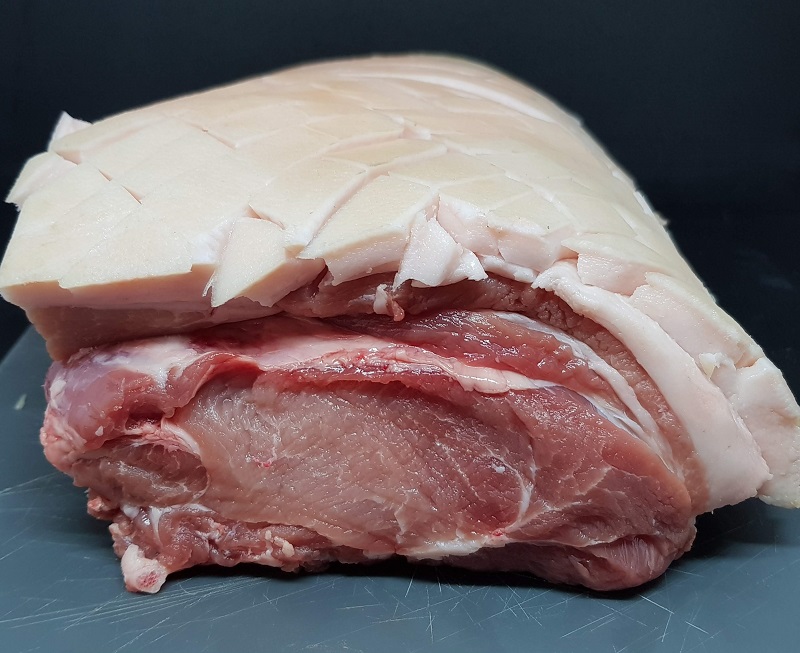
Crispy Crackling
The challenge with pork roast is typically that we want crispy crackling. It’s almost the be-all and end-all for a perfect pork roast. And this is where the dilemma arises. For crispy crackling, high heat is required, and high heat increases the risk of a dry roast. What to do? The answer is sous vide!
Now you’re probably thinking that crispy crackling and a water bath don’t exactly sound like they go together, but it’s actually “proven” that the crackling turns out even better when cooked sous vide than when done traditionally in the oven.
Pork Roast Sous Vide
Sous vide is, in general, the most fantastic cooking method. Especially when you want to make a perfectly tender and juicy pork roast with crispy crackling.
The advantage of using sous vide is that you set the desired core temperature beforehand. And the pork roast reaches this temperature – from the inside out.
When the roast comes out of the water bath, it needs a quick run in the oven to get the crackling crispy. The downside to sous vide is that the pork roast is already perfectly cooked after its time in the sous vide, so it’s essential that it only gets a very quick stint in the oven.
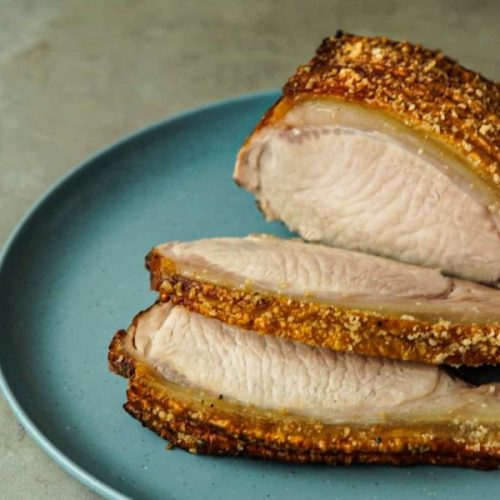
Pork Roast Sous Vide
Equipment
- Sous Vide
- Chef'S Knife
- Oven
Ingredients
- 1 kg Roast Pork Loin
- Salt and Pepper from grinder
- Coarse salt
- Bay Leaf crushed
Instructions
- Start by going over the cracklings with a sharp knife. Often they aren't cut uniformly or deep enough into the fat from the factory. Get your butcher to do it for you, if needed.
- Season the roast with salt and pepper on both sides.
- Vacuum seal it and cook it for 5 hours at 59 degrees Celsius (138 degrees Fahrenheit) in sous vide. If you think your pork roast is of questionable quality, give it an extra hour.
- Take the meat out of the bag and dry it very thoroughly with a clean tea towel. There's a lot of gelatin on top that will work against you in getting crispy cracklings.
- Get between every single crackling and dry it as well as possible.
- Put coarse salt on top of the roast and deep into the cracklings as well.
- Heat your oven to the highest possible temperature (my oven goes to 300 degrees Celsius (572 degrees Fahrenheit), 275 degrees Celsius (527 degrees Fahrenheit) is also fine) and set it to convection. Do not use the grill as it will burn the cracklings.
- Place the roast about 3-5 cm from the top and give it 20-25 minutes until all the cracklings are crispy. You don't need to watch the roast for the first 15 minutes, but after that, check it every other minute. It will finish quickly in the end.
- The result was a juicy and delicious roast with the most beautiful cracklings on top.
- Enjoy the best pork roast of your life!
- Note: The juice from the bag can of course be used for gravy, but the "disadvantage" of this cooking method is that not much juice comes out; it stays in the meat 🙂
Notes
