


Recipe for pad thai
Pad Thai
If you want to serve something that REALLY tastes like Thailand, the answer almost has to be Pad Thai!
Pad Thai is one of the absolute classics in Thai cuisine—arguably the biggest one. In fact, the dish was included in CNN’s top 5 list of the world’s most delicious food in 2011.
I have yet to meet anyone who doesn’t like Pad Thai. And it’s understandable!
This is the recipe as my own Thai mother taught me, and it tastes authentically of faraway, exotic Southeast Asia.
I made it for lunch the other day when I had a few different things in the fridge that needed to be used 🙂
What is Pad Thai?
Pad Thai is a classic in Thai cuisine, so it is very likely to be found in most Thai restaurants.
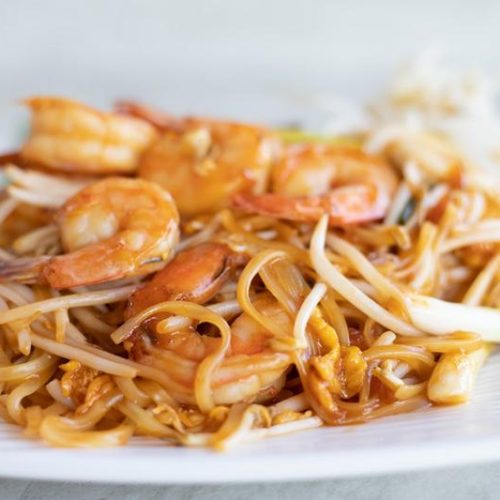
“Pad” means “fried,” and a genuine Pad Thai mainly consists of stir-fried rice noodles, large tiger prawns, bean sprouts, and roasted, crushed peanuts on top. Not to forget the sauce! It’s the sauce that makes Pad Thai so fantastic.
The sauce in Pad Thai is made from fish sauce, dark soy sauce, and palm sugar, and an essential part of the sauce in a traditional Pad Thai also comes from tamarind juice.
Tamarind is a small, very sour and bean-like fruit that contains small black seeds surrounded by a sticky mass that resembles the pulp of a date.
You might also come across tamarind fruit in “snack bags” at the Asian supermarket: Here, the fruit is dried and therefore very dark, and it’s coated in sugar. It’s actually one of my favorite Thai snacks.
How Does Pad Thai Taste?
Pad Thai has an incredibly harmonious taste, and unlike many other Thai dishes, it is not spicy.
The dish is both sweet (from the palm sugar), sour (from the tamarind juice) and a bit salty and “nutty” from the soy sauce, fish sauce, and crushed peanuts.
Together with the smooth, tender noodles and large juicy tiger prawns, it is a true pleasure to eat!
Palm sugar is typically sold in the form of round, compressed lumps and has a lovely mild, rounded, and slightly caramel-like taste. You can choose to use cane sugar if you can’t find palm sugar. However, it is available in most Asian supermarkets.
The Background Story
Pad Thai reportedly dates back to the period during World War II. Due to war and flooding, Thai rice cultivation failed, and rice became a scarce commodity, so supply no longer matched demand.
The government thus launched a major promotion of noodles.
Another explanation is that it was the Thai prime minister in the 1930s who invented Pad Thai to strengthen Thai patriotism and nationalism.
Ingredients
- 300 gram Tiger prawns
- 50 gram noodles rice noodles
- 1 handful Bean Sprouts
- 2 pcs. Egg
- 30 gram Peanuts
- 1 clove Garlic
- 0.25 pcs. Red Onion
- 0.5 pcs. Lime
- 20 gram Oil neutral in taste
- 50 gram Water
- 30 gram Fish Sauce
- 45 gram Tamarind juice
- 30 gram Vinegar
- 30 gram Palm Sugar equivalent to 1 lump. Optionally replace with 2 tablespoons of cane sugar
- 6 gram Soya I just used Kikkoman soy sauce
Instructions
- Thaw the tiger prawns in a bowl filled with water.
- Fill another bowl with lukewarm water and soak the rice noodles in it.
- In the meantime, move on to the next step.
- Rinse the bean sprouts.
- Chop the onions and garlic.
- Cut the lime into quarters.
- Measure out the oil.
- Measure out the water.
- Coarsely crush the peanuts in a mortar or mini chopper.
- Crush the palm sugar.
- Mix fish sauce, tamarind juice, vinegar, and the crushed palm sugar in a pot.
- Place the pot on the stove and let it boil while stirring.
- Clean and prepare the tiger prawns once they are thawed.
- Remember to remove the black vein.
- Place your wok on the stove and turn it on full heat. If you don't have a wok, you can use a large pan instead. It's just important that it has a non-stick coating.
- Pour the oil onto the very hot pan.
- Put the chopped garlic and onions into the hot oil.
- Let it turn golden.
- Now add the tiger prawns to the pan. Prawns become tough and rubbery if cooked too long. I prefer to cook them slightly under - they remain wonderfully soft and tender!
- Add the rice noodles and let them fry. Rice noodles tend to clump together very easily during cooking, and here you use the water you measured earlier to continuously pour a little on the noodles while using a spatula to separate them.
- Push the entire delightful mixture to one side of the pan.
- Crack the eggs onto the empty side of the pan.
- Stir the eggs as they cook. The yolks should break, but the yolks and whites do not need to be mixed into a completely uniform mass: small yellow and white pieces of egg should be visible 🙂
- Add the Pad Thai sauce and mix everything together.
- Finally, add the bean sprouts and turn off the heat.
- Enjoy your meal 🙂