


Recipe for beef brisket sous vide
It is doubtful that I will ever outgrow the sous vide method – it has immediately won my heart forever!
What’s so fantastic about sous vide cooking is that it has never been easier for me to make a perfectly cooked, tender, and juicy piece of meat. Should it be rare, medium, or something else? Your wish is my command!
Here’s the method for achieving the absolute best beef brisket with sous vide. The result is a tender piece of meat that practically melts in your mouth, and the long cooking time and low temperatures give you the juiciest beef brisket you can imagine.
I will go through sous vide times and temperatures to ensure you get the best result every time.
Where is the beef brisket located?
Beef brisket requires a lot of tenderizing to become truly delicious. Beef brisket has a very coarse structure.
There is a very natural explanation for this.
Beef brisket is a whole cut located at the front of the chest and between the animal’s forelegs, and because this muscle is used a lot and is subjected to considerable stress, it contains a large amount of dense connective tissue with very coarse fibers.
This means the meat needs a certain amount of tenderizing to become good. In other words: It needs to be cooked for a long time.
Beef brisket sous vide tenderizing
Long-time cooking can be divided into several common techniques. One method often used for cooking meat with a lot of connective tissue and coarse fibers is braising, which is a super way to utilize all the flavor potential, but a pressure cooker can also be used to break down the meat’s connective tissue and thus tenderize the meat.
Beef brisket is entirely ideal for sous vide cooking. You have 100% control over the meat’s temperature – every time.
I must be honest, though, and say that the very long cooking time in the water bath may not entirely justify the result, but you still get an incredibly delicious piece of meat that has mostly taken care of itself without costing you significant effort.
Beef brisket sous vide: Times and temperatures
When we talk about sous vide, only two factors are at play: time and temperature.
However, it always depends on the given cut, what water temperature, and after how long you achieve the very best end result – and, not least, how you prefer your meat.
Therefore, there are many suggestions for perfect times and water temperatures out there when it comes to cooking beef brisket sous vide.
As for the cooking time, I have seen recommendations ranging from 24 to 50 hours – yes, even up to 72 hours.
Here, how thick a cut you are working with is not irrelevant. The thicker the cut, the longer it needs in the water bath.
I personally prefer my beef brisket medium rare.
Overall, if you want your beef brisket medium rare, the temperature should be between 55-58 degrees. For medium, you should stay within 59-64 degrees, and if you prefer it well-done, it should be > 65 degrees.
You cannot cook beef brisket rare or under 55 degrees. As mentioned earlier, the connective tissue needs to be broken down, and that only happens at > 55 degrees.
Beef brisket sous vide: The crust
As with all meat cooked sous vide, you will end up with a somewhat gray and dull-looking piece of meat when you take it out of the sous vide.
That’s clearly because the meat does not get a crust in the water bath.
We want a crust, however, because it helps to add flavor to the meat.
When it comes to the coarse cuts that need significant tenderizing/cooking before serving, the meat becomes so tender during long-time cooking that it is not possible to give it a crust afterward.
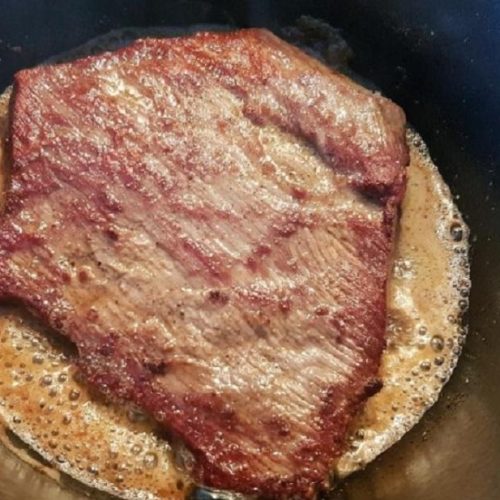
Therefore, the coarse cuts, including beef brisket, always get a crust before long-time cooking – whether you’re working with sous vide, braising, regular boiling, or something else.
You can give your beef brisket a crust in various ways. The common factor is simply working with very high temperatures.
I typically recommend either using a regular frying or grill pan, grill, or gas torch.
Personally, I am a big fan of putting a good dollop of homemade ghee on a smoking hot pan and quickly browning the meat.
The grill is, of course, a perfect choice during the summer months, and a gas torch is particularly helpful if you’re working with cuts that do not have a uniform surface. The gas torch is therefore not entirely necessary when we talk about beef brisket since the cut is relatively flat.
Serving
Beef brisket is really slow-cooked food for the cool autumn and winter days, and what is almost better for those occasions than mash?
I have previously made a very creamy celeriac purée in sous vide, which would go quite well with the buttery soft meat, otherwise, either potato-celeriac mash or Jerusalem artichoke mash is also a good suggestion for super delicious accompaniments to warm up during the cold months.
A regular potato mash would also be wonderful, and besides that, both apples, regular boiled potatoes, and root vegetables can make a superb contrast to the tender brisket.
This past summer, I actually used some of the leftovers from a 7.5-kilo piece of beef brisket to make a truly fantastic burger.
Beef Brisket Sous Vide
Equipment
- Sous Vide
- Frying Pan
- Cutting Board
- Chef'S Knife
Ingredients
- 1 kg Beef Brisket
- Ghee for searing - or 1:1 oil/butter
- Salt and Pepper From the grinder
Instructions
- Take the meat out of the refrigerator 10 minutes before cooking, so it's not entirely cold when it hits the hot pan.
- Unwrap the meat from its packaging.
- Place your frying pan on the stove and turn to the highest heat. Once the pan is smoking hot, add the fat. As mentioned, I prefer to use ghee, but I can also recommend a 1:1 mixture of oil and butter. The oil ensures that the fat reaches a high temperature, while the butter adds a lovely nutty flavor. Season the meat with salt and pepper.
- Place your beef brisket in the extremely hot fat. The meat should just "kiss" the pan and get a quick sear on both sides.
- Then place the meat in a vacuum bag.
- Vacuum seal the bag tightly.
- Place the vacuum-sealed meat in the water bath.
- Let it cook for 48 hours at 58 degrees Celsius (136 degrees Fahrenheit).
- Remove the cooked meat from the water bath and unpack it from the bag.
- Pat the meat dry with a clean cloth or tea towel.
- Slice the meat into relatively thin slices against the grain of the fibers.
- Serve with your chosen side dishes.