
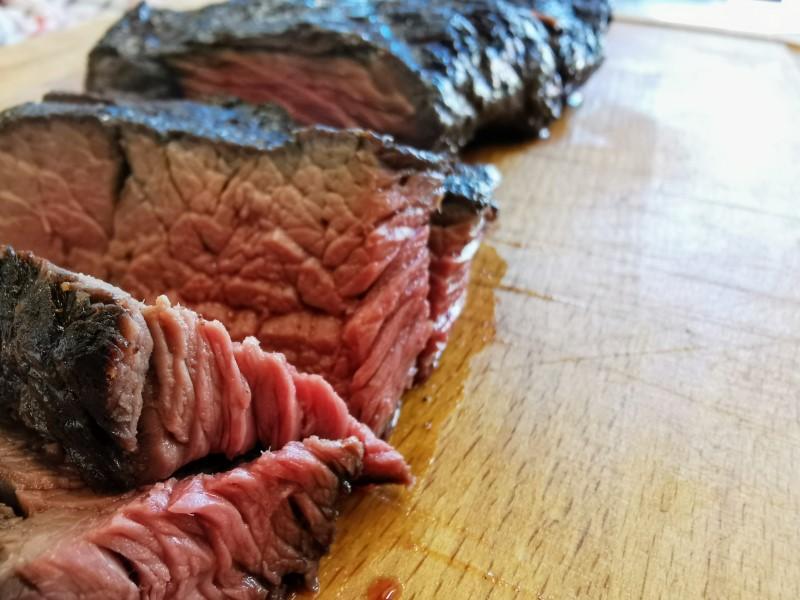

Recipe for bavette sous vide
Flap steak, flap meat, bavette. No matter what we call it, it is an absolutely fantastic American cut that, like hanger steak, teres major, flat iron, etc., belongs to the “butcher’s secrets”: cuts with low or almost no demand and therefore rarely found in the display case.
The very coarse meat structure is quite unfamiliar to us Danes, which is why butchers typically choose to make the meat into ground beef: The almost most popular type of meat among Mr. and Mrs. Denmark!
And that’s a shame. This is primarily due to Danes’ non-existent knowledge of these cuts, and it is also difficult to request a cut that you do not even know exists.
Bavette is, however, insanely delicious. Incredibly tender and very flavorful with a strong beef taste.
If you haven’t previously tasted bavette, you have a great culinary experience awaiting you. It is quite different from, for example, tenderloin.
Here, I will show you how to make the most delicious, tender bavette using sous vide, and I will provide both sous vide times and temperatures, tested and approved by yours truly.
Where is the bavette located?
Bavette – or flap meat – is approximately 2½ centimeters thick and is located under the bottom sirloin, which is the rear and leanest part of the sirloin.
The lesser-known, yet incredibly tender and flavorful bavette is positioned down towards the belly, above the flank, and has a very coarse texture that resembles hanger steak.
Bavette in sous vide
As the bavette lies on the cutting board, it may not look particularly tender or exciting.
However, bavette meat is so fantastically tender that it traditionally only needs to be quickly cooked over high heat, for example, in a pan or on the grill.
After a turn in my sous vide, I believe this method provides the absolute tenderest piece of meat that will melt in your mouth! It is a pure explosion of flavor that will be a hit if you’re in the mood to impress.
Bavette times and temperatures
Time and temperature – that is all that matters when it comes to sous vide cooking.
The temperature depends on how you prefer your meat. The time, on the other hand, depends on the thickness of your specific piece of meat. For example, when dealing with a tenderloin, it does matter whether it is six or nine centimeters thick.
When working with such a thin cut as bavette, which at most varies by one centimeter in thickness, it has no significant impact on the result. You can safely follow my instructions on time and temperature.
In general, if you want your bavette rare, the core temperature should be in the range of 49 – 52 degrees Celsius. If you prefer medium-rare, it’s 53 – 55 degrees, and if you want it medium, stick to 56 – 59 degrees. For well done, the range is 60 – 64 degrees.
Personally, I prefer my beef medium-rare.
Searing and resting time
If you think the meat looks uninteresting on the cutting board, just wait until it comes out of the water bath: Gray, dull, and unappealing it will look!
It naturally doesn’t have a sear yet. Searing not only makes the meat look more appetizing and delicious – it also adds flavor to the meat.
Since the meat is already fully cooked in your sous vide, it only needs to touch the pan briefly to get a sear. So here, you need to crank up the stove!
You can use a regular frying pan or grill pan, or you can use a blowtorch or your grill.
The blowtorch is particularly great if you’re dealing with cuts with an uneven surface. It isn’t essential in this case, though, as the bavette is flat.
Personally, I like to use a bit of homemade ghee on the searing hot pan.
– And resting time, you ask? Not when we’re talking sous vide! The meat is ready to be sliced right after it has been seared.
Slicing
When slicing your bavette, you need to approach it somewhat differently than you might have expected.
You probably know that meat should always be sliced against the grain, and that is also true here.
What is somewhat unusual, however, is that the grain of the bavette runs along the short side.
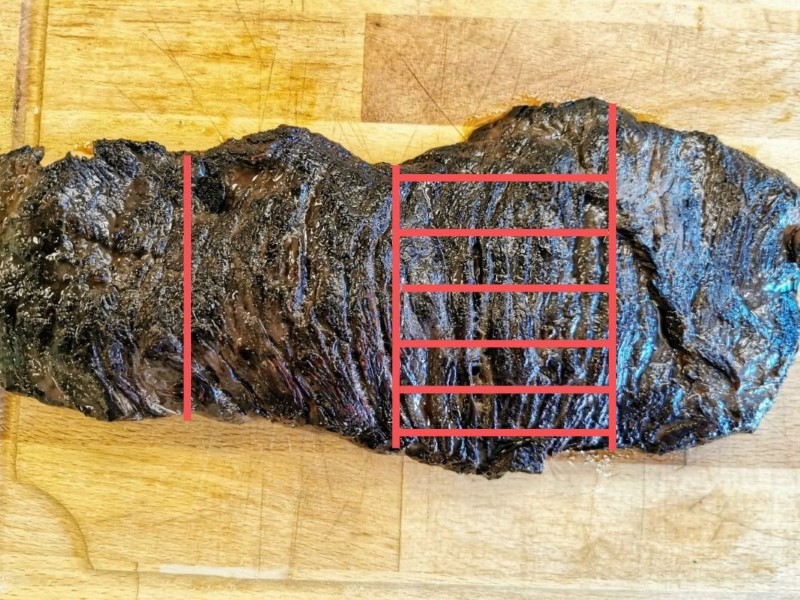
Therefore, first divide the roast into, for example, four pieces, as shown above, and then slice each piece into strips across the grain.
Serving
This powerful piece of meat pairs particularly well with the mild flavor of, for example, potatoes, a fresh, crisp salad, and sweet roasted root vegetables.
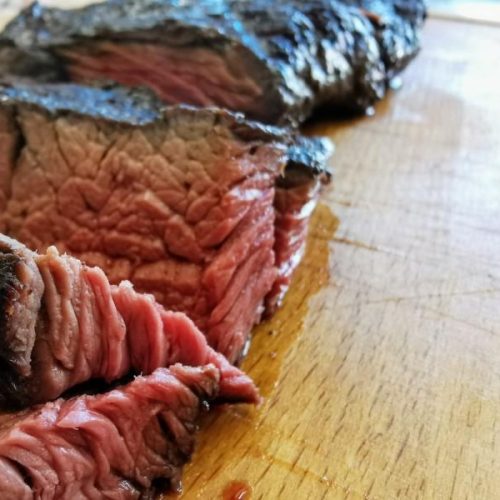
Bavette sous vide
Equipment
- Sous Vide
Ingredients
- 1 kg Bavette
- Salt and Pepper from grinder
- Ghee to frying. Can be substituted with oil/butter
- Flake Salt
Instructions
- Trim your bavette if necessary: Remove visible membranes and tendons as well as any excess fat and fat nodules. Season the meat with salt and pepper.
- Place the meat in a vacuum bag. Vacuum seal the meat. Place the vacuum-sealed bavette in your sous vide at 56 degrees Celsius (133 degrees Fahrenheit).
- Let it sit in the water bath for 2 hours. Remove the meat from your sous vide. Unpack the meat from the bag.
- Pat the meat dry with a clean towel or cloth. Place a pan on the stove and heat to maximum heat.
- Put a dollop of ghee on the smoking hot pan. Alternatively, you can use a mixture of butter and oil in a 1:1 ratio.
- Give the meat a quick sear. We’re talking a maximum of 20 seconds on each side! Remove the meat from the pan and place it on the cutting board.
- Slice the bavette as previously instructed.
- Finally, sprinkle the slices with flaky salt and serve.