
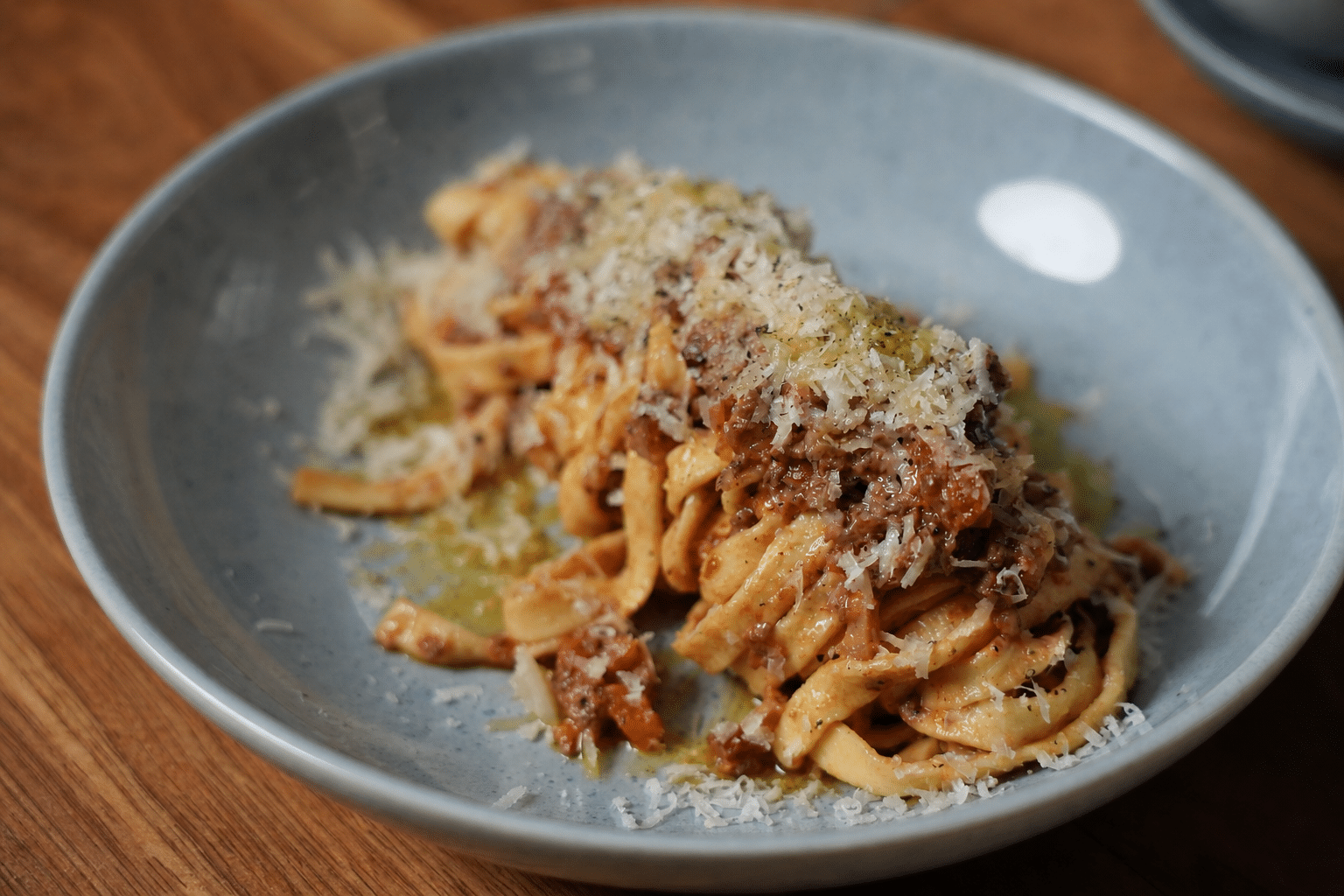

This is not tomato sauce with ground meat poured over spaghetti. Ragu alla bolognese is a specific, centuries-old dish from the city of Bologna in Emilia-Romagna, and the name alone tells you that: “ragu” means a slowly simmered meat preparation, and “alla bolognese” means it comes from Bologna. What most restaurants and home cooks call bolognese bears little resemblance to the original.
The difference comes down to a handful of choices: coarser, fattier meat instead of lean ground beef, a full soffritto of celery, carrot, and onion as the base, unsmoked cured pork rather than smoked bacon, and wide tagliatelle instead of spaghetti. And time. Lots of it.
The official recipe and the academy behind it
Bologna takes its ragu seriously enough that the city’s Chamber of Commerce has an official version on file. In 1982, the Accademia Italiana della Cucina, Italy’s official culinary academy, registered a notarized recipe for the dish at the Bologna Chamber of Commerce. On April 20, 2023, an updated version was deposited at the same institution, following research by a committee of the Accademia.
The updates reflect changes in ingredients and modern kitchen equipment, but the fundamentals remain: a soffritto base, ground beef (sometimes mixed with pork), fresh pork belly or pancetta, a little tomato, wine, and a long, slow simmer.
What sets the original apart from meat sauce
The first thing most people get wrong is the pasta. In Bologna, ragu alla bolognese is served with tagliatelle, a wide, flat ribbon pasta. The wide surface area holds the sauce in a way that thin spaghetti cannot – spaghetti is simply too smooth, and the sauce slides right off.
The second thing is the pork. Pancetta plays an important role in authentic bolognese, and it is worth knowing that pancetta is not the same as bacon. Pancetta is cured but not smoked, which gives a cleaner, more delicate flavor. Regular smoked bacon adds smokiness that does not belong in this dish.
The third thing is the tomatoes. Tomatoes were not part of the earliest versions of ragu alla bolognese and were added later. That means tomato is a background note here, not the main event. You will not find a jar of tomato sauce doing most of the work.
Milk is another feature of classic versions: added toward the end of cooking to round the flavor and soften the acidity from the tomatoes.
Why this recipe works
The soffritto, equal parts celery, carrot, and onion cooked slowly in oil until soft, is the foundation of the sauce. This step matters more than it looks. It builds a sweetness and depth that shortcuts simply skip.
The meat is a mix of ground beef and ground pork, which keeps the texture from becoming tight and grainy. The prosciutto crudo, thinly sliced Parma ham, adds another layer of savory, cured flavor and distributes richness throughout the sauce.
The long simmering time, three to four hours, is not negotiable. The ragu develops its characteristic deep-orange, creamy texture only after a low, slow cook. At two hours it still tastes thin and unfinished. By four hours the fat has emulsified into the sauce and the flavors have melded completely.
Finishing by tossing the pasta directly into the sauce, rather than plating them separately, makes the ragu coat every strand instead of pooling at the bottom of the bowl.
Ingredients
Serves 4
- Fresh tagliatelle for 4 persons (or 14 oz/400g dried tagliatelle)
- 7 oz (200g) ground beef
- 14 oz (400g) ground pork
- 7 oz (200g) prosciutto crudo, thinly sliced
- 1/4 cup (50g) celery, finely diced
- 1/4 cup (50g) carrot, finely diced
- 1/4 cup (50g) onion, finely diced
- 3 tablespoons neutral oil
- 1 generous cup (250ml) red wine
- 2.5 cups (600g) passata (pureed tomatoes)
- 3.5 cups (800ml) water, plus more as needed
- Freshly grated Parmesan, for serving
- Salt to taste
Instructions
1. Heat the oil in a large, heavy pot over medium heat. Add the celery, carrot, and onion and cook, stirring occasionally, for about 5 minutes until softened and lightly colored but not browned.
Read more: The accountant who quit his job to make artisan bacon
2. Add the ground beef, ground pork, and prosciutto crudo. Cook over medium to medium-high heat, stirring regularly, until the meat has browned and any liquid has cooked off, about 10 to 15 minutes.
3. Pour in the wine. Stir and let it simmer for 5 minutes until the alcohol has evaporated and the sharp smell has gone.
4. Stir in the passata and add the water. Stir to combine.
5. Bring to a gentle simmer, then reduce the heat to low. Cook uncovered for 3 to 4 hours, stirring occasionally. Add a splash of water if the sauce gets too thick before time is up. It is ready when it has turned a deep, dark orange and looks creamy and glossy.
6. Season with salt to taste.
7. Cook fresh tagliatelle for about 2 minutes in well-salted boiling water until just al dente. Warm the ragu in a large, wide pan. Add the drained pasta and toss to combine over medium heat for 1 to 2 minutes, adding a splash of the pasta cooking water to loosen if needed.
8. Plate immediately and finish with freshly grated Parmesan.
Tips and variations
Get the soffritto right. The vegetables should be finely chopped – by hand if possible – and cooked slowly until genuinely soft. Rush this step and the sauce will show it.
Coarser beef makes a difference. Lean, finely ground beef from a supermarket package is not what this dish wants. Ask a butcher for a coarser grind from a fattier cut like chuck or brisket. Fat carries flavor and keeps the meat tender over a long braise.
Add milk if you like. The 2023 official recipe registered by the Accademia Italiana della Cucina lists whole milk as an optional addition, added toward the end of cooking and simmered until fully absorbed. It rounds the flavor and quiets the tomato’s acidity.
On the pork product. The official recipe calls for fresh pork belly or unsmoked pancetta, with smoked pancetta explicitly listed as a prohibited variation. This recipe uses prosciutto crudo for its savory depth. If you substitute pancetta, use the unsmoked kind.
Make it ahead. The ragu keeps in the refrigerator for up to 4 days and freezes well for up to 3 months. The flavor improves after a night in the fridge. Cook the tagliatelle fresh when you serve.
On the pasta. Fresh tagliatelle is the classic choice and worth making or buying. If you use dried, choose a wide, flat ribbon pasta. The wide surface is what holds the sauce.