
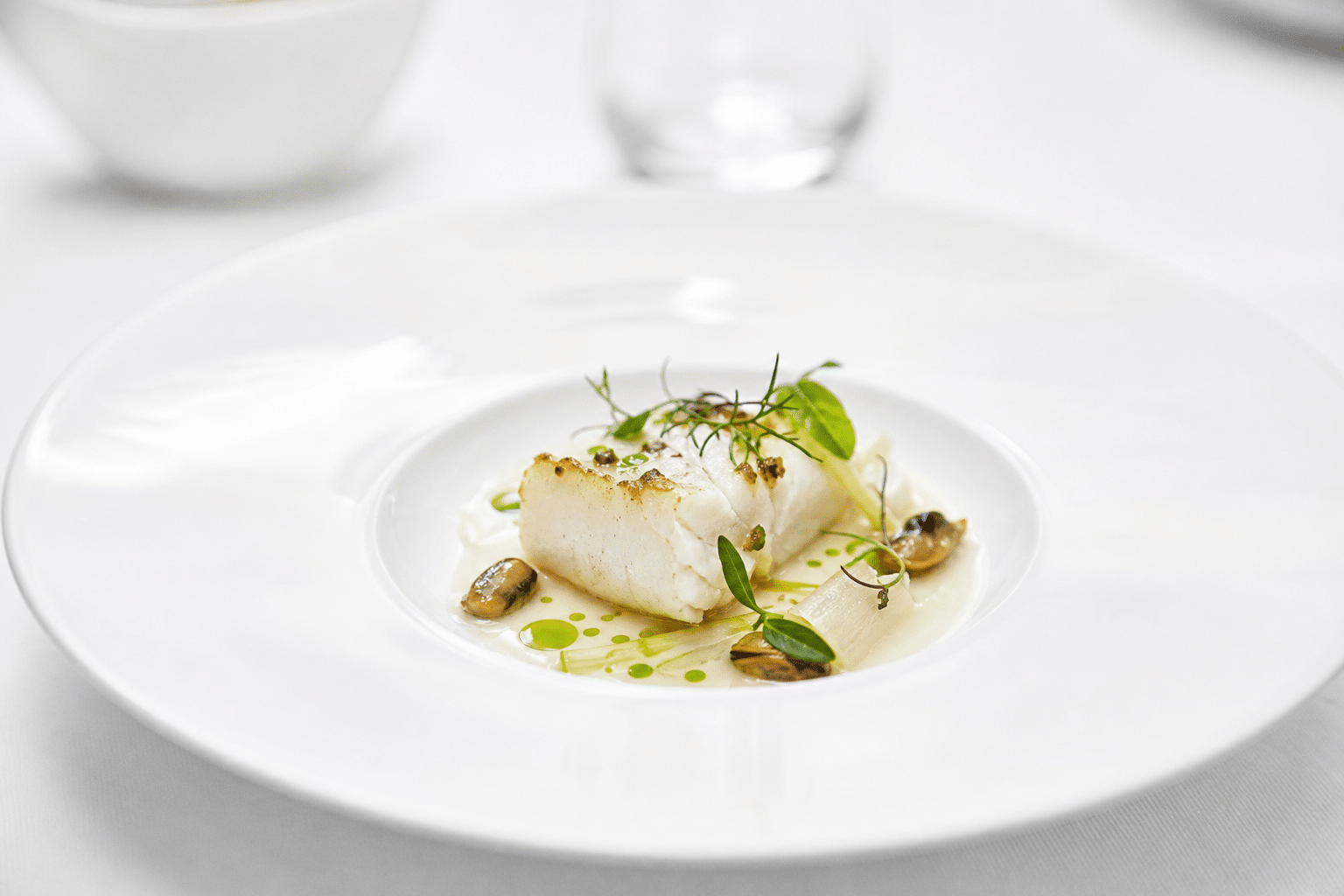

He got it, spent two years there, then put in 80- to 100-hour weeks in London before returning to Denmark to open one of Copenhagen’s most distinctive restaurants. Now the chef and longtime MasterChef Denmark judge, who left the show earlier this year after 12 seasons, is sharing the three things he sees home cooks get wrong over and over again.
Cooking by accident
Mielcke, born in 1977, describes his path into professional cooking as more accident than plan. “It wasn’t a conscious choice on my part to become a chef,” he says. “I come from a family with long educations, and I think I’ve fallen a bit outside the nest.”
He started picking up restaurant shifts during high school, moving from his hometown to Aarhus, then Paris. Food had been something he noticed from childhood – tastes, smells, textures – but it only gradually took over. “It’s not really a path I chose, but I was more sucked into it,” he says.
Getting the job no certificate would have opened
Landing at Pierre Gagnaire – the flagship Paris restaurant in the 8th arrondissement that has held three Michelin stars continuously – is a feat for a formally trained chef. Doing it without credentials is a different thing entirely.
“I knew I would get questions about an apprenticeship certificate, so I had to find a way to get a chef position without going through the Danish education route,” Mielcke says. He found that way, worked at Pierre Gagnaire for two years, then headed to London to help open the Sketch restaurant.
A restaurant that ignores the rankings
After returning to Denmark in 2003, Mielcke eventually partnered with Jan Hurtigkarl. They opened Mielcke og Hurtigkarl on Frederiksberg, in the greater Copenhagen area, in 2007, and Mielcke has run it ever since.
His ambition there is deliberately not about trophies. “My ambitions with the restaurant are that what we make should be an experience and be world-class. We’re not striving for recognition,” he says. “The ambition has been more to create an independent restaurant where there’s room for other chefs and trainees to come in and make their mark on the menu.”
Read more: The accountant who quit his job to make artisan bacon
Guest experience is the organizing principle. “It should be something unique when you come and eat at us,” he says.
The three things home cooks consistently get wrong
Mielcke spent 12 years judging home and amateur cooks on MasterChef Denmark before stepping down in April 2026. He has a clear view of where people fall short. Here are his three fixes.
1. Learn to make desserts first
Mielcke’s first recommendation lands as a surprise: before you worry about your sauces or your sear, get comfortable in the pastry side of the kitchen.
“Most people can benefit from understanding the dessert kitchen,” he says. “It’s about consistencies, and your techniques must be completely correct, or you’ll go wrong.”
The egg is the place to start. “Working with eggs, for example, can give people an insight into how everything works together. If you understand how to make good cake cream, you can develop the technique in many different directions.”
This isn’t about becoming a pastry chef. Pastry demands a precision that savory cooking forgives, and building that muscle carries across everything else you make.
2. Trust yourself over the recipe
Mielcke is not against recipes, but he wants cooks to treat them as a starting point rather than a court order. “You must rely on your intuition regarding the recipe you use,” he says. “You must know when the recipe makes sense, but also when you should feel your way forward.”
Recipes are generic. Your kitchen, your stove, your pan, and your ingredients are specific. “The product of the food you make depends on the equipment you have. You must be present in what you make, and you must have the backbone to trust your own qualities.”
His test case is the most practical one possible: “If you think the meat should come off the pan now, even though the recipe says something else, you’re probably right that the meat should come off the pan and rest.”
3. Build a small arsenal of Japanese umami sauces
The third tip is the most immediately actionable. “The last thing I go far with in my own kitchen is having a small battery of Japanese sauces, which are very flavorful and give good umami, so you can make a fantastic dish just before serving it,” Mielcke says.
Read more: How to boil eggs perfectly every time: exact timings for soft, jammy, and hard
Mielcke’s food leans heavily toward Japanese and Southeast Asian flavor profiles, and this tip reflects that. For US cooks building that battery from scratch, the category includes soy sauce (the base), ponzu (a bright citrus-soy condiment), mirin (a sweet rice wine used for finishing), and dashi-based sauces. All are available in the Asian foods aisle of most grocery stores. A splash added in the final minute of cooking – over roasted vegetables, into a pan sauce, through a bowl of noodles – delivers depth that hours of simmering cannot replicate.
Why he is skeptical of home sous vide machines
One tool he is openly critical of is the home sous vide machine. His issue is not the technique itself but how it short-circuits skill development.
“It’s a way people can cheat if they can’t figure out how to sear meat,” he says. “If you need to make many dishes for a dinner party, it’s an easy way to avoid proper preparation. This means many people who actually care about cooking can’t figure out how to sear meat, because they don’t have it in their fingers.”
Learning to read a sear by sight and sound is exactly the kind of intuition he is after in tip two. The machine does the work, but you stay at the same level.
Mielcke and former MasterChef co-judge Jesper Koch launched their travel series Bali on the Menu on TV3 and Viaplay on October 20, 2026, a six-episode show following the two chefs through Bali as they seek out gastronomy, culture, and local ingredients.