
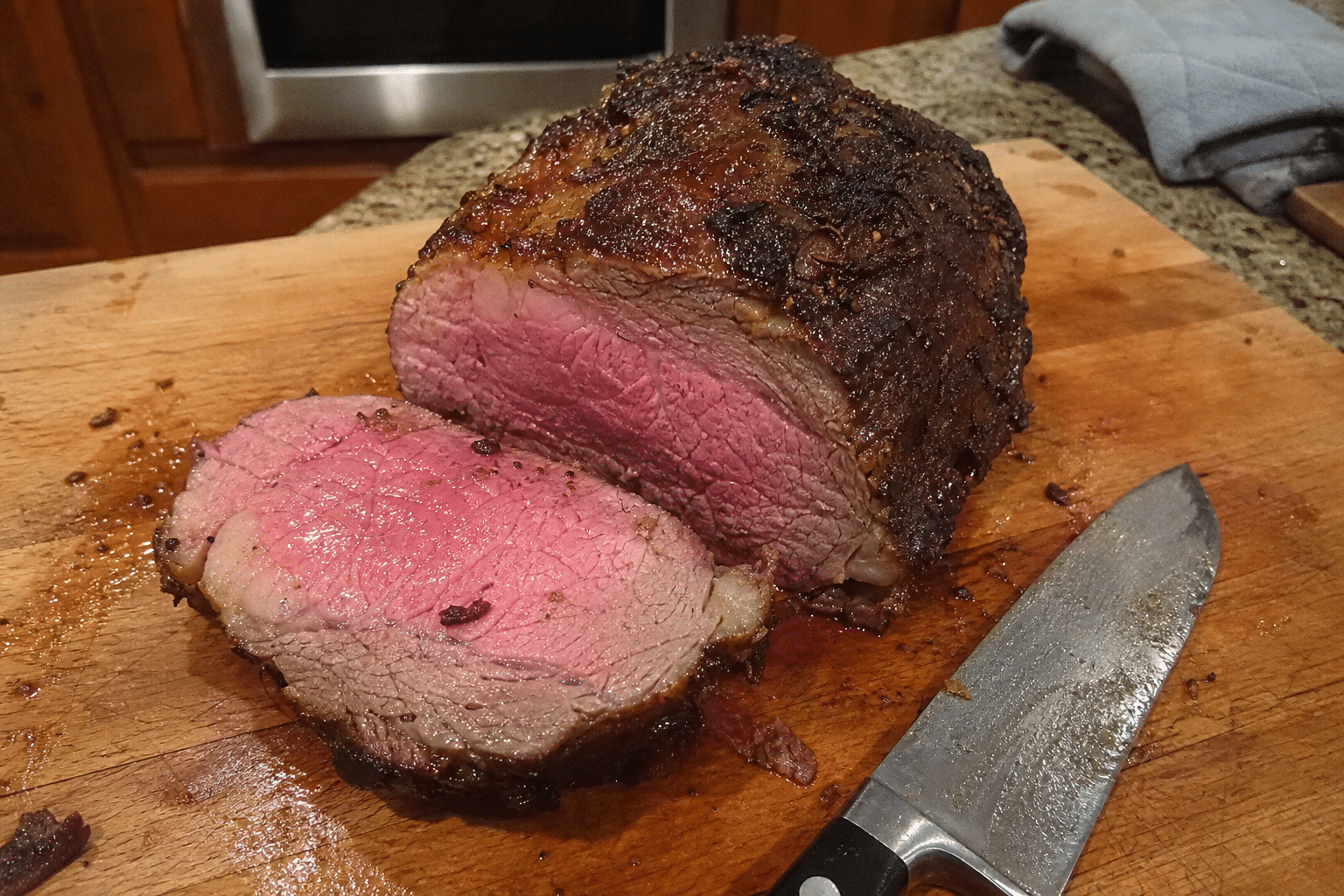

A bone-in standing rib roast, sold in most butcher cases and supermarket meat departments as prime rib, is one of the most impressive cuts in the meat case. The bones act as a natural roasting rack, the heavy marbling bastes the meat from within, and the fat cap crisps into a crust when treated to high heat.
Low-and-slow roasting at 225 to 250°F (107 to 121°C), followed by a brief blast at 500°F (260°C), gives you even, edge-to-edge cooking and a dark, mahogany exterior. All you need is a meat thermometer and a plan.
Why this recipe works
A roast cooked at high oven temperature develops a thick gray band of overcooked meat just under the surface; a roast cooked at 225°F barely has one at all. The low heat brings the internal temperature up gently, so the entire cross-section of the roast reaches your target at roughly the same time.
The dry brine, applied one to two days ahead, does double duty. Salt draws moisture to the surface, which the meat then reabsorbs as a seasoned liquid over several hours. It also dries the exterior so the high-heat finish creates a faster, deeper crust.
Buying the roast
A standing rib roast is sold by number of ribs. Plan on one rib per two people: a 2-rib roast (about 4 to 5 lbs / 1.8 to 2.3 kg) feeds four, a 4-rib roast (about 8 to 9 lbs / 3.6 to 4.1 kg) feeds eight to ten.
Look for good marbling, the network of white fat running through the red muscle. USDA Prime has the most; USDA Choice, widely available at most supermarkets and warehouse stores, produces an excellent roast at a lower price.
Read more: New England clam chowder made from scratch: thick, creamy, and better than any can
Ask for the “first cut” (ribs 10 to 12), which has a larger, more uniform eye of meat and cooks more evenly. The “second cut” (ribs 6 to 9) is fattier and equally delicious, with a slightly more varied shape.
Ingredients
Serves 8 to 10
- 1 bone-in standing rib roast, 4 ribs (about 8-9 lbs / 3.6-4.1 kg)
- 2 tablespoons (30 g) kosher salt, for the dry brine
- 1 tablespoon (8 g) freshly ground black pepper
- 6 garlic cloves, minced to a fine paste
- 2 tablespoons fresh rosemary leaves, finely chopped
- 1 tablespoon fresh thyme leaves
- 2 tablespoons (30 ml) olive oil or softened unsalted butter
Instructions
1. Dry brine 1 to 2 days ahead. Set the roast bone-side down on a wire rack fitted over a rimmed baking sheet. Rub kosher salt generously all over every surface, including along the bones. Refrigerate uncovered for 12 to 48 hours. The surface will look dry and tacky before it goes in the oven. That is correct.
2. Season before roasting. Remove the roast from the refrigerator about 1 hour before cooking. Mix the pepper, garlic, rosemary, and thyme with the olive oil or butter into a rough paste. Press it firmly across the top and sides of the roast.
3. Roast low and slow. Heat the oven to 225°F (107°C). Place the roast bone-side down on a rack in a roasting pan. Roast until the internal temperature reaches the pull temperature for your preferred doneness (see the chart below). For a 4-rib roast, expect 3.5 to 4.5 hours. The thermometer reading matters far more than the clock.
4. Rest while the oven heats. When the roast hits its pull temperature, remove it from the oven and tent loosely with foil. Turn the oven up to 500°F (260°C) and let it fully preheat, about 20 minutes. The roast rests and the internal temperature continues to rise slightly during this time.
Read more: What the FDA’s ‘rarely consumed raw’ rule means for your Thanksgiving cranberries
5. High-heat finish. Remove the foil and return the roast to the 500°F oven. Roast uncovered until the surface is deep brown and visibly crisped, 15 to 20 minutes. Watch it closely; at this temperature the crust can darken quickly.
6. Rest and carve. Remove the roast from the oven and rest it uncovered for 15 minutes. To carve, stand the roast upright and cut straight down along the rib bones to free them in one piece, then slice the eye of the roast across the grain to your preferred thickness.
Pull and final temperatures by doneness
Doneness | Pull at this temp | After carry-over |
|---|---|---|
Rare | 115-118°F (46-48°C) | 120-125°F (49-52°C) |
Medium-rare | 123-125°F (51-52°C) | 128-133°F (53-56°C) |
Medium | 130-133°F (54-57°C) | 135-140°F (57-60°C) |
USDA safe minimum | 142°F (61°C) | 145°F (62.8°C) |
USDA FSIS sets the safe minimum internal temperature for beef roasts at 145°F (62.8°C), with at least 3 minutes of rest. Any doneness below 145°F is below the USDA-recommended safe level.
Tips and variations
Use a leave-in probe thermometer. A wired probe thermometer placed in the thickest part of the roast, not touching bone, lets you monitor temperature without opening the oven repeatedly. The low-and-slow phase is long enough that repeated checks cost you meaningful heat.
Horseradish cream. Mix 1/2 cup (120 ml) sour cream, 2 tablespoons prepared horseradish, 1 teaspoon white wine vinegar, and a pinch of salt. Refrigerate until serving. It is the traditional accompaniment for a reason: the sharp, creamy sauce cuts the richness of the beef cleanly.
Read more: What long fermentation actually does, and does not do, for sourdough’s nutritional profile
Pan drippings for au jus. After removing the roast for the high-heat finish, place the roasting pan over two burners on medium-high heat. Add 1 cup (240 ml) beef broth and scrape up all the browned bits. Simmer 2 to 3 minutes, strain into a pitcher, and keep warm.
Scaling down. A 2-rib roast follows the same method exactly. The low-oven phase drops to roughly 1.5 to 2.5 hours; all temperature targets remain the same.
Storage. Refrigerate within 2 hours of cooking in a covered container. Reheat slices at 275°F (135°C) with a splash of broth, covered with foil, until just warmed through, about 15 to 20 minutes.
Allergens. Butter is a dairy product; substitute olive oil for a dairy-free version. No other common allergens are present in the base recipe.
Cold sliced prime rib the next day makes an excellent sandwich on toasted bread with the leftover horseradish cream.