
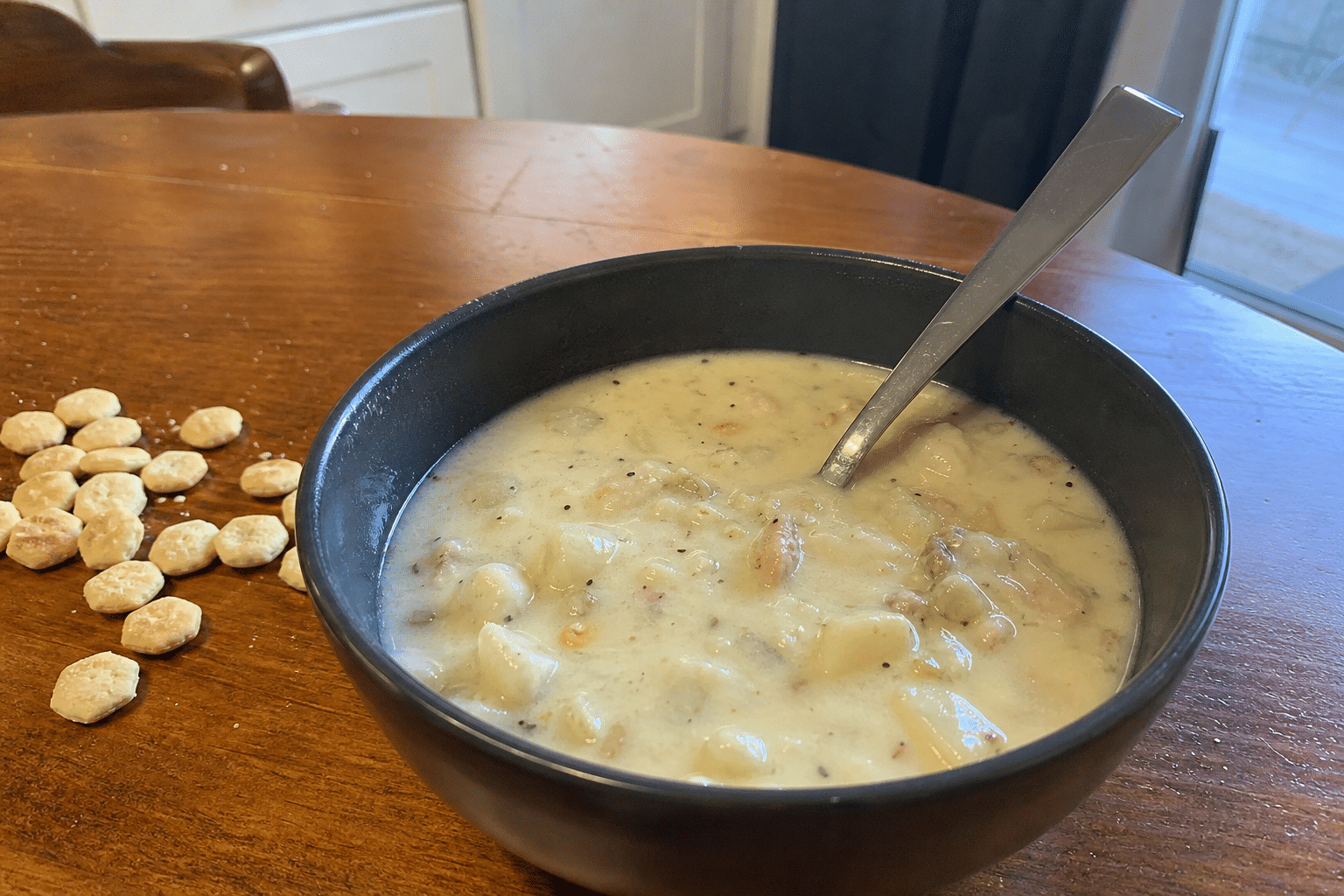

New England clam chowder is not complicated, but it has a handful of things that must go right: good pork fat for the base, potato starch for thickness, cream at the end, and clams added last so they don’t turn to rubber. Get those four things right and you have a chowder that is briny, rich, and deeply satisfying.
This recipe uses either fresh littleneck clams or canned clams, so it works any time of year. No flour paste, no shortcuts on the pork fat. Just the classic New England method.
Why this recipe works
The thickener here is not flour or cornstarch: it is potato. As the diced potatoes cook through, you mash a quarter of them against the side of the pot. That releases starch directly into the broth and gives you a silky, cohesive base without any raw flour taste.
Salt pork is the traditional fat, and it earns its place. It renders a clean, neutral pork flavor that lets the clams come forward. Bacon works in a pinch, but its smokiness competes with the brine. If salt pork is not at your store, look near the ham and lard.
The cream goes in at the end over low heat and never boils. Boiling a cream-based chowder breaks the emulsion and leaves you with a greasy, grainy broth. Low and slow from the moment the dairy hits the pot.
Ingredients
Serves 4
For the base:
- 4 oz (115 g) salt pork, rind removed, cut into small dice (or 4 strips thick-cut bacon)
- 1 medium yellow onion, diced small (about 1 cup / 150 g)
- 2 stalks celery, diced small
- 1 lb (450 g) Yukon Gold potatoes, peeled and cut into 3/4-inch (2 cm) cubes
- 2 cups (480 ml) bottled clam juice
- 1 cup (240 ml) water
- 1 bay leaf
- 3 sprigs fresh thyme, or 1/2 teaspoon dried
For the finish:
- 1 1/2 cups (360 ml) heavy cream
- 2 cans (6.5 oz / 185 g each) chopped or minced clams, drained with juice reserved — OR — 2 lbs (900 g) fresh littleneck clams, scrubbed
- Salt and white pepper to taste
To serve:
- Reserved salt pork cracklings or crumbled bacon
- Oyster crackers
Instructions
1. Place a large, heavy-bottomed pot over medium heat. Add the salt pork and cook, stirring occasionally, until the fat has fully rendered and the bits are crisp and golden, about 8 to 10 minutes. Remove the cracklings with a slotted spoon and set aside on a paper towel. Leave all the fat in the pot.
Read more: What the FDA’s ‘rarely consumed raw’ rule means for your Thanksgiving cranberries
2. Add the onion and celery to the pot. Cook over medium heat, stirring occasionally, until softened and translucent but not browned, about 6 to 8 minutes.
3. Add the potatoes, clam juice, water, bay leaf, and thyme. If using canned clams, add their reserved liquid now too. Bring to a simmer and cook until the potatoes are completely tender and you can pierce them with no resistance, about 15 minutes.
4. Remove the bay leaf and thyme sprigs. Using the back of a large spoon, press roughly one-quarter of the potatoes against the side of the pot until they break down. Stir to distribute the starch into the broth. The base will visibly thicken.
5. If using fresh clams: While the potatoes cook, steam the clams in a separate pot with 1/2 inch (1 cm) of water over high heat. Cover and cook until the shells open, about 4 to 6 minutes. Discard any clams that do not open. Strain the steaming liquid through a fine-mesh sieve and add it to the chowder pot. Pick the clam meat from the shells and set aside.
Read more: What long fermentation actually does, and does not do, for sourdough’s nutritional profile
6. Reduce the heat to low. Pour in the heavy cream and stir gently. Add the clam meat (from fresh or canned). Heat slowly, stirring occasionally, until the chowder is steaming and the clams are just opaque throughout, about 3 to 4 minutes. Do not let it boil. According to USDA FSIS, fish and shellfish are safe at an internal temperature of 145°F (63°C); for fresh clams, the shells opening during steaming is the reliable sign they have reached that temperature.
7. Taste and season with salt and white pepper. Ladle into bowls and top with the reserved cracklings. Serve with oyster crackers on the side.
Tips and variations
Fresh vs. canned clams: Fresh littleneck or cherrystone clams deliver more briny, oceanic depth. Canned chopped clams are consistent, available year-round, and still produce a great bowl. If using canned, buy clams packed in their own juice, not water, and use that juice in step 3.
Do not skip the pork fat: Even if you substitute bacon for salt pork, do not drain the fat before adding the vegetables. That fat is the flavor base.
Read more: Fresh homemade cranberry sauce that beats the can every time, ready in 15 minutes
Storage: Chowder keeps in the refrigerator for up to 3 days in a sealed container. Reheat gently over low heat, stirring frequently, never at a full boil.
Freezing: Dairy-based chowder does not freeze well. The cream separates on thawing and the potatoes turn grainy. Make only what you will eat within 3 days.
Scaling up: This recipe doubles cleanly. Use a large Dutch oven and give the potatoes a few extra minutes to simmer if the pot is very full.
Allergen note: This dish contains shellfish and dairy. For a dairy-free version, substitute full-fat coconut milk for the heavy cream; it will not be traditional New England style but it carries the briny base well.
For a thicker bowl, stir in one additional tablespoon of cold butter at the very end, off the heat.