
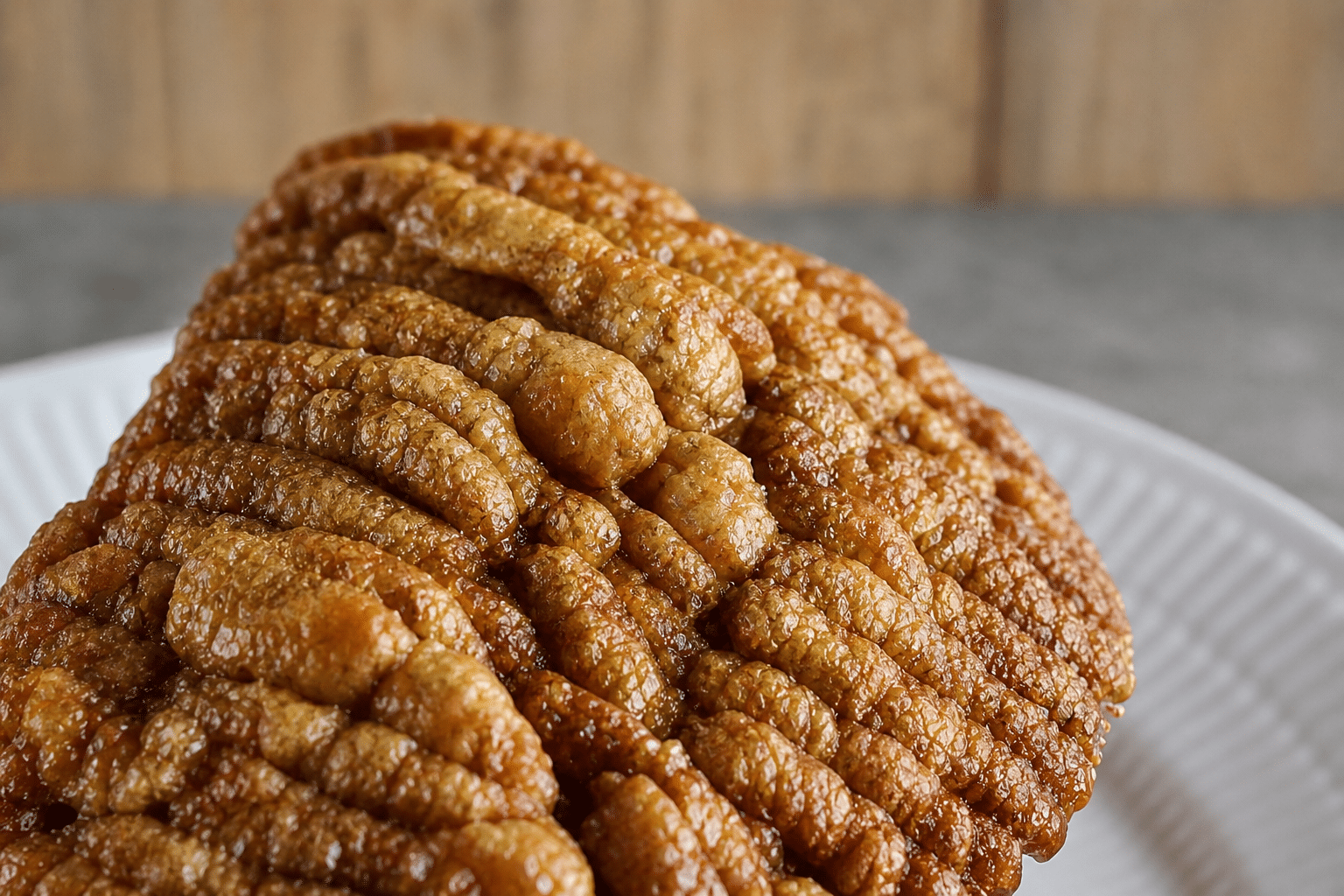

This is ribbenssteg: Denmark’s beloved bone-in pork rib roast, cooked low and slow until the fat renders into something extraordinary, then finished under the broiler for crackling that actually shatters. I think it is one of the great holiday roasts, and it is almost completely unknown outside Scandinavia.
If you have cooked only pork loin, this is a different world. The rib cut comes from the chest of the pig, with the rib bones still attached and a thick cap of fat and skin on top. That fat is not something to trim away. It is the whole point. As it slowly melts during roasting, it bastes the meat from the inside and builds a depth of flavor that a leaner loin simply cannot give you.
Why the rib cut beats the loin
Loin is tidy, uniform, and easy to cook. Rib roast has bones, fat, and connective tissue, which means it rewards patience.
The connective tissue in particular has to have time to break down, and this is the thing people miss: hitting the right internal temperature is necessary, but it is not sufficient. The meat can read a correct temperature on a thermometer and still be tough if it has not had enough time to tenderize. This is why the roast needs a full hour and a half in the oven. Time is as important as heat.
Read more: The pasta hack that swaps cream for cream cheese and makes the silkiest sauce of your life
The payoff is juicier meat and better crackling than you will ever get from a loin.
Ingredients
Serves 6 | Prep: 15 minutes | Cook: about 1 hour 45 minutes
- 3.3 lbs (1.5 kg) bone-in pork rib roast, skin on
- 3/4 oz (20 g) coarse salt or coarse kosher salt
- 1 large onion, about 5 oz (150 g)
- 2 medium carrots, about 7 oz (200 g)
- 4 bay leaves
- 10 whole black peppercorns
- 3 cups (700 ml) water
Instructions
- Preheat your oven to 390°F (200°C) on conventional heat, not fan-assisted.
- Check the skin. It needs to be scored in parallel lines about 3/16 inch (5 mm) apart, cutting through the skin down to the meat but not into the flesh. If your butcher has not scored it, do it yourself with a sharp knife or a fresh utility blade.
- Rub coarse salt thoroughly into every groove of the scored skin. Work it in well, right down into the cuts.
- Cut the onion and carrots into rough, large chunks. Scatter them in a roasting pan along with the bay leaves and peppercorns.
- Set the roast skin-side up directly on top of the vegetables.
- Pour the water into the pan around and under the roast. The water must not touch the skin, or it will prevent the crackling from forming.
- Roast for approximately 1 hour and 30 minutes, using the rule of thumb of about 1 hour per kilogram. The meat is ready when it reaches an internal temperature of at least 145°F (63°C), which is the USDA minimum for whole cuts of pork. I personally take it to 162°F (72°C), which gives the connective tissue more time to melt and results in noticeably more tender, juicy meat.
- Remove the roast from the oven. Pour the pan liquid through a fine sieve, discarding the vegetables; this is your gravy base.
- Switch the oven to broil.
- Place the roast back in the empty pan, skin-side up. Broil for 10 to 15 minutes, watching closely the entire time, until the skin puffs up and crisps into crackling. It can go from golden to burned in under a minute.
- Rest the roast uncovered for 15 minutes before carving. Carve between the ribs to serve.
Tips and variations
Get the scoring right. The scoring is what lets the salt penetrate and the fat render out during cooking. Lines that are too shallow mean the crackling may never properly crisp. Press the knife firmly enough that you just graze the meat underneath.
Read more: Denmark’s dream cake in muffin form: sticky coconut-coffee topping in every single bite
If the crackling won’t crisp. This can happen if the skin was damp or the scoring too shallow. The fix: carefully slice the crackling off in one piece, lay it flat in the broiler pan, and grill it separately for a few minutes. Keep close watch and do not walk away.
Keep water away from the skin. The water under the roast keeps the oven moist and builds the gravy, but it must never splash onto the skin. Check it once or twice during cooking and top it up if it has nearly boiled away.
Read more: Homemade gochujang mayo: the spicy Korean condiment that makes everything better
The gravy. Season the strained pan liquid and reduce it in a small saucepan if you want a thicker consistency. Serve hot alongside the roast.
Make-ahead. You can complete the main oven stage, tent the meat loosely with foil, and hold it for up to 30 minutes. Run the broiler crackling finish right before you bring it to the table.