
St. Martin’s Eve has roots dating back to the 4th century
The foundations for St. Martin’s Eve were laid many years ago – specifically in the year 397 in the old Roman Empire. Let’s rewind a bit further. Originally named Martin of Tours, he was born in the year 336. He was a very warm and kind man, known for his special abilities and consideration for the sick and poor.
Martin became known for his generosity
He enlisted in the army at the age of 15 and was sent to Gaul. There he saw a poor beggar who looked lost. He noticed that all the town’s residents just walked past the beggar as if he didn’t exist. Martin was a soldier, so he had no money, and he also had no food. The only possessions he had were his cloak and his sword.
He decided to share his cloak so the poor man could have something to keep warm. In his dream the following night, he received a vision sent from heaven. It was Jesus who had disguised himself as the poor beggar, he was told in the dream. The rumor quickly spread in the town that he had special abilities.
When he was about 20 years old, he chose to become a monk. He had become a Christian and wanted to teach his fellow countrymen in Hungary about the Christian faith. However, he only succeeded in converting his mother to Christianity before returning to Gaul. In Gaul, they called him a holy man, and they were so impressed with him that they wanted to appoint him as bishop. Martin would not hear of it.
Martin hid among the geese to avoid being appointed bishop
To escape, he chose to hide in a goose pen – and here come some important details for the St. Martin’s Eve we know today. The people searched and searched for him. Eventually, they came to the goose pen. Here the geese squawked because they were displeased with Martin hiding among them. This led to his hiding place being discovered, after which he was forced to become bishop.
He was furious and angry with the geese for revealing him. He ordered that all households should slaughter and eat a goose at least once a year – on the day he was discovered and forced to become bishop. This was his way of getting revenge on the geese.
Martin died on November 8th, 397. He was buried on November 11th, and a large church was built over his grave. He was declared a saint, and his death day became a saint’s day – specifically St. Martin’s Day. This day was celebrated in large parts of Europe.
However, it took some time before Martin’s Day came to Denmark. Writings have been found from the 17th century describing the day. Martin was not a particularly Danish name at the time, so the day was renamed St. Martin’s Bishop.
St. Martin’s Eve is almost unchanged
Traditionally, we still eat poultry on St. Martin’s Eve, which is held the evening before November 11th, the day of his death. However, it became common long ago to eat duck instead of goose since geese were very expensive. Today, many still eat duck instead of goose – not because of the price, but because of traditions and preferences.
The menu is very similar to Danes’ Christmas Eve, so alongside duck/goose, people typically eat white and caramelized potatoes, brown gravy, and red cabbage.
St. Martin’s Eve recipes
Stuffed Goose
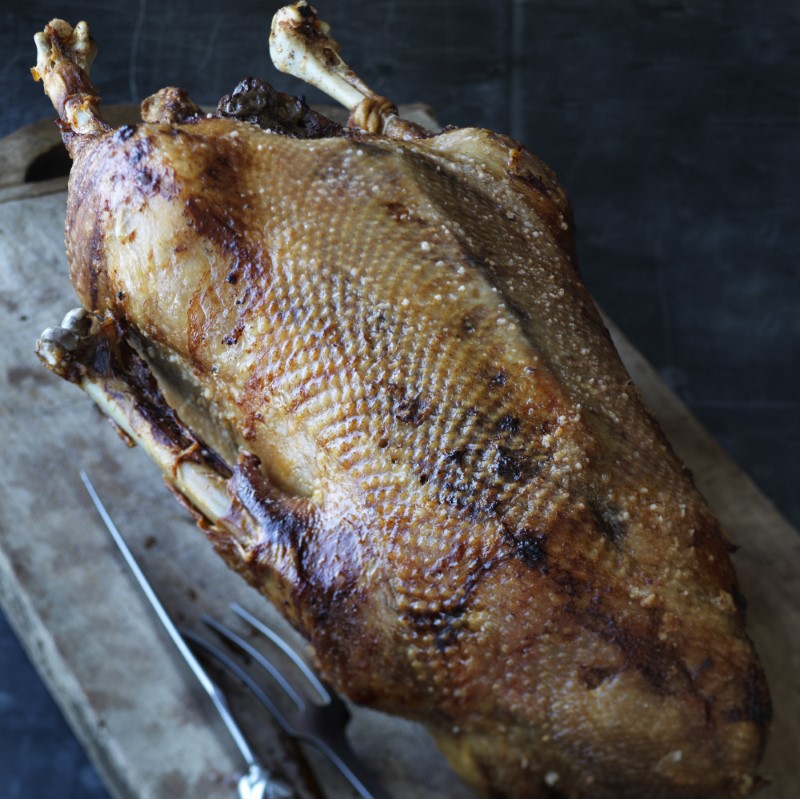
Slow Roasted Duck

Duck Breast Sous Vide

Confit de Canard/Duck Leg (Sous Vide)

Duck Recipes in General

Boiled Potatoes

Caramelized Potatoes

Brown Gravy

Christmas Gravy

Homemade Red Cabbage

Sous Vide Red Cabbage