
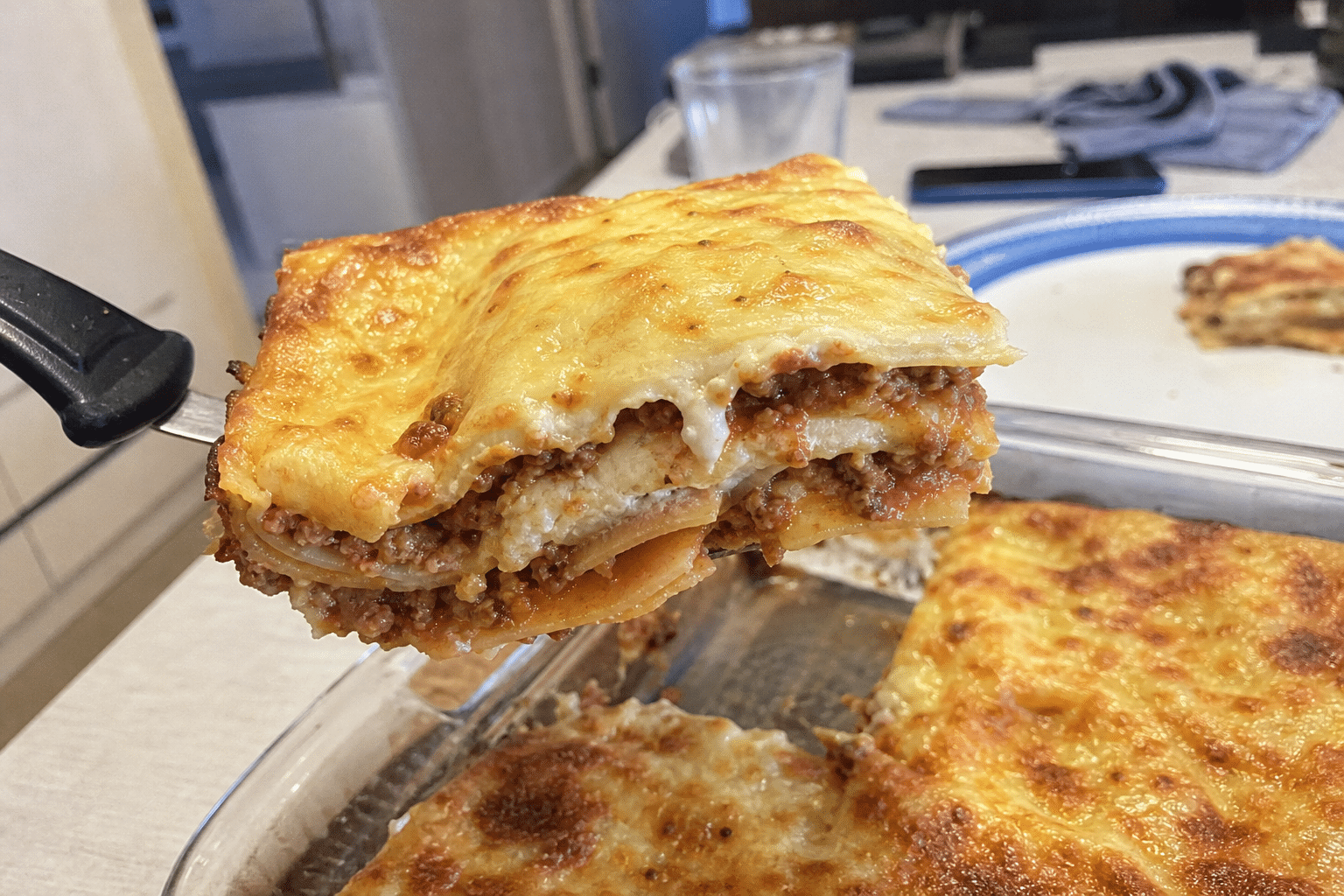

The gap between a mediocre lasagna and a great one comes down to three decisions: how long you cook the sauce, which white layer you use, and whether you let the finished dish rest before you cut it. Get those three right and everything else falls into place.
This recipe builds the dish from scratch. The meat sauce simmers for at least 45 minutes to develop body and depth. A classic bechamel goes between the layers instead of ricotta, giving you clean, cohesive slices rather than a crumbly filling. The finished lasagna rests 15 minutes before you touch it, which is the difference between a slice that holds its shape and one that collapses on the plate.
It serves 8 to 10 people from a 9-by-13-inch pan and reheats well the next day.
Why this recipe works
Ground beef and pork together make a richer, more complex sauce than beef alone. The pork adds fat and a subtler sweetness; the beef gives body. Brown both meats hard before adding anything else. You want real color on the meat, not steamed gray crumbles.
The wine goes in after the browning, before the tomatoes. It deglazes the fond on the bottom of the pan and cooks off its sharp edge. Add the crushed tomatoes after the wine has reduced by half, then lower the heat and let the sauce go for a minimum of 45 minutes. It should look noticeably darker and taste fuller than it did at 20 minutes.
Bechamel binds the layers. Ricotta gives a chunkier, drier texture that can separate when you slice. Bechamel flows slightly during baking, sealing the layers so the whole thing holds when you serve it. It also carries the Parmesan more evenly.
Read more: Rich turkey gravy from pan drippings, ready before the bird is carved
Ingredients
For the meat sauce:
- 1 lb (450 g) ground beef, 80/20 fat ratio
- 1/2 lb (225 g) ground pork
- 1 medium yellow onion, finely diced
- 2 medium carrots, finely diced
- 2 stalks celery, finely diced
- 4 cloves garlic, minced
- 2 tablespoons olive oil
- 2 tablespoons tomato paste
- 1/2 cup (120 ml) dry red wine
- 1 can (28 oz / 800 g) crushed tomatoes
- 1 teaspoon dried oregano
- 1/2 teaspoon dried thyme
- Salt and black pepper
For the bechamel:
- 4 tablespoons (57 g) unsalted butter
- 1/4 cup (30 g) all-purpose flour
- 3 cups (720 ml) whole milk, warmed
- 1/4 teaspoon ground nutmeg
- Salt and white pepper
- 1/2 cup (50 g) finely grated Parmesan, stirred in at the end
For assembly:
- 12 lasagna noodles (no-boil, or regular boiled until just pliable)
- 2 cups (200 g) shredded low-moisture mozzarella
- 1/2 cup (50 g) finely grated Parmesan
Instructions
1. Brown the meat. Heat 2 tablespoons olive oil in a large, deep skillet or Dutch oven over medium-high heat. Add the ground beef and pork in a single layer without stirring. Let them brown on the bottom, about 3 to 4 minutes, before breaking up. Season with salt and pepper. Cook until no pink remains and the meat has real color, about 8 minutes total, breaking it into small crumbles as you go. Drain any excess fat if the pan looks greasy.
2. Build the base. Lower the heat to medium. Add the diced onion, carrot, and celery directly to the meat. Cook, stirring occasionally, until the vegetables are soft and the onion is translucent, about 8 to 10 minutes. Add the garlic and tomato paste and stir for 1 minute, until the paste darkens slightly and smells toasted.
3. Deglaze and simmer. Pour in the red wine and scrape up any browned bits from the bottom of the pan. Let the wine reduce by about half, 2 to 3 minutes. Add the crushed tomatoes, oregano, and thyme. Stir to combine, bring to a low simmer, and reduce the heat to low. Cook uncovered, stirring occasionally, for at least 45 minutes. The sauce should thicken, deepen in color, and taste noticeably sweeter and more complex. Taste and adjust salt.
4. Make the bechamel. In a medium saucepan over medium heat, melt the butter. Whisk in the flour and stir constantly for 1 to 2 minutes until it looks like a pale, smooth paste with no raw flour smell. Pour in the warm milk slowly, whisking constantly to prevent lumps. Continue whisking until the sauce thickens enough to coat the back of a spoon, 5 to 7 minutes. Season with nutmeg, salt, and white pepper. Remove from heat and stir in the 1/2 cup Parmesan.
5. Prepare the noodles. If using no-boil sheets, leave them dry. If using regular noodles, boil in well-salted water until just barely pliable, about 2 minutes short of the package time. Drain and lay flat on a lightly oiled baking sheet to prevent sticking.
Read more: How to glaze a Christmas ham: honey-mustard, brown sugar, and a broil finish
6. Layer. Preheat the oven to 375°F (190°C). Spread a thin layer of meat sauce across the bottom of a 9-by-13-inch (23-by-33 cm) baking dish. Lay 3 to 4 noodles over the sauce in a single layer, slightly overlapping if needed. Spread about one-quarter of the remaining meat sauce over the noodles, then spoon over about one-third of the bechamel in dollops and spread it gently. Scatter a handful of mozzarella and a little Parmesan. Repeat two more times: noodles, meat sauce, bechamel, cheese. For the top layer, lay the final noodles, cover with the last of the meat sauce, spread the remaining bechamel evenly across, and finish with the remaining mozzarella and Parmesan.
7. Bake. Cover tightly with foil and bake for 25 minutes. Remove the foil and bake for another 20 to 25 minutes, until the top is deeply golden and bubbling at the edges. An instant-read thermometer inserted into the center should read at least 160°F (71°C), the safe minimum internal temperature for ground beef according to USDA FSIS.
8. Rest before cutting. Remove the lasagna from the oven and let it rest uncovered for at least 15 minutes. The layers firm up during this time, and slices will hold their shape cleanly on the plate.
Tips and variations
Don’t rush the browning. The fond that develops on the bottom of the pan during the meat-browning step carries flavor throughout the whole sauce. Don’t stir too early, and don’t crowd the pan or the meat will steam instead of sear.
Read more: Cast-iron skillet cornbread with a crispy crust and tender, buttery crumb
No-boil noodles need moisture. Make sure the meat sauce is on the looser side if you use no-boil sheets. They absorb liquid as they bake. If the sauce looks very thick after simmering, stir in a few tablespoons of water before assembling.
Make ahead. The meat sauce keeps in the fridge for 2 days or in the freezer for up to 3 months. The fully assembled, unbaked lasagna can sit in the refrigerator overnight; add about 10 minutes to the covered baking time if starting from cold.
Leftovers. Store covered in the fridge for up to 4 days. Reheat slices in a 350°F (175°C) oven for about 15 minutes rather than a microwave, which turns the noodles rubbery.
Without the pork. Use 1 1/2 lb (675 g) ground beef total. The sauce will be slightly less rich. Stirring in a small splash of whole milk during the last 10 minutes of simmering softens the flavor.
Allergens. Contains gluten (pasta, flour) and dairy (butter, milk, cheese). No eggs.