
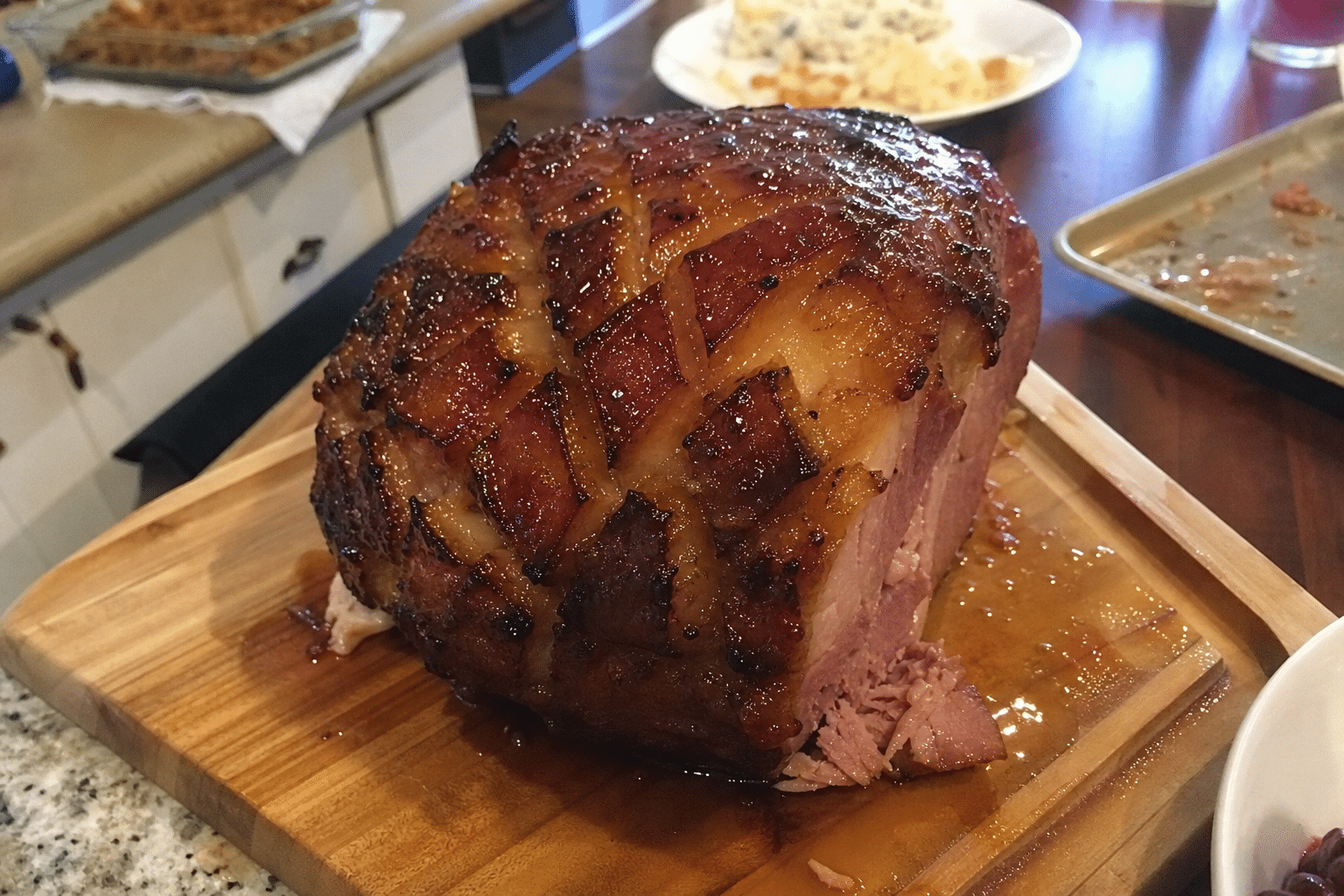

A bone-in ham is one of the most forgiving centerpieces on the Christmas table. It goes in covered, stays moist, and the glaze happens almost on its own in the final hour. The main risk is overcooking the interior while chasing a crust, and this method solves that.
This recipe works for a fully cooked bone-in ham, either spiral-sliced or whole, in the 8-10 pound (3.6-4.5 kg) range. The glaze is built from pantry staples – honey, Dijon mustard, dark brown sugar, and a splash of cider vinegar – and takes five minutes on the stovetop. You brush it on three times in the last hour, then finish under the broiler for a deeply caramelized, lacquered crust.
Why this recipe works
Three things matter here, and everything else is adjustable.
Low, covered heat for most of the cook. Covering the ham tightly with foil and roasting at 325°F (165°C) traps steam. The fat cap insulates the meat further. By the time you pull the foil and start glazing, the interior is already near its target temperature, and you are only building crust.
A glaze thick enough to cling. A thin glaze runs off and pools in the pan. Simmering the honey-mustard mixture for a few minutes concentrates it so it sticks to the surface and builds depth with each basting pass.
A broil finish. The broiler does in three to four minutes what another 20 minutes in the oven cannot. It flashes the sugars in the glaze, bubbling them into a dark, lacquered crust. The window between caramelized and burned is narrow – keep the door cracked and your eyes on the ham.
Read more: Cast-iron skillet cornbread with a crispy crust and tender, buttery crumb
Ingredients
For the ham
- 1 bone-in fully cooked ham, 8-10 lb (3.6-4.5 kg), spiral-sliced or whole
- 1/2 cup (120 ml) water or apple cider, for the pan
For the honey-mustard glaze
- 1/3 cup (110 g) honey
- 3 tablespoons Dijon mustard
- 1/4 cup (55 g) packed dark brown sugar
- 2 tablespoons apple cider vinegar
- 1/2 teaspoon ground cloves
- 1/4 teaspoon freshly ground black pepper
Serves 12-16 as part of a holiday spread.
Instructions
1. Pull the ham out of the refrigerator about 1 hour before roasting. Preheat the oven to 325°F (165°C).
2. If using a whole, unsliced ham, score the fat cap in a crosshatch pattern with a sharp knife – cuts about 1 inch (2.5 cm) apart and 1/4 inch (6 mm) deep. The scoring lets glaze seep into the fat rather than pool on top. Skip this step for a pre-scored or spiral-sliced ham.
3. Set the ham cut-side down in a roasting pan. Pour the water or cider into the bottom of the pan to prevent drippings from scorching. Cover the pan tightly with foil.
4. Roast covered until the ham reaches an internal temperature of around 100-110°F (38-43°C), which for an 8-10 lb bone-in ham takes roughly 1 hour 45 minutes to 2 hours. Check the temperature at the thickest part, well away from the bone.
Read more: Pico de gallo from scratch: the fresh tomato salsa with 15 minutes of prep
5. While the ham roasts, make the glaze: combine honey, Dijon, brown sugar, cider vinegar, cloves, and black pepper in a small saucepan over medium heat. Stir until the sugar dissolves, then simmer 3-4 minutes until the mixture coats the back of a spoon. Set aside off the heat.
6. When the ham hits 100-110°F internally, remove the foil and brush a generous coat of glaze over the entire surface. Return the pan to the oven, uncovered.
7. Continue roasting, brushing with another coat of glaze every 30 minutes, until the internal temperature reads 140°F (60°C) – the USDA minimum for reheating fully cooked hams sold in USDA-inspected packaging. The glaze will darken and turn fragrant with each pass; plan for 30-45 more minutes of uncovered roasting after removing the foil.
8. For the lacquered finish: when the ham reaches 140°F, move the oven rack to the upper third and switch to broil on high. Brush on a final coat of glaze and broil 3-5 minutes, watching continuously, until the surface is bubbling and the edges are deeply caramelized and catching color. Pull the ham the moment any spots threaten to blacken.
9. Rest the ham on a cutting board, loosely tented with foil, for 10-15 minutes before carving. This allows the juices to settle back into the slices.
Read more: The holiday appetizer that always goes first: warm brie with cranberry and honey
Tips and variations
Spiral-sliced vs. whole: Spiral-sliced hams cook faster because the pre-cut surfaces can dry out quickly. Keep them covered and foil-sealed for as long as possible, and do not over-baste or the slices will separate further.
Glaze variations: Swap the cider vinegar for fresh orange juice and add a teaspoon of orange zest. A tablespoon of whole-grain mustard alongside the Dijon adds texture. Ground cinnamon or allspice can replace the cloves.
Make-ahead: The glaze keeps refrigerated for up to 3 days in a jar. Warm it gently before brushing – cold glaze will not coat evenly.
Storing leftovers: Keep carved ham in an airtight container in the refrigerator for up to 4 days. If you are reheating leftover ham (already carved and stored), the USDA target rises to 165°F (73.9°C), not 140°F, since it is no longer in its original USDA-inspected packaging.
Fresh or raw ham: If you are working with an uncooked fresh ham rather than a fully cooked one, cook it to a minimum internal temperature of 145°F (62.8°C) and allow it to rest at least 3 minutes before carving, per USDA FSIS guidance.