
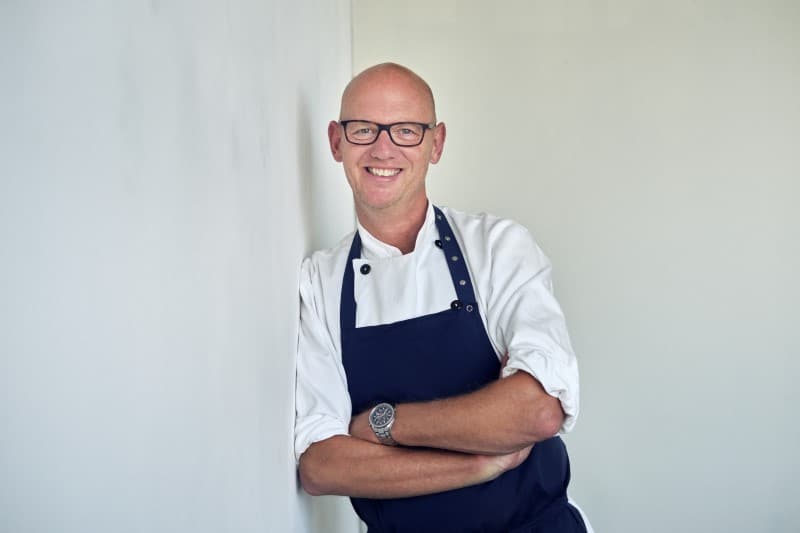

Food Nerd Rasmus Bredahl
Food nerd. That’s the first word that comes to Rasmus Bredahl’s mind when he has to describe himself.
He is a trained chef – among other places, from Philippe in Copenhagen – but the interest in taste and senses has always been there. So has the interest in how the brain behaves when it comes to food and taste, and what it wants – what you can call neurogastronomy.
“I have a huge passion for food and taste, and I have the opportunity to combine it with my profession. In recent years, I’ve tried to shift the food perspective to a kind of meta-level, like what is taste, what are senses, and what can we use them for,” he says.
Rasmus Bredahl is co-author of a book on neurogastronomy. The first of its kind in Danish.
“I also think it’s the first book in the world that tries to bring neurogastronomy down to a level that’s a bit more understandable and explanatory for everyone,” says Rasmus Bredahl.
His goal is to spread food joy and neurogastronomy to everyone, and his mantra is that everyone can join in. Today, he also works as a speaker, author, and food stylist, among other things.
We Ask – Rasmus Answers
Learn more about Rasmus Bredahl and find out which cuisine is his favorite below.
Education?
I graduated as a chef in 1992. First, I apprenticed at Restaurant Philippe, which was one of the first really good restaurants with food from the French country kitchen. At that time – in the late ’80s and early ’90s – there were very few good restaurants. In all of Scandinavia, there were four Michelin restaurants at that time, and they each had one star. So I was lucky to get into a good French restaurant where I learned French cuisine from scratch.
After that, I apprenticed at the royal shooting range Sølyst in Klampenborg. It was something completely different – just the clientele, as it was, among others, the Queen who came to dine. But it was also a great experience where I learned a lot.
Why did you become a chef?
I’ve always had something with taste. Ever since I was a little child, I’ve experimented with taste and what it could do. In my childhood, it was popular to make eggnog – that is, eggs whisked with sugar – when we craved something sweet because money was tight. While the other kids settled for that, I added flavor. Lemon, my father’s whiskey, that kind of thing. I could feel something happening in my mouth. The taste changed.
So with that sense for food and taste, it was also natural for me. I started my apprenticeship on my 18th birthday and qualified as a chef at 22. It might have been a bit early, but it was just right. At 25, I became the head chef at restaurant Brøchner.
Why and when did you start to get interested in neurogastronomy?
The last 15-20 years, it’s something I’ve been very interested in and worked with, but as I said, I’ve always been very interested in tastes specifically. I’ve always thought of tastes as Lego bricks that needed to be put together. When I was an apprentice, it was something that divided opinions. People thought it was something strange to combine sour, salty, and sweet in the same meal, but I’ve always had an understanding for that – and a desire to engage with it.
What is your best memory from the kitchen?
Back in the 1990s, Philippe was one of the slightly more hip restaurants. It had both good food and was smart – which certainly wasn’t true for all restaurants at that time. The feeling of walking through that restaurant as a completely young person, a young culinary student. There was a smell from the kitchen, happy voices from the guests, you could hear the waiters buzzing and the wine bottles clinking.
I’ve always been very interested in both the food and the space. For me, it’s a synergy. So I can remember walking through the restaurant, feeling the excitement for food from all sides and thinking “this – this is the epitome of being in the restaurant business”.
What dish do you like to make the most?
Something I really like is the French classics like boeuf bourguignon or bouillabaisse.
In my youth, I always thought there must be something more out there than my parents’ kitchen. It was in the 1980s when knowledge about food wasn’t that great here, they perhaps had a middle-class income, and it was solid Danish food. Then I apprenticed at Philippe, which has a French kitchen, and it was really an eye-opener for me. Therefore, those quintessential French classics are like mother’s milk to me. It’s pure deliciousness.
What is your show-off dish?
In my cookbook “Neurogastronomi” I had to come up with a dish that defined neurogastronomy. The idea of neurogastronomy is to find out how the brain tastes and what it wants – and to pull people a little out of their comfort zone. When you ask people, for example, who’ve been to a good restaurant and had 13 dishes which dish they would highlight, it’s rarely the tastiest one but the one where they’ve had an aha experience and maybe been a bit provoked.
It was with this mindset that I developed the dish – a dessert burger. It looks like a burger but is a dessert. For example, the beef is a brownie, the lettuce is mint leaves, and the dressing is lemon cream.
I’ve made it for many different events since. Among others, for the entire McDonald’s management at a seminar where they got it in real burger boxes. It’s surprising but delicious, and I think it’s really fun.
What dish do you make most often in your own kitchen?
I have two teenage boys, so we make a lot of burgers at home. It’s a good way to get something into them when they come home from swimming or football, and you can customize a burger as you like.
A burger is eaten with fingers, and therefore it’s a perfect, sensory, and tactile experience. I like that too.
Do you have a favorite cuisine?
The French – it’s a bit like my heart’s child, you could say, and where I was trained.
But in recent years, I’ve developed a great love for Indian cuisine. I’ve started eating more vegetables and less meat, and Indian cuisine has something with vegetables, umami, and stews. I think there’s so much taste in Indian cuisine, and it’s probably the kitchen where it’s easiest to do without meat without missing it.
What is your favorite dish?
A good French classic. It could be a good crème brûlée or a really good bouillabaisse. I also like steak bearnaise with homemade fries.
Do you have a favorite restaurant?
The best food I’ve had in informal settings is at Ticket in Barcelona. They have a pretty wild fairground/circus theme, and then they have, for example, an entire area for desserts. It’s a corner of the restaurant that’s set up really wildly. Besides getting some mind-blowing desserts, it’s just a wacky experience. It’s pure Salvador Dali meets functionalism.
I’m also really fond of the Michelin restaurant Etxebarri, located in the Basque Country. It’s also in the top 10 in the world. Their kitchen is without electricity, and all food is prepared over an open fire. It’s amazing what they can achieve with that. It was also the warmest restaurant experience ever.
Do you have a guilty pleasure?
I’m crazy about eating dark chocolate after dinner. I have to hide it from my sons because they devour it – and they always find it.
Which type of knife do you use the most?
At one point, I was an ambassador for knives from the brand Yaxell, and I’ve used them ever since. They are fantastic. I hate having bad tools. Especially my knives have to be just right.
Which machine(s) is your favorite(s)?
I’m an analog chef, so I’m not super familiar with big machines. So my favorite “machine” is probably knives. They are one of the most important things for a chef. It’s fundamental for a chef to be able to do their craft. To be able to use a knife. They are indispensable in a kitchen. The foundation – the ability to use a knife – has to be there.
If you could only have a few pieces of equipment to cook with, what would they be?
A knife and a stove. And then I really like all food that is cooked over an open fire or something that comes as close as possible – so also a good grill or grill pan.
Fact Box
Name: Rasmus Bredahl
Age: 40 years
Region: Zealand
Founded in 2005 Madkonsulenten, where he, among other things, creates recipes, food styling, events, and product development. Rasmus Bredahl is also co-author of the book Neurogastronomi. In the book, you will learn, among other things, how the brain controls your desire for food, your hunger, and what you experience when you eat.
Find Rasmus Bredahl on Instagram at @madkonsulenten.
Photo at the top taken by Tuala Hjarnø.