
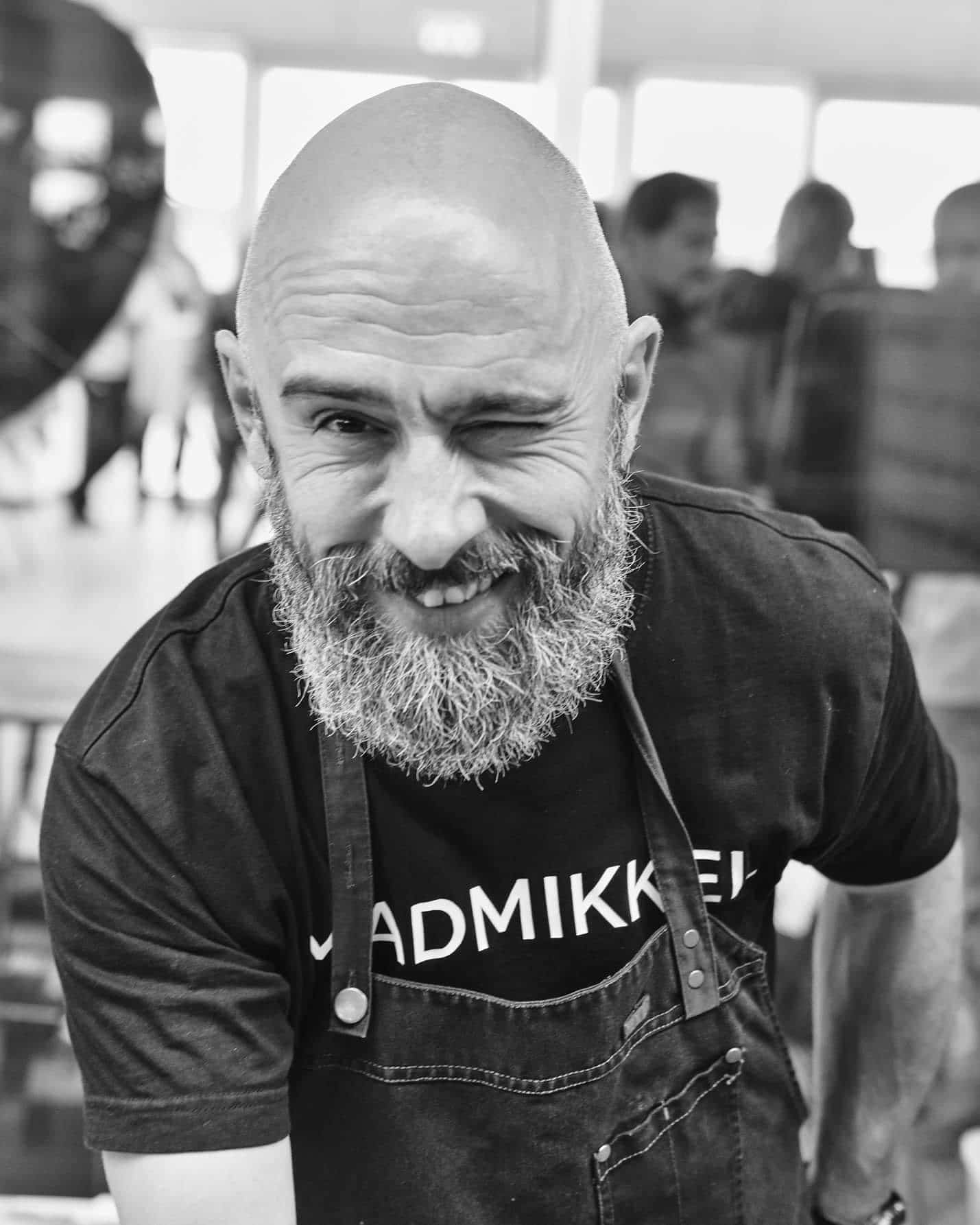

Madmikkel makes a living by sharing the joy of food
Mikkel Wejdemann – also known as MadMikkel – makes a living by infecting others with his passion; namely culinary curiosity. Originally trained as a teacher, he can combine that knowledge with his current role as a gastronomic consultant on various food projects worldwide, which also includes workshops, project management, and educational programs.
Choosing this path wasn’t something Mikkel Wejdemann had necessarily envisioned when he started at the teacher’s college. However, his love for food has always been there.
“I have the classic story of sitting on the kitchen counter watching my father cook. I was actually a picky child, but during teacher training, I realized that I could cook and combine things to make them taste good,” he says.
In the early years, he taught home economics and later worked at a boarding school where he developed and launched a gastronomy program.
“I enjoyed teaching young people a lot about food and getting them to try things they initially said they didn’t like. It’s fantastic to be able to change people’s eating habits,” says Mikkel Wejdemann.
A collaboration with Coop and a long cycling trip from Aarhus to Antarctica made it clear to him that he should no longer be a teacher, but instead start his own business and work on conveying the joy of food to others.
“I love inspiring and motivating people to make more and better food. I can infect and inspire people with my passion for food, and I think that’s super cool,” he explains.
One of the most important things for Mikkel Wejdemann is to eat produce when it’s in season because that’s when it tastes best.
“I personally eat very seasonally, and that’s what I try to pass on. When I work on changing people’s eating habits, the most important thing is that it tastes good – good taste should be the catalyst. Therefore, we should serve things when they taste best. And they do when they’re in season,” he says.
Besides his love for food and making a living from sharing that joy, Mikkel is an adventurer and has visited more than 50 countries. This way, he expands his cooking repertoire, and his travels have brought him a great deal of culinary experiences.
“I like visiting both local markets and street food stalls, and I find it cool that one day I can cook with a family in a remote mountain village, and the next day visit one of the world’s best restaurants. I generally love the contrasts in everyday life and food,” says Mikkel Wejdemann.
We ask – Mikkel answers
We’ve asked Mikkel Wejdemann a series of questions so you can get to know him better. You can find out, for example, what his favorite ingredient is and why it’s important to let go of recipes and instead have a playful approach to cooking.
What is your education, and what is your path to what you do today?
I’m originally trained as a teacher. The path to what I do today has been winding. I’ve always enjoyed conveying information, which is why I became a teacher. At the college, I had a teacher who was one of the country’s top food critics at the time – Helle Brønnum Carlsen. We connected well, and she introduced me to the entire universe surrounding cooking. I was hooked! At the same time, I discovered that I could influence young people, teach them about ingredients, and perhaps get them to try things they otherwise wouldn’t. Later, I got the chance to teach home economics and also taught a gastronomy course at a boarding school.
I’ve always traveled a lot in my free time, so at some point, I took a leave of absence and embarked on an adventure, cycling from Aarhus to Antarctica. You could call it a wild, gastronomic bike ride. In that context, I started a food project with Coop, where I was sent out into the world to explore and cook in various parts of the world. It was on that trip that I realized I shouldn’t be a teacher anymore. I needed to go “all in” on food. So I quit my job and have since worked as a consultant, helping to develop food projects, educational courses, and much more – hopefully inspiring as many people as possible to move towards a more flavorful and sustainable direction.
What is your best kitchen memory?
I clearly remember the first time I was invited to participate in the competition “Chef of the Year.” I was still relatively new to the culinary field, and there I was, standing between Michel Michaud and Francis Cardenau, who are some of my biggest idols. It was quite surreal to stand there – next to them – in a cooking competition, and I managed to bring home a prize.
But I also have a wealth of great memories from my travels. Cooking on a mountainside with a hermit in Mexico, being in India or Tanzania cooking with various local families, experiencing their traditions and recipes.
I’m incredibly lucky and privileged, constantly immersed in amazing culinary experiences, and it creates many good memories, so it’s hard for me to choose just one.
What dish do you like to make the most?
It varies by season. I love cooking seafood, but I also love working magic with seasonal ingredients and creating something delicious.
Right now, I’m eagerly waiting for lumpfish roe to become more affordable. It’s a delicacy. Then come the asparagus, then the strawberries, and then the cabbages.
I enjoy food made with seasonal ingredients, using what you can get. For me, it’s also about sustainability because there’s no reason to “waste” more than necessary. I live in Aarhus, and I often go to the market on Ingerslevs Boulevard to get inspired by what I can find. I think the unpredictability of cooking is exciting.
What is your show-off dish?
Anything with oysters. Many people have a love/hate relationship with oysters. Either they find it a slimy blob, or they think it’s fantastic.
I like having guests who don’t usually favor oysters and then giving them an experience that makes them want more afterward. I think it’s cool to convert people with your cooking.
What do you dislike in the kitchen?
My professional work involves including people in the kitchen and getting them started. I don’t do that much at home because I actually rarely have much time in my own kitchen. So when I’m there, I just want to geek out myself. I don’t need help at home; I just want to dive into the food on my own.
What dish do you make most often in your own kitchen?
Right now, it’s everything with blue mussels. I’m working on a major project where we’re trying to get Danes to eat more blue mussels, so I’ve had to develop 40 recipes with blue mussels for a cookbook that’s coming out soon. So I’ve been making a lot of that lately!
As a result, I’ve also eaten a lot of blue mussels recently, but I still think they taste great. I haven’t gotten tired of them.
I believe blue mussels are brilliant, and they have so much potential. They’re the most sustainable ingredient, only surpassed by tap water. So given the climate challenges we face, they’re also fantastic.
Do you have a favorite cuisine?
All food from Northern Spain – the Basque Country and Galicia. They have some of the world’s best seafood. Their cooking is generally quite simple, but they’re incredibly skilled at packing lots of flavor and richness into all their dishes.
What is your favorite dish?
The season determines my favorite dish, but as you can hear, I’m always very oriented toward the sea.
A serving of fjord shrimp with the first white asparagus is fantastic. I also love fresh, Danish strawberries and lumpfish roe when it’s in season. I like that you can look forward to a new ingredient when the season changes.
What is your favorite ingredient?
I don’t have a favorite ingredient, but I have a “favorite supermarket” – it’s everything that comes from the sea; fish, seaweed, oysters, blue mussels, that kind of stuff. If it can be pulled from the sea, I find it fun to play with.
One or more things you always keep in the fridge?
Butter and onions. Very basic, but you can make good things with them. And garlic, mushrooms, and lemon. With those, you can do just about anything.
The best restaurant experience you’ve ever had?
Apart from my own gastro travels, I’ve been a freelance food writer and critic, so I’ve traveled and eaten a lot. Therefore, it’s really hard to choose.
The last truly great experience I had was at Lyst in Vejle. Daniel McBurnie has created an amazing place, the food tastes wonderful, the wine was exceptional, and both the surroundings and service were top-notch. It was overall a super good experience.
Do you have a favorite restaurant?
DiverXO in Madrid, which is a three-star Michelin restaurant. The food is insanely good, and the entire universe is creative and playful.
I can also highly recommend Rasmus Munk’s Alchemist here in Denmark. It’s off the charts in a wild way. The whole experience is a complete narrative, and I’m a huge fan of that.
Koks in the Faroe Islands could easily be on the list as well.
What type of knife do you use the most?
I mostly use my small chef’s knife from Japanese Yaxell.
A knife should be an extension of my arm. It should be razor-sharp and stay sharp. When cutting, it should go quickly and smoothly. The knife should be one you can hold for a long time. Yaxell meets those requirements.
What is your favorite machine?
My immersion blender. I like that you can make purée, mash, sauce, and everything in between with it. I use it a lot at home.
What kitchen appliance do you have a strained relationship with?
Recently, I was helping Gorm Wisweh with a new cookbook about sauces. We were working with a Thermomix, and I know it’s genius, but the particular machine I was using, I developed a strained relationship with. Gorm was significantly happier with his Thermomix than I was.
If you could only have 6 pieces of equipment to cook with, what would they be?
My knife, a cutting board, a good cast iron pan and pot, and my immersion blender. I don’t need more because then I can make just about anything.
A piece of advice for people who want to start cooking?
We should play more in the kitchen. I want people to break free from their recipes a bit. Start with what you like, get a grip on your basic flavors, and taste along the way. If your food lacks acidity, you know it can come from lemon or vinegar, for example. If it lacks sweetness, it can come from sugar or honey, for example.
Try to experiment a bit and find out what you can do. The worst that can happen is that you have to redo it – and that’s actually not that bad.
Facts
Name: Mikkel Wejdemann
Age: 42 years
City: Aarhus
Mikkel Wejdemann runs “Madmikkel,” where he performs consulting work, gives lectures, and develops ideas – all centered around food and gastronomy.
Find and read more about Mikkel on his website madmikkel.dk and on Instagram under @mad.mikkel.