
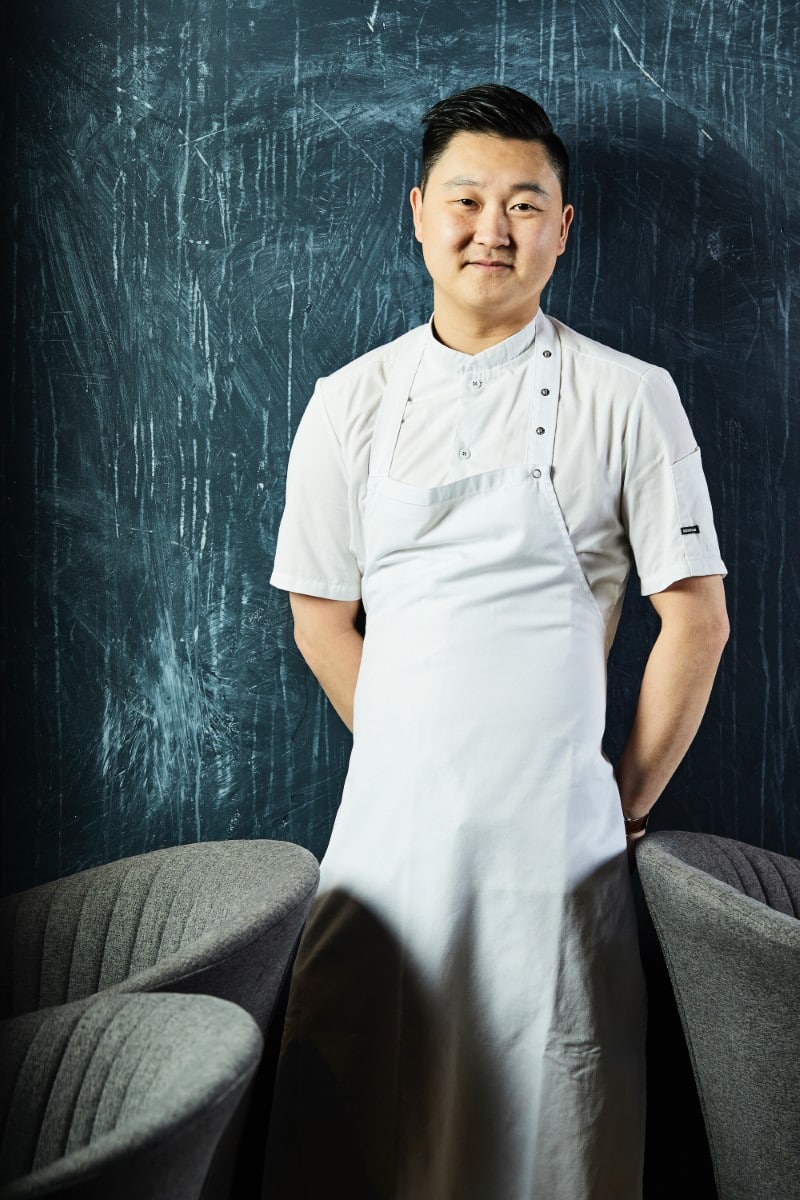

Good Culinary Experiences Should Be Accessible to Everyone
Dennis Juhl is a master chef, with a touch of North Jutland humor and down-to-earthness. His talent is wide-ranging, and his journey has taken him far and wide, but also back to North Jutland, where he comes from. Here, he has successfully run the restaurants ‘Textur‘ and ‘Struktur‘ with his partner Frederik Østeraa, both based on the concept that everyone should afford a good experience.
“The whole concept around ‘Textur’ is to create a setting where you can get high-quality dishes, but where the pricing still allows room for pensioners and students, so they can visit the restaurant several times a year. We prefer to have the same guests visit multiple times, which is why the menu changes often, so they still get something new each time they come. It obviously also brought a lot of success initially, and our menu continues to be nominated for ‘Dish of the Year’. So, we create food at a high gastronomic level, but at a price point where everyone can be part of the experience,” he says.
Despite the good intentions, over time he felt he missed a place that could accommodate more and a variety of experiences for different types of people.
“We opened ‘Struktur’ because I could feel that I started missing the finer part of dining experiences, like exclusive ingredients and expensive wines. At that time, there wasn’t a place like that in Aalborg, where you could both come in to eat but also just get a cocktail at the bar. So, I began to miss a place that embraced all those things, and I was inspired by a place in New York called ‘Balthazar‘. So, to create a universe where you can get everything from cheap to expensive dishes, and the same with wines. That way there’s room for everyone, creating a unique dynamic in the room where a big CEO can sit next to a student. So, there should be room for all aspects,” he explains.
Dennis describes his path to the culinary profession as natural for him. There has always been a drive in him to create something with craftsmanship.
“I have always wanted to be a chef, and I’ve always known that was the path for me. Even at a primary school level, it’s always been what I wanted. So, it also came very naturally to me, all the way from childhood. I started as a dishwasher when I was 13 at ‘Hotel Nibe’, and later worked as a kitchen assistant. So, I got a taste of the industry early on. In school, I wasn’t particularly strong linguistically – as I am dyslexic. So, it was also natural for me to choose a craft path rather than a high school path,” he shares.
He graduated in 2009 from ‘Ruths Hotel‘, but during his education, he was in many different places. When he started his culinary education, he received good advice to try out different styles within the culinary arts. Therefore, he also made an agreement with the places he interned at that he would only be there for one year at a time.
“I’ve been at everything from classic Italian restaurants to an inn and a hotel, simply to get a feel for what this industry was all about. In my free time, I worked for free at newly opened fine-dining restaurants. So, I’ve always had a plan for my education,” he shares.
His approach to the field has also taken him far and wide, including working for the award-winning chef Michel Michaud at ‘Ruths hotel’, and he has a clear memory of his time with him.
“It was fantastic, and he is absolutely one of the most passionate people I’ve worked with. Therefore, his food is expressed in many ways, because when you’re so passionate, cooking becomes an ideology. Everything had to be new all the time, and everything had to be made entirely from scratch, even though it was classic French cooking,” he says.
Even though Dennis’s CV boasts impressive achievements, it was still North Jutland that drew him back, and there’s a special reason for that.
“After being in the fine-dining and competition environment – where all ingredients were always very exclusive – I felt I missed creating something more down-to-earth with the ingredients. It was to prove to myself that I could do more than just the exclusive stuff. So, I needed to show that I could also use the crooked asparagus or the cheap fish. The ingredients are still fresh and of good quality, but for me, it was about thinking outside the box in my cooking. For example, how to use coffee grounds and potato peels in cooking. All to challenge myself on the more creative and technical side. I also find great satisfaction in making the odd look successful,” he shares.
He is not the type to brag or describe himself in grand terms. Instead, he lets the food and the experience speak for themselves. Despite this, his creative mind is always at work, and he is ready with a future project.
“We are opening a Deli and wine bar in Hasseris called ‘La Tour,’ which is something I have missed greatly in Aalborg. The concept is that you can come in and taste various dishes, and if there’s something special about the dish you really liked, you can buy the ingredients to take home. That could be tapenade, sauces, or other things that were part of the dish you ate. Everything you can eat in the shop, you can also buy to take home, which should help inspire people in their own kitchens. Additionally, the place will have ready meals, which will be good slow-cooked dishes, and it will function as take-away,” he shares.
In his younger years, he dreamed of a Michelin star, but as the years have gone by, he has opened his eyes to other things. He might consider opening a fine-dining restaurant in Aalborg at some point, but for him, the most important thing is to have himself involved on a whole human level.
We Ask – Dennis Answers
Get to know Dennis better when we ask the brave North Jutlander a series of personal questions. You can, among other things, learn about his best kitchen memory or why dry-aged meat is better than other meats.
What is your best memory from the kitchen?
I have a lot of good memories in the kitchen, but the best experiences I have are with the team in the restaurant. Spending so much time together, experiencing both ups and downs, helps us bond really well. It’s one of the great things in our industry because you develop very close friendships.
Which dish do you like to cook the most?
It must be everything good from the sea; I truly enjoy it. Otherwise, cooking for me is very mood-driven, so there isn’t a specific dish. If, for example, it’s raining or gray outside, I might feel a strong urge for slow-cooked meals.
What is your nemesis?
Normally I’m crazy about all kinds of offal, but pork liver I’ve never had in a dish where I thought it was good, unless it was in liver pâté. So, as a purely fried protein, it has never caught me.
Do you have a favorite cuisine?
I love using French cooking methods and the approaches that cuisine offers, but Nordic ingredients come more naturally to me. However, having worked in an Italian restaurant, I’ve also found joy in Italian cuisine and their wines, just as I did when working at an inn where I found joy in that type of food. So, I’ve always been inspired by the places I’ve worked and what the different cuisines have to offer. I let myself be inspired by all the world’s cuisines, but always with a Danish anchor in the use of ingredients.
What is your favorite ingredient?
Everything from the sea! No matter what it is, I just think it has a wide range of flavors and can taste absolutely amazing. At the same time, it can be prepared in so many different ways, encompassing many taste aspects.
What does dry-aged meat mean to you?
It depends on what type of meat it is, so if you have a steak that has been aged for 12 weeks, I wouldn’t recommend cooking it medium-rare. The flavor and characteristics of the meat are very influenced by what ingredient it is and how long it has been aged. You should always consider what the meat can withstand, so, for example, a rib-eye that has only been aged for a few weeks tastes best when cooked with lots of herbs like thyme and butter. But a really good piece of kobe beef should be seared very hard, but without adding anything. Here, the fat from the meat should have room to work into the flavor so that it doesn’t taste like anything else.
Where and when were you last impressed?
I often get impressed when I go out to eat, but it’s often very varied. However, there are some dishes that are more defining than others, creating some memories. One of those times was when I first went to ‘Noma‘, I had a dish that was absolutely fantastic. It was a dish that did something special for me, but in that way, there are many dining experiences that have been more unique than others. For example, also ‘Geranium’s hake or the dishes I’ve tasted by Ronnie Emborg when he was at ‘AOC‘ and in New York.
Do you have a favorite restaurant?
I don’t have a fixed favorite restaurant, but the places where I’ve had the best experiences are at ‘Geranium’ and ‘Atera‘ in New York. They have just managed to create a very special universe and thus also an extraordinary dining experience. Not just taste-wise, but also with excellent service from the staff.
Do you have a guilty pleasure?
Not really, but I can easily eat a good greasy burger when I have a hangover, for it just works, and it’s about the right food at the right time.
Which type of knife do you use the most?
I have two knives that I use most often. One is an 18cm universal chef’s knife that I’ve had since 2007. The other is a small 15cm utility knife. These are absolutely the knives I use the most.
What brand are your knives?
I don’t have a particular knife brand I rely on, but I’m not the biggest guy, so I like small and light knives that fit my hands. For example, the handle shouldn’t be too large, and my knife set spans over 8 different brands, all of which do something special for me. So, it’s also very varied and has to suit the work I’m doing, but I often use knives with thin blades.
Which kitchen appliance do you have a strained relationship with?
There are probably quite a few, but there are especially some appliances I have an ambivalent relationship with. For example, a ‘Roner’, which is a temperature-controlled water bath. I think it’s a really good tool, but it’s just misused. Many put everything into it, and it’s far from everything that benefits from being in that machine. Not all types of meat are suitable for this cooking method, but for example, a short rib can be really good to put in a ‘Roner’.
Can you name the three most important techniques chefs use that others can benefit from in their own kitchens?
One should master their basic craft and cooking methods, which I think is lacking today. If you fry a steak, it should have the same quality whether it’s one or 30 you’re frying; it should end with the same result. The same applies to making the right cuts of fish or game. You should have a good knowledge of that before venturing into cooking with it. You need to get closer to your ingredients.
Is there something people almost always do wrong in the kitchen that you think should be improved?
People should probably become better at using their senses instead of following the norm slavishly. It’s also about seasoning, even though we all taste differently. You should use your basic cooking methods and feel, taste, and smell your way forward because dishes need constant attention. Therefore, you can go far if you know the most basic things and then work from there.
Fact Box
Name: Dennis Juhl
Age: 33
Residence: Nibe
Job: Restaurateur and Chef
Company: Textur, Struktur, and La Tour.
You can follow Dennis and his work on Instagram under @dennis.juhl., as well as the restaurant ‘Textur and ‘Struktur’ on @restauranttextur and @restaurantstruktur.
/Photo:/ Jesper Rais