
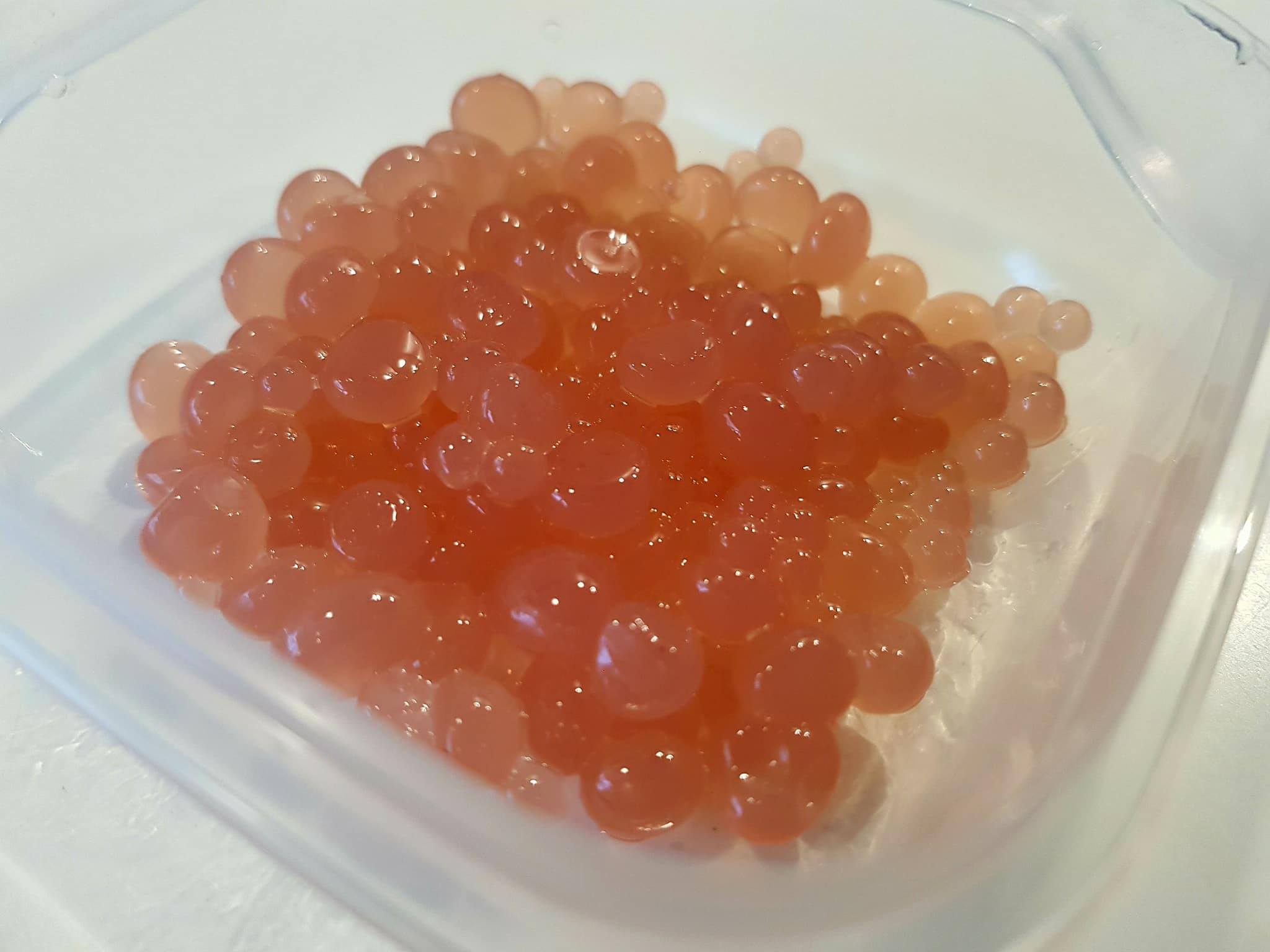

There are two methods for making caviar.
The method we will discuss here is also called “fruit pearls,” as fruit juice is typically used to create small, firm pearls.
If you want to make pearls with a liquid center that “pops” in the mouth when chewed, then see our section on direct spherification here.
Here we focus on caviar made with fruit juice, oil, and agar agar, i.e., the aforementioned “fruit pearls”.
To get started, you will need the following:
• agar agar (can be purchased, for example, here)
• Neutral cooking oil, such as grape seed oil
• Pipette
• 1 bowl with a cylindrical container
• Sieve
• Flavorful liquid, such as fruit juice.
Follow this guide for fruit pearls/caviar:
1) Ice Cold Oil
Start by pouring oil into a bowl and placing it in the freezer. It should remain there for at least 30 minutes, but preferably longer.
The colder the liquid, the easier it is to create the pearls.
2) Agar Agar Mixture
Add agar agar to your fruit juice/flavored liquid. The dosage is between 2–10 grams/kg of liquid. We recommend using between 7-10 grams/kg of liquid when making pearls.
Take your agar agar and soak it in the liquid. It should sit there for about 10 minutes. After this, bring the liquid to a boil.
Heat the liquid to between 95-100 degrees Celsius with constant stirring. This should be done until all the agar agar is dissolved.
Remove the pot from the heat.
3) Create the Caviar/Fruit Pearls
Let your liquid cool to between 50-55 degrees Celsius.
Be careful not to let the liquid get any cooler, as the agar agar will solidify when the temperature is between 40-45 degrees Celsius.
Carefully draw the liquid up into a pipette (be careful, it’s hot!).
Then gently drip the liquid into the cold oil – this should be done carefully.
Since oil and water do not mix, a type of “pearl” will now form.
The cold oil causes the agar agar to solidify quickly, which means that the caviar collects at the bottom of the oil bath as small pearls.
4) Rinsing
Fill a bowl with tap water.
When you have the amount of caviar you desire, you can pour them into a sieve and rinse them with water from the tap. This should be done gently. In this way, the oil is washed off the pearls.
Let the pearls drain, and they are ready to serve.
For example, see this video where fruit caviar is made or this recipe where they are used.