
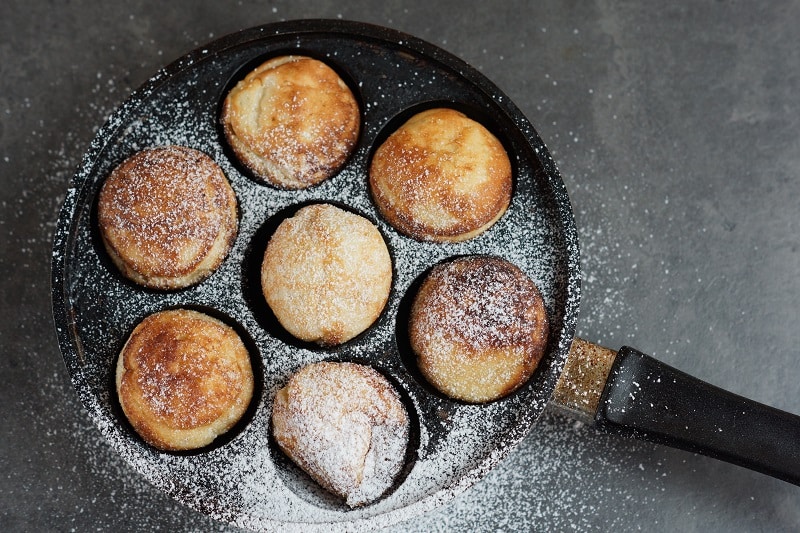

At this time of the year, it is impossible to avoid æbleskiver, but why are they actually called æbleskiver? They are not served in slices, and in a frozen bag from the supermarket, you have to look unusually long to find apples. But it has not always been like this. The æbleskiver have a very long history, and in that history, you find both apples and slices.
From ancient times to today
It is difficult to pinpoint the exact year when the æbleskive was invented, so they might have existed since ancient times, but at least we know that they existed in the Middle Ages. Back then, the æbleskiver were precisely that – slices of apples. The slices were dipped in batter and fried. It was a delicacy served as a dessert on festive occasions, and in the 1800s, it was very common for the farmhands and maids on the farms to receive a certain number of æbleskiver to eat during Christmas.
It was only during the Renaissance that the æbleskive pan with the hemisphere-shaped holes gained popularity, and the æbleskive became round. However, it still contained apples, often in small chunks or as a puree. After the industrialization, the apple content began to disappear, and the æbleskive as we know it today was born.
Modern, homemade æbleskiver
Apart from no apples, a typical æbleskive today contains wheat flour, eggs, and buttermilk with a little sugar, salt, and baking soda.
It’s an easy batter to make, but it can require a bit of practice to get them baked. In a ceramic pan, you need to fill the holes 2/3 full and let them bake until the edge is golden brown, after which you should use something like a knitting needle to turn the slices so that the center batter, which is still unbaked, runs down and forms the last part of the round shape. Therefore, it is important that the edge becomes golden brown before the batter is fully baked, so temperature and timing must be just right. For some, it might be easier with an electric æbleskive pan, but it is largely a matter of taste what works best. But æbleskiver, like so many other things, taste better when they are homemade, and when you make æbleskiver at home, you even have the opportunity to put apples in the batter.
You might be hesitant about investing in an æbleskive pan that you only use once a year. But æbleskive pans can also be used for things like egg muffins, round meatballs, or rösti. It is only your imagination that sets the limits.
Æbleskiver recipes
Homemade æbleskiver with buttermilk