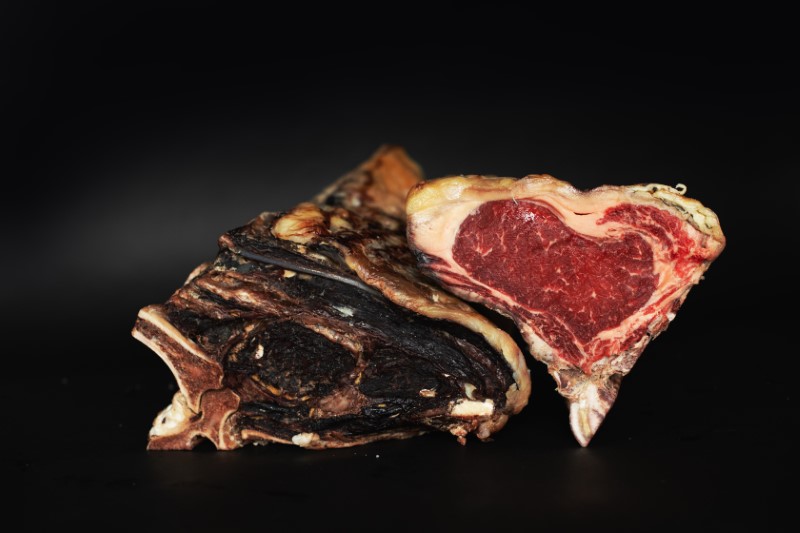
First, we will provide a brief overview of why you might want to age (dry aging) your meat:
Fundamentally, there are specific goals that all contribute to enhancing the taste or texture of the meat.
Moisture Loss:
Moisture loss is a very important factor. A dry-aged beef steak can lose up to about 30 percent of its original volume in water loss, which concentrates the flavor.
That’s the theory – but is it true?
Tenderness occurs when enzymes naturally present in meat break down some of the tougher muscle fibers and connective tissue. A good piece of dry-aged steak should be noticeably more tender than a fresh steak. But is it?
The flavor change is due to many different processes, including enzymatic and bacterial, along with the oxidation of fat and other fat-like molecules. Properly dry-aged meat will develop deep umami, nutty, and almost cheese-like aromas.
But is dry-aged meat really better than fresh meat?
It is and remains a matter of taste. However, we have never had guests who have eaten dry-aged beef, pork, or lamb that did not highlight the meat’s delicious and intense flavor.
If we have now convinced you that dry-aging is better. Why should you do it at home yourself, when the meat can be ordered online or from my butcher?
Two reasons:
– The first (and most important reason) is bragging rights. You can sit at a dinner party and tell the process from start to finish while enjoying an excellent piece of meat.
– The second reason is cost savings. Even substantial savings. Aged meat takes up space at the butcher, and it takes time before they can sell it and get their money. This cost is passed on to the consumer. Aged meat can cost anywhere from 30-100% more than a comparable piece of fresh meat. As long as you are willing to give up a corner of your refrigerator or you have an extra refrigerator (or a maturation cabinet), your extra costs are minimal.
You may have read that in addition to the time and space requirements, a large part of the cost of dry-aging meat is the waste factor of the amount of meat, both in the form of smaller steaks (moisture loss) as well as trimmings that need to be trimmed off. This is not as big a factor as one might think, and the reasons will come later in the article.
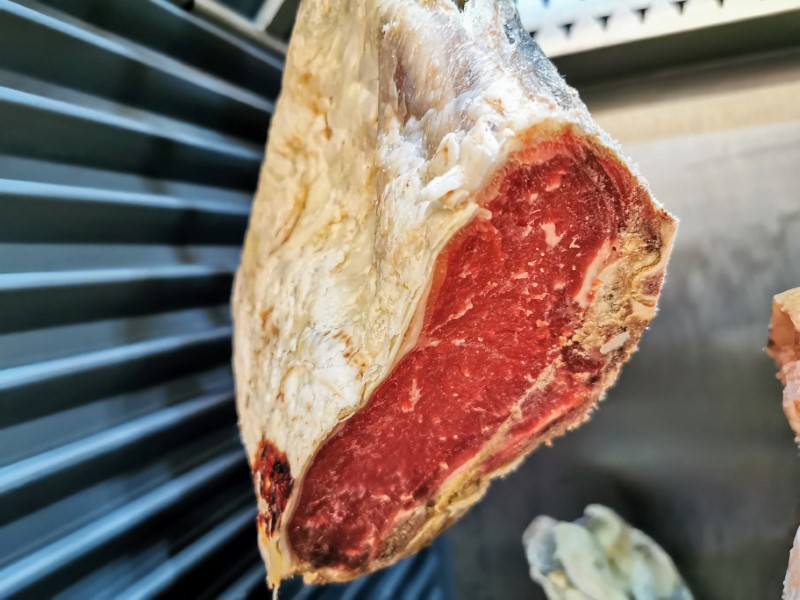
Choosing meat for dry-aging.
What meat should I choose for dry-aging?
The most important aspect of being able to properly dry-age the meat is that the piece is large. For example, a porterhouse, a whole sirloin, or rib or marbled beef tenderloin are ideal cuts to age yourself.
Can I age an individual steak?
No, you cannot age an individual steak. The dried layer that needs to be trimmed is too large and “eats” almost the entire steak.
What is the minimum size I need to buy for proper dry-aging?
Think in cuts of at least 1.5 kg, ideally, they should be over 2.5 kg. Keep the bones and tendons on the cuts, so they dry out while adding flavor to the meat. What is trimmed off is world-class for stocks and sauces, such as this here.
” data-entity-type=”file” data-entity-uuid=”89244b7b-feed-4480-9e18-5e6023e87c63″ src=”/wp-content/uploads/inline-images/Dry-aged%20marmoreret%20oksefilet%20-%20for%20lille.jpg” />
What causes the taste to change?
A few things. The first is the enzymatic breakdown of muscle proteins into shorter fragments, which changes their taste in desirable ways. But this effect is completely secondary to the far more important change that occurs when fat is exposed to oxygen. It is the oxidation of fat, along with bacterial action on the meat’s surface, that causes the deepest taste change you get in meat aged for more than 30 days.
It is true that much of this taste change is concentrated on the outer parts of the meat—the parts that largely need to be trimmed away—and for this reason, if you want to get the most out of your aged meat, it is very important to ensure that the fat cap by the bone is still there. Unlike the fat cap on the trimmings that are removed and discarded, the meat that lay next to the bones will still have a lot of oxidized fat and intensely umami-tasting meat. When the aromas from this area of the aged meat reach your nose, it will change your entire dining experience. If you love the taste of aged steak, then the outer areas of, for example, a rib-eye steak will be the best possible taste experience.