


Christmas time and cookie baking are two things that go hand in hand for many people. While many of us regularly bake cakes like traybakes, cookies are something that many bake mostly during Christmas. This is probably because there are a multitude of traditions attached to the classic cookies that over the years have become so associated with Christmas that it’s hard to change. How many of us would think of baking and serving ginger cookies in March or making “klejner” in July? Probably not many, and although these types of cookies are known and loved by most Danes, there are some very specific rules for when during the year we eat them.
Should there be one or more types of cookies in the cookie tins? And should they be the same type year after year, or do you like to try new variants? There are many opinions and views on Christmas baking, and nothing is by definition more correct than another. For there are as many traditions associated with Christmas baking as there are families, and what may sound strange to one person can be just as obvious to another.
The History of Christmas Cookies
Regarding the origin of Christmas cookies, the history goes far back. We have to go back the longest when it comes to “klejner” and “pebernødder.” These two types of cookies belong to the time before it became common to have stoves in private homes. Back then, all daily meals were prepared at an open hearth, where you could, for example, cook soup and porridge in pots and fry meat on a pan or spit. Baking was immediately more difficult, as the lack of a proper oven greatly limited what could be made. Larger breads, such as rye bread, could be baked directly on the hearth, but it was difficult to control the temperature, and the crust of the bread often became very hard. At the same time, it required large amounts of firewood to heat the hearth for bread baking, so this was only done about once a month.
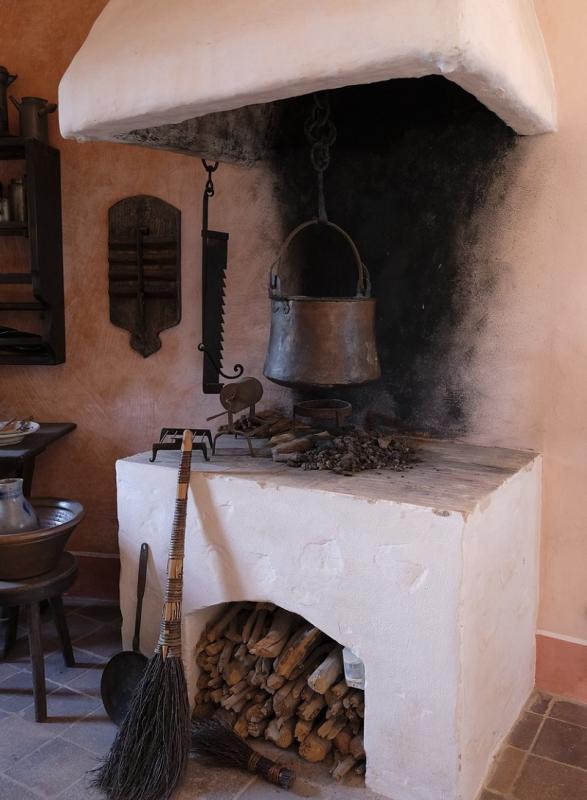
“Klejner,” as is known, should not be baked but boiled, which is why they could be prepared at the open hearth. “Pebernødder” were originally a leftover of rye bread dough, into which various spices, honey, and perhaps a few eggs were kneaded. This dough was then rolled into small balls the size of nuts, which were subsequently baked on the hearth. The small “pebernødder” may have been hard, but still tasty, and in a time where sugar and sweets were far from something one had every day, the small, spiced “pebernødder” were a rare luxury reserved for special occasions.
In the latter half of the 1800s, the cast iron stove replaced the open hearth as the place where housewives cooked. In a short span of years, it moved into most Danish homes and displaced the open hearth, which had otherwise been used for centuries. With the stove also came the oven into Danish households, opening up a multitude of new things that could be prepared at home. Bread, including finer loaves and buns, could be baked more frequently, avoiding eating bread that was weeks old, and roasts could also be cooked in it. Last but not least, you could now bake cakes at home, and a wealth of recipes for pies, pound cakes, yeast cakes, and cookies were developed. Miss Jensen and Madam Mangor were particularly influential in the development of these new dishes, and their cookbooks became true bestsellers in a time when many had to get used to cooking in an entirely new way.
Ginger Cookies
Belong to the very oldest of the Christmas cookies. Originally, the term “pepper cakes” was also used for the brown, spiced cookies, and just like today, there were a multitude of different recipes for the cookies. The term “pepper” did not originally mean to add pepper, but to spice, so the term “spice cookies” might be more accurate. Ginger cookies are known as far back as the Middle Ages, but like most of the other Christmas cookies, they only became widespread with the arrival of the cast iron stove in homes. Ginger cookies are baked from a dough made of wheat flour, syrup, and sugar, as well as a multitude of different spices, including cinnamon, cloves, and allspice. Additionally, chopped candied peel, orange or bitter orange peel can be added, just as some also include chopped almonds in the cookies.
Of course, we cannot overlook the Christmas gingerbread houses. These can be a delightful family activity to undertake together, and the gingerbread house can easily be made with the standard ginger cookie dough.
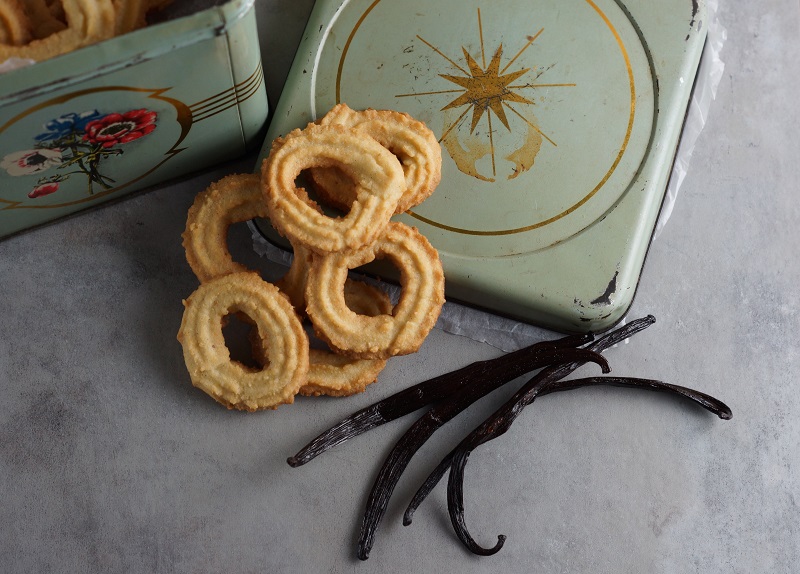
Vanilla Rings
Vanilla rings were considered among the absolute finest pastries, as the cookies contain both the exotic spice vanilla, chopped almonds, and large amounts of butter and sugar. The first recipes for these cookies date back to the 1860s, precisely the period when the stove came into use, making it possible to bake fine cookies with stable heat without significant temperature fluctuations. Vanilla rings consist of butter, sugar, and wheat flour with ample amounts of vanilla – preferably fresh seeds from a vanilla pod. The cookies often also contain chopped almonds or nuts. The dough can be run through a meat grinder to make the cookies uniform, but you can also simply fill the dough into a sturdy piping bag and shape it into the characteristic rings.
Jewish Cookies
Exactly where the distinctive name of the cookie comes from is unclear, but most food historians agree that the recipe for the cookies comes from Jewish bakers, of which there were many in Copenhagen in the 19th century. These bakeries were popular because they had a large selection of delicious cookies, and perhaps the cookies with cinnamon sugar became so popular that, to save money, people decided to bake them themselves? The cookies consist of a simple dough made with butter, wheat flour, and sugar and shaped into simple, round cookies. The unbaked cookies are brushed with beaten egg and sprinkled with cinnamon sugar and possibly chopped almonds before being baked.
Finnish Bread
Is probably a Danish invention, although some sources claim that the cookie originates from Sweden. There is a good chance, however, that it does not originate from Finland, where the small, elongated cookie sprinkled with pearl sugar and chopped almonds is virtually unknown. So perhaps it has roots in Sweden, where there is a long tradition of baking many different types of cookies. Like Jewish cookies, Finnish bread consists of a simple shortcrust pastry based on flour, butter, and sugar. The cookies are rolled out into long sticks, which are cut into smaller pieces. Before baking, the cookies are brushed with beaten egg and sprinkled with pearl sugar and chopped almonds.
Fat Bread
In some places also called rum slices. The cookie itself is usually the same, but the difference is that the icing on top of the cookies is either flavored with rum or lemon. The recipe most likely originates from Southern Jutland, where it has long been one of many types of cookies on the traditional Southern Jutland coffee table. The dough for fat bread and rum slices is very similar to that for Finnish bread, and the cookies are also cut almost the same way. However, the dough sticks are cut diagonally when baking fat bread and rum slices, whereas the Finnish bread is simply cut straight across. Fat bread and rum slices are baked without “topping” and glazed afterwards with a flavorful icing made of confectioners’ sugar and flavored with rum, rum essence, or lemon juice.
Pebernødder
Contrary to earlier times’ “pebernødder” made from rye bread dough with honey and spices, today’s “pebernødder” are made from a dough based on wheat flour, butter, and sugar as well as various spices like cinnamon, ginger, and – yes, ground black pepper! The dough is rolled into small balls the size of a hazelnut kernel, which are then baked until they are quite hard.
Klejner
“Klejner” is perhaps the Christmas cookie that has retained the most of the original taste and appearance. The dough consists of butter, wheat flour, sugar, and cream and is usually flavored with vanilla, lemon zest, and cardamom. The dough is then rolled out and cut into “klejner” with a so-called “klejnespore,” after which they are shaped and boiled in either coconut fat or neutral oil.
More Recipes for Christmas Cookies
If you’re just crazy about Christmas baking, we have a lot of recipes for different cookies here:
Sources: