

Bearnaise sauce, Bearnaise Sauce, Sauce Bearnaise – or just Bearnaise. No matter what you call it, there’s no doubt which sauce is being discussed: It’s the sauce famous for its delightful, tangy richness and versatility, yet infamous for failing because it can easily split.
Below, you will learn much more about this French classic. We’ll look at the various preparation methods (there are quite a few!), and we’ll also share our tip to save a split Bearnaise.
The History of Bearnaise Sauce
Bearnaise sauce apparently originated by accident at the French restaurant, Le Pavillion Henri lV, just outside Paris in the 1800s. The restaurant was not an ordinary restaurant. It was housed in what was from 1600 until 1682 the home of the French royal family – where Henri lV had lived.
Henri lV was born in the French province of Béarn, and he was incredibly passionate about gourmet food and cooking. In his honor, the sauce was named “Bearnaise” (after the town of birth, Béarn).
What is Bearnaise Sauce?
Bearnaise sauce is a so-called secondary sauce of Hollandaise sauce, which is one of the five French mother sauces.
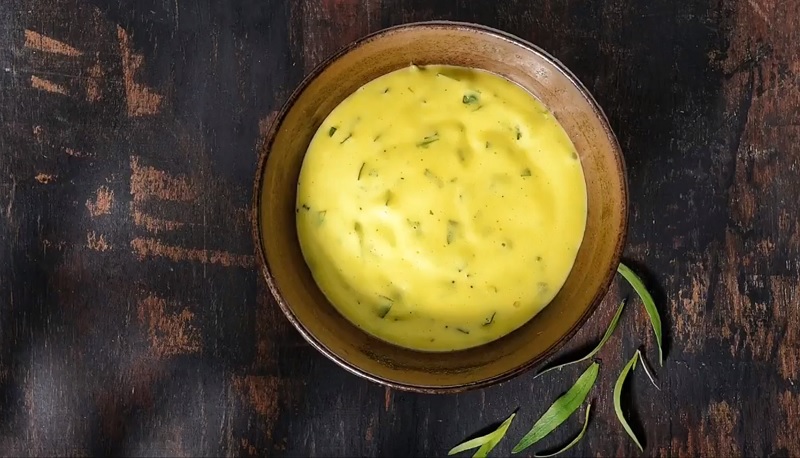
A classic Bearnaise consists of clarified butter, egg yolks, essence, lemon juice, freshly chopped tarragon, and salt and pepper. A Bearnaise should be thick and creamy, and it is thickened through an emulsion of the clarified butter and egg yolks.
Whether a Bearnaise can be said to be successful partly depends on the balance, i.e., the rich sauce must have quite a bit of acidity to balance the fat. In addition, it should of course not be split. Since the sauce is very unstable, it can easily split.
If you want to learn more about the ratio of the different ingredients, we have a good table here.
Why does a Bearnaise sauce split?
Bearnaise typically splits if just some of the sauce gets hotter than 60 degrees Celsius. This usually happens if you leave it on the stove while setting the table or if the sauce is poured into a gravy jug or bowl that is warmer than 60 degrees.
Therefore, the sauce should always be made last and served immediately.
At the bottom of the article, you can see how to save a split Bearnaise if the worst happens.
Bearnaise Essence
To make a Bearnaise sauce from scratch, you first need to make the essence. A Bearnaise essence is a spiced vinegar, which is an indispensable ingredient in making Bearnaise sauce.
You can easily find ready-made essence in the supermarket for cheap, but we would recommend making it yourself. Although it should preferably be made well in advance, the actual work doesn’t take more than fifteen minutes. We promise it’s worth it, as the flavor becomes much more “authentic” and intense in your finished Bearnaise.
A homemade Bearnaise essence can only keep for about 14 days in the fridge, so a good tip is to pour it into ice cube trays and freeze it – then you can always grab a cube when it’s time for homemade Bearnaise.
How to Make a Bearnaise
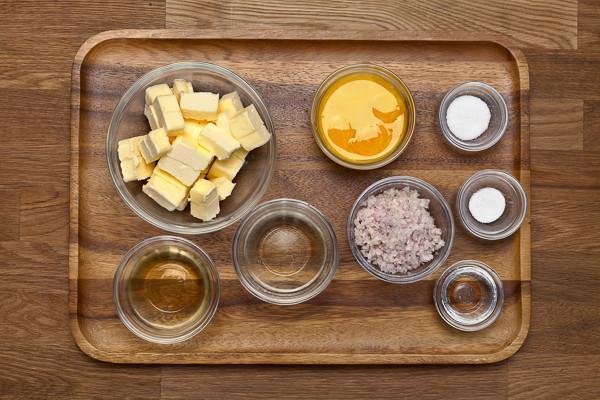
The most important thing to keep in mind when making a good sauce is to minimize temperature differences as much as possible. Therefore, make sure to take your egg yolks out of the fridge well in advance and ensure you have melted the butter in good time to allow the temperature to drop. For a Bearnaise sauce, you’ll need clarified butter, also known as ghee.
How to Make Clarified Butter:
- Start by melting the butter in a small saucepan over low heat.
- Pour the butter into a small jug without getting too much of the white sediment (consisting of milk particles/proteins and salt) with it. The sediment should be discarded, but if you get some of it, it’s not a major concern.
Once you have clarified the butter, separate your eggs so the yolks are alone and the whites are separate. For a Bearnaise sauce, you only need the yolks, so feel free to save the whites for something like meringue or to add a little extra volume to an omelette. If you’d like to learn more about eggs in general, read more here.
Bearnaise Sauce Recipes
When the sauce is ready to be assembled, there are several different options you can choose from in our world:
- Directly in a small, thick-bottomed saucepan on the stove
- With an immersion blender
- With a siphon
- Tempered in sous vide and finished with an immersion blender.
- In a bowl over a water bath
- In a kitchen machine with a heating element (e.g., Monsieur Cuisine édition plus or Thermomix).
Below, we will go through each method and their advantages.
Bearnaise in a Saucepan
The advantage of making the sauce in a saucepan is that you constantly feel the sauce’s consistency and how far you are in the process.
Here are some recipes where the Bearnaise is made in a saucepan. There’s even a single vegan variant included!
Bearnaise Over a Water Bath
You can also make the sauce over a water bath. See for example Bo Beck’s version here:
Bearnaise with Immersion Blender
You can use an immersion blender to thicken the sauce. Here, the key to a good result is still the temperature.
First, the butter should be heated to 60 degrees, and you can do this in the microwave, saucepan, or sous vide. Then blend all ingredients with the immersion blender. Use a jug/tall, narrow bowl and ensure the immersion blender is all the way at the bottom before you start blending. See for example here:
Bearnaise Siphon
By using a siphon, you can achieve an even fluffier sauce than usual.
Typically, sous vide is used for the preparation, but it also means you can make it well in advance.
Because you “inject” air into the sauce, it needs to be even stronger in flavor than a normal sauce; otherwise, it will be bland when it comes out of the bottle.
Sous Vide Bearnaise
The smart thing about combining the egg yolks and butter in your sous vide is that you’re absolutely sure the sauce will never reach too high a temperature and therefore split.
The key to ensuring you thicken the sauce after its water bath journey is to use a jug/tall narrow bowl and ensure the immersion blender is all the way at the bottom before you start blending.
Bearnaise in a Steam Oven (Combi Oven)
By using a steam oven/combi oven, you can melt the different ingredients together in a vacuum bag, just like you do with sous vide. Here, you also finish the sauce with an immersion blender.
Bearnaise in a Stand Mixer
The advantage of using a stand mixer (with built-in heating element) is that it practically does everything for you.
The disadvantage is that you don’t have much feel for the sauce’s consistency, but on the other hand, your sauce will never split, as the machine controls the temperature.
Cold Bearnaise Dressing
If you love the taste of Bearnaise but don’t think it quite fits, for example, on a warm day with a barbecue, you can instead make a cold version of Bearnaise in a dressing form. Just look here:
How to Save a Split Bearnaise
You can save a split Bearnaise sauce by starting “over,” by whisking an egg yolk in a new (clean) saucepan and whisking in the split sauce (just like when you whisk butter into the sauce), slowly and under vigorous stirring.