
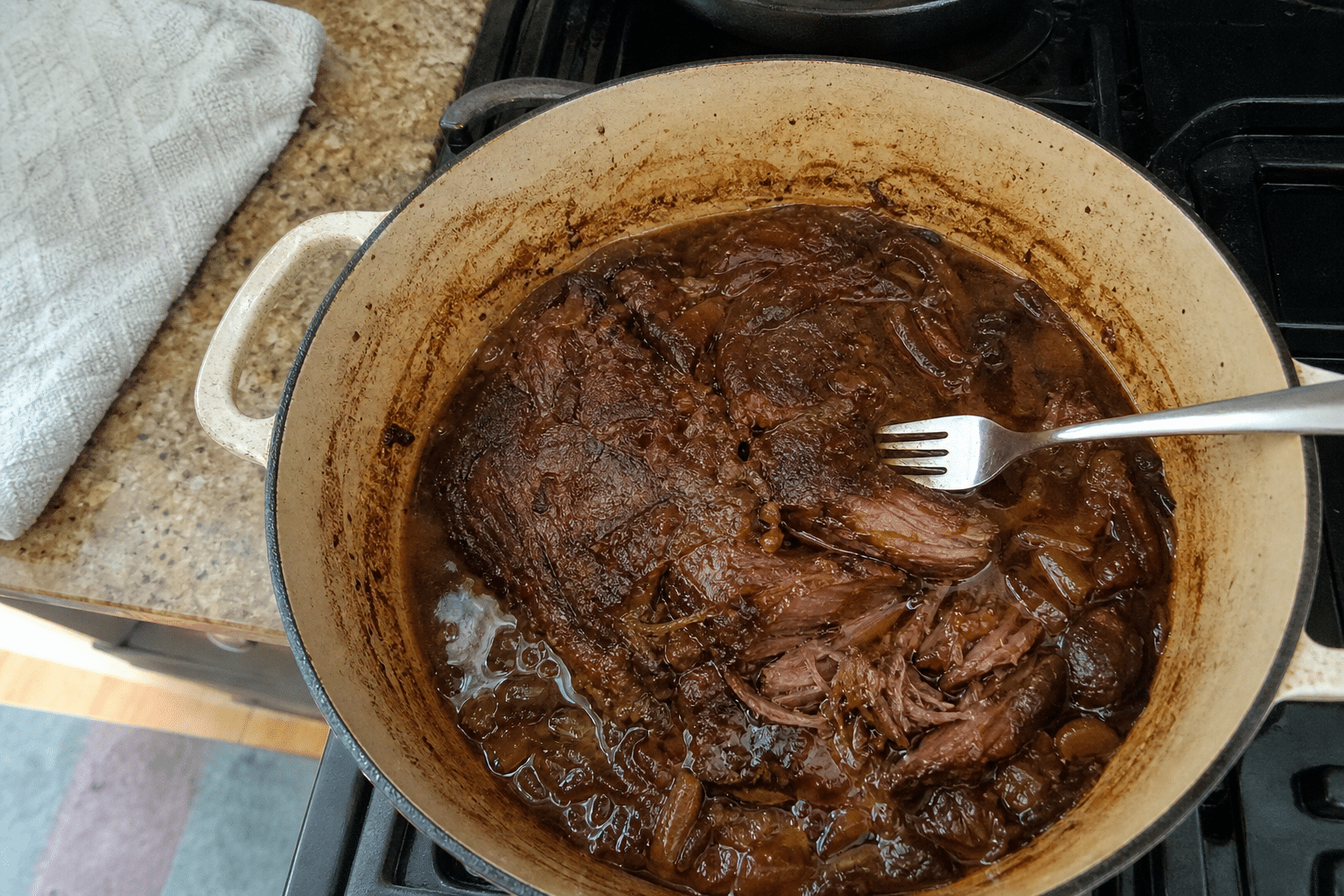

Price tells you almost nothing about how tender a piece of meat will be. Some of the cheapest cuts I buy turn into the most tender dinners on my table, as long as I match the cut to the right method.
There are really only two tricks, and below I tell you which cut wants which. Get that right and a bargain cut will beat a pricey steak.
The two ways cheap meat gets tender
Most budget cuts come from hard-working muscles loaded with collagen, the connective tissue that turns chewy when you cook it fast. Heat rewrites that. Collagen starts melting into soft, rich gelatin at around 160°F (70°C), and the longer you hold it there, the more it dissolves and bastes the meat from the inside.
That is why these cuts reward low, slow, moist cooking: a covered braise or a long roast, usually 3 hours or more, until a fork twists in and meets no resistance.
The second route is the opposite. A few cheap cuts are already tender and just have a loose, coarse grain. Those you cook hot and fast, never past medium, then slice thin across the grain. For safety, the USDA puts whole beef, pork, and lamb at 145°F (63°C) with a 3-minute rest, and ground meat at 160°F (71°C). Braised cuts run well past that on their way to tender.
1. Beef chuck
Sold as chuck roast, braising steak, or shoulder, this is my default for a pot roast or a stew. It is cheap, well marbled, and full of collagen.
Braise it covered at a bare simmer, around 300°F (150°C) in the oven, for about 3 hours, until a fork twists out clean. Rush it at high heat and it stays tight and dry.
Read more: How to roast a whole duck with perfectly crispy skin, using a low-and-slow oven method
2. Beef shin
Called shin or shank, and osso buco when it is cut across the bone. It has more connective tissue than almost any other beef cut, which is exactly the point: it melts into a glossy sauce that coats your lips.
Give it 3 to 4 hours in liquid. The marrow in the bone is a free bonus.
3. Short ribs
Labeled short ribs, or Jacob’s ladder in the UK. There is fat and collagen packed between the bone and the meat, so they braise into something rich and spoonable.
Cook them in stock or wine, or smoke them low, until the meat pulls back from the bone. Chill the braise overnight and lift off the fat cap for a cleaner sauce.
4. Beef cheeks
A cheek is the most overworked muscle on the animal, so it is dense with collagen and cheap at the butcher counter. About 3 hours of braising turns it spoon-soft and almost sticky.
You often will not see cheeks in the case, so ask; they are usually in the back.
Read more: Æbleskiver: the fluffy Danish Christmas puffs softer than any doughnut, with lemon and cardamom
5. Oxtail
This is gelatin in cut form. It is bony and looks like a project, which is why shoppers walk past it, but the payoff is a sauce with body you simply cannot fake.
Braise it long and slow. Cook it a day ahead, chill, skim the set fat, and reheat for the cleanest result.
6. Pork shoulder
On US labels this is Boston butt or picnic. It is marbled and collagen-rich, and very hard to mess up.
Slow-roast or braise it to about 195 to 205°F (90 to 96°C) and it shreds into pulled pork. Season it hard the day before; the long cook is forgiving on timing.
7. Lamb shank
The lower leg does a lot of work and costs a fraction of the rack or the leg. Figure one shank per person and braise 2.5 to 3 hours, until the meat slides off the bone.
Lamb neck is even cheaper and does the same job in a stew.
8. Flat iron steak
Here is where the rules flip. Cut from the chuck, and sold as feather blade or butler’s steak in the UK, this is one of the most tender muscles on the whole animal once the central line of gristle is trimmed out.
No braising needed. Cook it hot and fast like a steak, pull it at 145°F (63°C) with a 3-minute rest, then slice it thin across the grain.
9. Hanger or skirt steak
Hanger (onglet) and skirt (sometimes sold as bavette) are thin, loose-grained, and deeply beefy, for a lot less than the famous steaks. They only turn tough when you overcook them or slice them the wrong way.
Sear them hard and fast, rest to 145°F (63°C), and slice thinly against the grain. They are my go-to for tacos, stir-fries, and steak salad.
When a cheap cut still comes out tough
- You cranked the heat on a braising cut. Collagen needs time at temperature, not a hotter oven. Drop the heat to a bare bubble and give it another hour.
- You sliced a quick-cook steak with the grain. Always cut across the fibers, as thin as you can; it is the single biggest fix for chewy flat iron, hanger, or skirt.
- You stopped a braise at 145°F. Safe and tender are different targets. A braising cut needs to climb to roughly 195 to 205°F before the collagen converts, so keep going well past the safe mark.
- The pot ran dry or boiled hard. Keep the meat partly submerged with the lid on at a gentle simmer, so it stays moist while the collagen melts.