
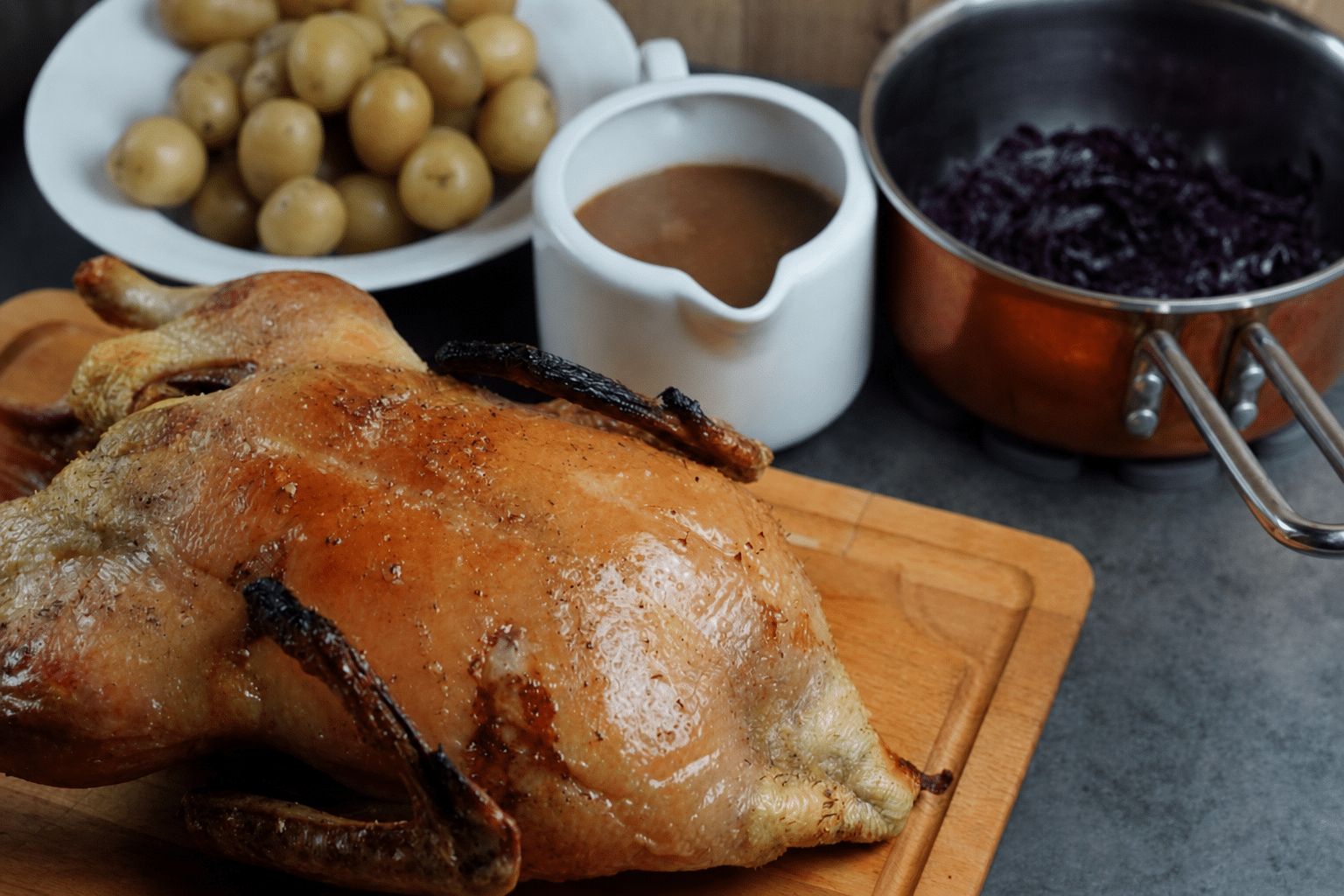

Whole roast duck is one of the most underrated holiday centerpieces you can put on the table. It is richer than chicken, more striking than a roast turkey breast, and feeds four people handsomely. The reason most home cooks avoid it is the skin: in a hot oven, the thick layer of fat under duck skin never fully renders, and you end up with something soft, greasy, and disappointing.
This method solves that completely. We roast the duck at 257°F (125°C) for four hours, stuffed with orange and thyme, basting throughout with orange juice and pan drippings. By the time the long cook is done, the fat has largely melted away. Then we blast the oven to 480°F (250°C) for ten to fifteen minutes, and the skin crisps so completely it practically crackles when you cut into it.
It is a genuinely impressive centerpiece, and the process is forgiving once you understand what each stage is doing.
Why this recipe works
Duck carries a substantial layer of fat under the skin that needs time and gentle heat to melt. At 257°F (125°C), that fat slowly liquefies and drips down into the pan over four hours. By the time you fire up the heat at the end, there is very little fat left between the skin and the crisping heat. The result is crackling skin and deeply moist meat.
Read more: Æbleskiver: the fluffy Danish Christmas puffs softer than any doughnut, with lemon and cardamom
The orange-and-thyme stuffing does two things. It perfumes the meat from the inside, and the orange juice in the pan creates a humid environment that keeps the breast from drying out during the long cook. A split vanilla pod tucked into the vegetable bed below the duck adds a subtle roundness to the finished pan sauce.
The two-stage structure also makes the cooking practical: the slow phase can be done well ahead, and the skin-crisping step takes only fifteen minutes right before sitting down to eat.
Ingredients
Serves 4
For the duck:
- 1 whole duck, about 6.5 lbs (3 kg)
- 2 oranges, cut into large wedges
- 1/2 bunch fresh thyme (or 2 tsp dried)
- Salt and pepper
- 2 cups (500 ml) orange juice, plus more for basting
For the roasting pan:
- 3 carrots, cut into rough chunks
- 3 red onions, cut into rough chunks
- 1/4 celeriac, cut into rough chunks
- 1/2 vanilla pod, split lengthwise
- Duck innards (neck, giblets, wing tips), if included with the bird
- 4 cups (1 liter) water
For the sauce:
- Strained pan liquid from the roasting pan
- A scant 1/2 cup (100 ml) heavy cream
- 1 tsp sugar
- Lemon juice or a splash of vinegar
- 2 tsp cornstarch mixed with 1 tbsp cold water
- Salt and pepper
Instructions
Prep the duck:
- Remove any innards from the cavity and set them aside. Trim off the neck and wing tips if still attached, and add those to the pile.
- Pat the duck dry with paper towels. Season the inside of the cavity and all outer surfaces generously with salt and pepper.
- Stuff the cavity with the orange wedges and fresh thyme. Close the opening with two or three metal skewers.
Build the pan:
- Scatter the carrots, red onions, celeriac, reserved innards, a few extra thyme sprigs, and the split vanilla pod across the bottom of a large roasting pan.
- Set a roasting rack over the pan. Place the duck breast-side up on the rack.
- Pour the orange juice and the water over the duck, letting the liquid run down into the pan below.
Slow roast:
- Place the pan in a cold oven, then turn the oven on to 257°F (125°C) with no convection fan. Roast for approximately 4 hours.
- Every 45 minutes or so, baste the duck generously with the pan liquid. If the pan looks dry, add a splash of orange juice.
Crisp the skin:
- Remove the duck from the oven and set it aside on a plate. Turn the oven up to 480°F (250°C) and allow it to come fully up to temperature, about 15 to 20 minutes.
- Return the duck to the rack and roast for 10 to 15 minutes, watching it closely, until the skin is deep golden and crispy all over.
Make the sauce:
- Pour the pan liquid through a fine-mesh strainer into a medium saucepan, pressing on the solids to get all the flavor out. Skim as much fat from the surface as you can.
- Bring to a boil and reduce until about 2 cups (500 ml) remain, roughly 10 to 15 minutes.
- Stir in the cream and the sugar. Thicken by whisking in the cornstarch slurry a little at a time until the sauce coats the back of a spoon.
- Balance with a squeeze of lemon juice or a splash of vinegar, then season with salt and pepper to taste.
Carve and serve:
- Rest the duck for about 10 minutes after coming out of the oven.
- Remove the legs, separating the thighs from the drumsticks if you like. Remove the wings at the joint.
- Slice the breast meat off the bone and cut it diagonally into thick slices.
- Spoon the orange-and-thyme stuffing from the cavity onto the serving platter alongside the carved meat.
The duck is safe to eat when an instant-read thermometer inserted into the thickest part of the thigh reads 165°F (74°C), not touching bone.
Tips and variations
Make it the day before. This duck is an excellent make-ahead. Reduce the slow-roasting time by 20 minutes, then carve the bird once it has fully cooled. Arrange the pieces in an oven-safe dish, cover, and refrigerate overnight. The next day, reheat at 350°F (175°C) for about 30 minutes, then do the high-heat skin-crisping step right before serving.
Read more: The creamy beef and leek pasta that tastes like it took all day but is ready in 30 minutes
What to serve with it. Roasted potatoes and braised red cabbage are the natural accompaniments. For a fully festive spread, try caramelized potatoes on the side: boil small potatoes until tender, then toss them in a pan with a generous pat of butter and a spoonful of sugar until they turn glossy and deep golden.
No roasting rack? Pile the vegetable chunks thick enough to lift the duck off the pan floor. It is not ideal but it keeps the duck from sitting flat in its own rendered fat.
Leftovers. Duck reheats well. Store any carved meat covered in the refrigerator for up to 3 days. Reheat covered with foil in a 350°F (175°C) oven until warmed through.