
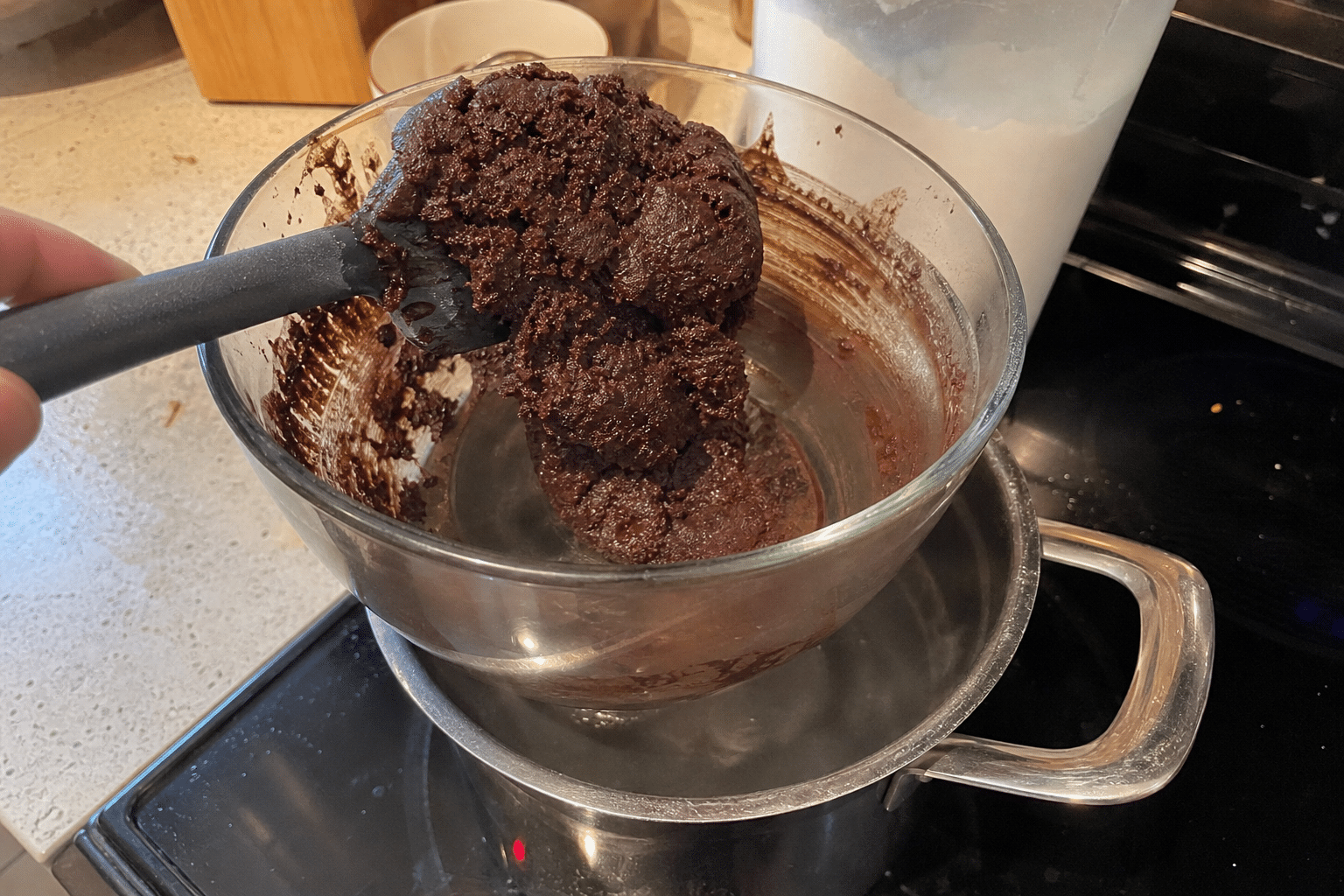

You are melting chocolate for truffles or dipping cookies when the bowl seizes without warning. The silky liquid stiffens into a dull, coarse paste, and no amount of stirring or extra heat smooths it back out.
The cause is almost always water. Understanding exactly what that water does to the structure of melted chocolate explains both why the damage happens so easily and how, in the right circumstances, more liquid can fix it.
Chocolate is a fat system, not a mixture
Melted chocolate is not a uniform liquid. It is a fat suspension. Cocoa butter, the natural fat pressed from cacao beans, forms the continuous liquid phase, and suspended within it are tiny dry particles: crystals of sugar and grains of cocoa solids. As long as everything stays dry and within the right temperature range, those particles stay dispersed and the melt flows smoothly.
Colorcon’s food scientists describe it as an oil-continuous system. Cocoa butter is nonpolar and hydrophobic, it repels water at a molecular level. That incompatibility is not a flaw in chocolate design; it is what gives tempered chocolate its clean snap, its gloss, and its quick melt.
Read more: Gratin dauphinois: the creamy French potato bake that beats roast potatoes on a cold night
Why a drop does the damage
The moment water contacts the melt, it ignores the cocoa butter and targets the sugar. According to Colorcon, “even a small amount of water dissolves surface sugar and forms a sticky syrup that causes particles to clump, leading to chocolate ‘seizing.'”
Here is the sequence:
- A trace of water reaches the surface of a sugar crystal in the melt.
- It dissolves just enough sugar to form a dense, concentrated syrup.
- That syrup acts as a glue, pulling nearby sugar and cocoa particles together.
- Clumps grow until they can no longer stay suspended in the cocoa butter.
- The batch stiffens into a grainy paste with patches of separated fat.
A trace of water is actually more destructive than a larger amount. A small dose dissolves just a little sugar, creating concentrated syrup, maximally sticky. That same logic explains the rescue method.
Keeping water out: prevention
Every water source near the melt is a potential hazard:
- Dry every tool. One drop on a spatula or spoon is enough. Wipe utensils dry before they touch the bowl.
- Control the double boiler. Steam from boiling water is the most common culprit. Keep the water at a low simmer, not a boil, and make sure the bowl seals snugly over the pot.
- Avoid condensation. A cold bowl set over simmering water will sweat on the inside. Warm the bowl first, or use a heatproof bowl that starts at room temperature.
- Use oil-based colorings. Water-based food colors cause the same clumping in home kitchens as they do in industrial confectionery. Oil-dispersible colorings blend cleanly into the fat phase.
- Add vanilla last. Vanilla extract is water-based. Stir it into finished ganache, not into the melt.
The counterintuitive rescue
Colorcon states plainly that seized chocolate cannot be restored to its original smooth, fluid state, it cannot be used for tempering, coating, or molding, and the only industrial solution is to discard it and start again.
Read more: Fridge thawing lets you refreeze meat, but cold water and microwave don’t
For home bakers, however, more liquid can convert a seized batch into something usable, even if not what you started with.
The Exploratorium’s Science of Cooking program explains the fix: when seizure occurs, whisk in one tablespoon of warm water, then add more by the teaspoon while stirring until the mixture smooths out. For intentional liquid additions, the guide recommends at least 1 tablespoon (15 ml) of water per ounce of bittersweet, semisweet, or white chocolate, and 1½ tablespoons (approximately 20 ml) per ounce for unsweetened chocolate.
The reason this works is the inverse of why a drop ruined it. Enough water fully dissolves the remaining sugar, the syrup stops being concentrated, the clumping force drops, and the mass relaxes into a smooth, pourable consistency.
Read more: Spaghetti and meatballs from scratch: the long-simmered tomato sauce that makes all the difference
The result is not restored chocolate. It is a ganache or sauce. It will not set hard, it will not temper, and you cannot use it for coating. Use it in brownies, as a fudge sauce, in a truffle filling, or in hot chocolate.
Prevention vs. rescue at a glance
Scenario | Action |
|---|---|
Drop on a utensil before anything seizes | Remove the utensil; stir; rescue with liquid if it seizes |
Steam entering from the double boiler | Lower heat to a bare simmer; rescue if already seized |
Water-based flavoring added to the melt | Add warm cream or water to rescue |
Need to temper, dip, or coat | Rescue will not work, discard and start fresh |
Making ganache, sauce, brownies, or hot chocolate | Rescue with warm liquid; use as-is |
When there is no way back
Rescue with liquid fails in one scenario: scorched chocolate. If the chocolate has overheated, darker in color, smelling bitter or burned, the cocoa solids have broken down, and no amount of cream or water will fix it.
Seized chocolate that gets reheated multiple times also becomes harder to save with each pass. For anything that needs to temper or coat cleanly, dipped strawberries, enrobed truffles, or bark meant to snap, the best approach is to discard the seized batch and start fresh.