
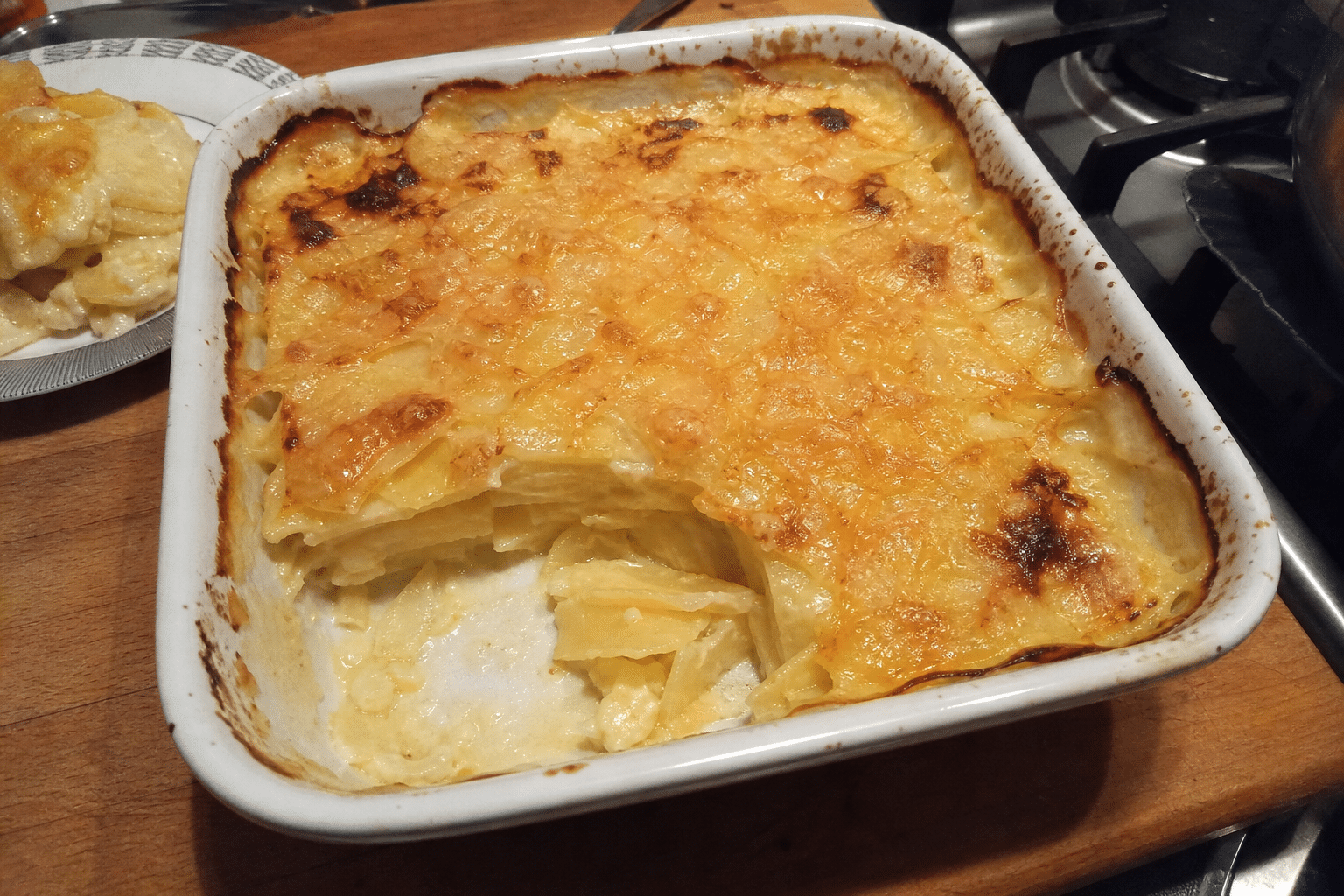

Gratin dauphinois comes from the Dauphiné region of southeastern France, and it is one of those dishes that looks modest right up until you taste it. No cheese, no breadcrumbs, no crispy topping. Just waxy potatoes and garlicky cream, coaxed over 90 minutes into something that holds its shape when sliced and tastes impossibly rich.
It is not tartiflette, which uses Reblochon cheese and smoked lardons. It is not the British-style potato gratin with a bubbling cheddar crust. The classic dauphinois lets the cream and starch do the work alone, and that restraint is exactly what makes it so good alongside a winter roast.
Why this recipe works
Three things separate a set, sliceable gratin from a watery, collapsed one.
Waxy potatoes, not floury ones. A floury potato like a Russet breaks down in the oven, turning the cream starchy and grainy and collapsing the layers. Waxy varieties like Yukon Gold or Red Bliss hold their shape through long, low heat, giving you clean distinct layers instead of mush.
Keep the starch on the slices. Do not rinse the sliced potatoes. The surface starch is what thickens the cream as the gratin bakes, binding the whole thing so it slices cleanly. Rinse them and the cream stays loose.
Low heat, long time. At 300°F (150°C), the cream reduces gently and the potatoes cook through without the top browning before the center has set. High heat scorches the surface and leaves the middle underdone. Give it the full 90 minutes.
Read more: Fridge thawing lets you refreeze meat, but cold water and microwave don’t
Ingredients
Serves 6 as a side
- 2 lbs (900 g) waxy potatoes, such as Yukon Gold or Red Bliss, peeled
- 1 1/2 cups (360 ml) heavy cream
- 1/2 cup (120 ml) whole milk
- 3 garlic cloves, 1 halved and 2 smashed
- 1/4 teaspoon freshly grated nutmeg
- 1 1/4 teaspoons fine salt
- 1/4 teaspoon freshly ground white or black pepper
- 1 tablespoon unsalted butter, softened
Instructions
1. Heat the oven to 300°F (150°C). Rub the inside of an 11×8-inch (28×20 cm) baking dish thoroughly with the cut face of the halved garlic clove. Butter the dish generously all over.
2. Combine the cream, milk, smashed garlic, nutmeg, salt, and pepper in a small saucepan. Warm over medium-low heat, stirring occasionally, until it just begins to steam, about 4 minutes. Do not let it boil. Remove from heat and let it infuse for 10 minutes while you prepare the potatoes.
3. Slice the potatoes as thin and even as possible, about 1/8 inch (3 mm) thick. A mandoline makes this significantly more consistent. Do not rinse the slices.
4. Layer the potato slices in the dish, overlapping them like roof tiles. Work in a single direction for the first layer, then alternate the direction for the next, which helps the gratin hold together when you serve it.
Read more: Spaghetti and meatballs from scratch: the long-simmered tomato sauce that makes all the difference
5. Pour the cream mixture through a fine-mesh strainer over the potatoes, pressing on the garlic to extract all the flavor. The cream should come close to the top of the layers. Press the potatoes down with the back of a spoon to submerge them.
6. Cover the dish tightly with foil. Bake for 60 minutes, then remove the foil and continue baking for another 25 to 30 minutes, until the top is golden and a paring knife slides through the center with no resistance, about 90 minutes total.
7. Remove from the oven and let the gratin rest uncovered for at least 15 minutes before slicing. It firms up noticeably as it cools and cuts into clean squares at this stage.
Tips and variations
All cream versus cream and milk. Using pure heavy cream gives a richer, denser result. Adding whole milk lightens the texture slightly without losing the characteristic creaminess, which works better if you are serving the gratin alongside a rich braised meat. Keep the cream-to-milk ratio at roughly 3:1 and do not substitute low-fat dairy or the cream will not thicken properly.
Infusing the cream is worth the extra step. Pouring cold cream straight over raw garlic gives you a sharp, uneven garlic flavor. Warming it first draws out a milder, sweeter garlic note and distributes the nutmeg evenly throughout every layer.
Potato choice is non-negotiable. Yukon Golds are the most reliable waxy variety in most American supermarkets. Fingerlings also work well sliced on the diagonal for wider, more attractive layers. Avoid russets entirely.
Make ahead. Gratin dauphinois reheats beautifully. Bake it fully, let it cool to room temperature, cover, and refrigerate for up to two days. Cold gratin slices even more cleanly than fresh. Reheat covered with foil at 325°F (160°C) for 20 to 25 minutes until hot through.
Scaling. For a larger gathering, bake two dishes side by side rather than one deep dish. Stacking more than about 2 inches (5 cm) of potato layers risks a mushy bottom before the top finishes cooking.
Leftover gratin keeps in the refrigerator for up to three days. Slice individual portions and reheat in a small pan with a splash of cream and a lid over low heat for about 8 minutes, which revives the texture better than a microwave.