
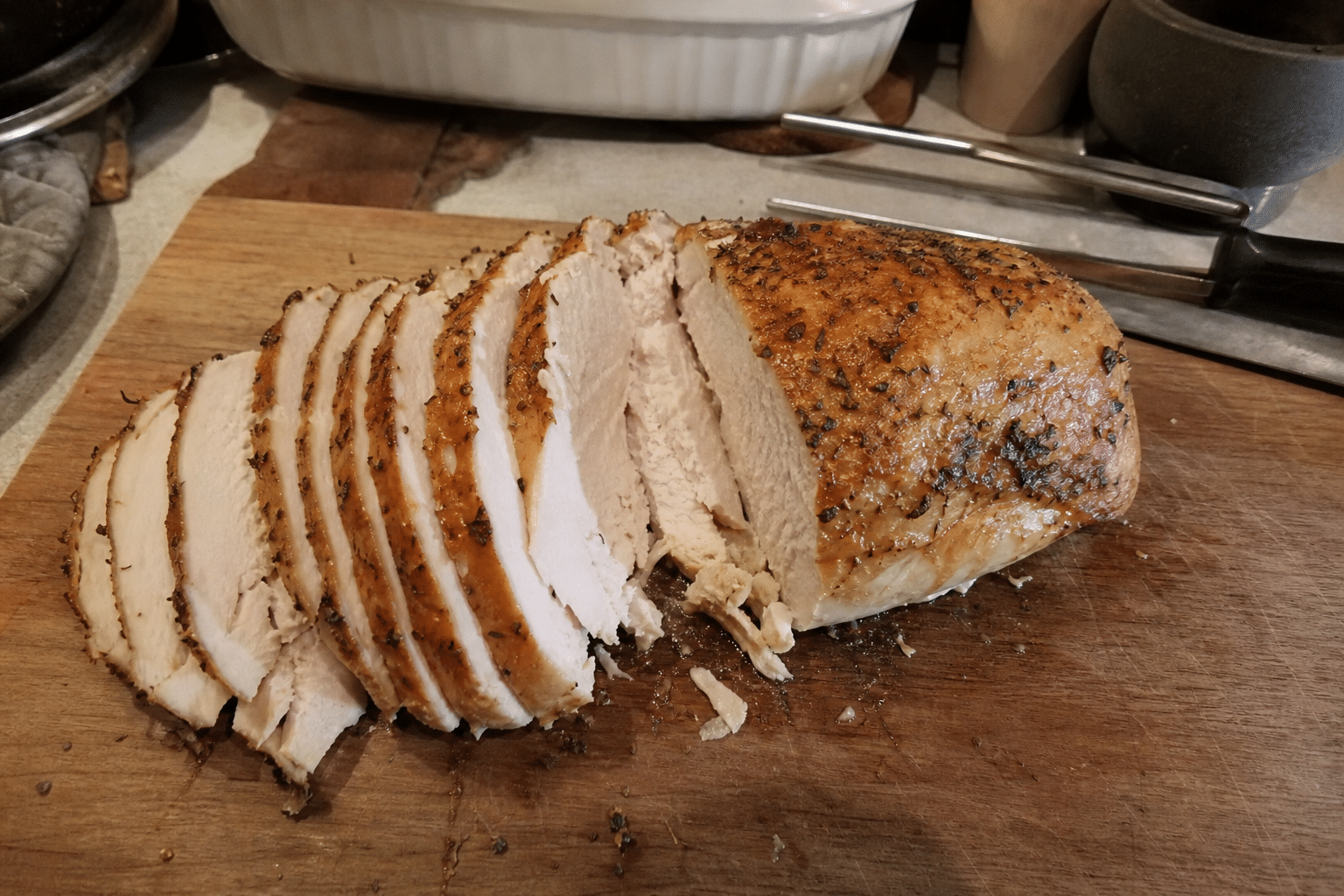

Thanksgiving for two to six people does not need a 15-pound bird. A turkey breast roast fits that gathering exactly: it carves cleanly, comes out of the oven two hours after it goes in, and leaves no mountains of leftovers. The technique here, a 24-hour dry brine followed by herb butter worked under the skin, does most of the heavy lifting the day before.
Why this recipe works
Two steps separate a dull, dry turkey breast from one people ask about at the table.
Dry brining applies salt directly to the meat and refrigerates it uncovered overnight. The salt draws moisture to the surface, dissolves, and is then reabsorbed into the muscle fibers. By the time the breast goes into the oven, it is seasoned all the way through and holds onto its moisture better than an unbrined bird. Leaving the skin uncovered in the refrigerator also dries it out, which means it browns and crisps instead of steaming.
Herb butter under the skin melts as the breast roasts and bastes the meat from the inside. Because the butter sits between the skin and the flesh rather than on top of the skin, the fat does not waterlog the surface. The skin stays in contact with the heat of the oven and turns properly golden.
Ingredients
For the turkey:
- 1 bone-in turkey breast half (4-5 lbs / 1.8-2.3 kg) or whole breast (6-7 lbs / 2.7-3.2 kg), or one boneless turkey breast roast (2-3 lbs / 900 g, 1.4 kg)
- 1 teaspoon Diamond Crystal kosher salt per pound of turkey (use 3/4 teaspoon if using Morton)
- 1/2 teaspoon freshly ground black pepper
For the herb butter:
- 4 tablespoons (57 g) unsalted butter, softened to room temperature
- 2 cloves garlic, finely minced
- 1 tablespoon fresh thyme leaves, or 1 teaspoon dried
- 1 tablespoon fresh rosemary, finely chopped, or 1 teaspoon dried
- 1 tablespoon fresh sage, finely chopped, or 1 teaspoon dried
- 1/4 teaspoon kosher salt
- 1/4 teaspoon black pepper
For the pan gravy:
- Drippings from the roasting pan
- 2 tablespoons all-purpose flour
- 1 1/2 cups (360 ml) low-sodium chicken or turkey stock
- Salt and black pepper to taste
Equipment: instant-read meat thermometer, roasting pan with rack or rimmed sheet pan with wire rack, kitchen twine (for boneless roasts)
Instructions
The day before: dry brine
1. Pat the turkey breast completely dry with paper towels. Work your fingers gently between the skin and the breast meat to loosen the skin without tearing it, creating a pocket on each lobe.
2. Mix the measured kosher salt and pepper. Rub the mixture all over the outside of the turkey, then work a generous pinch directly under the loosened skin, pressing it onto the meat itself. Set the breast skin-side up on a rack over a rimmed baking sheet or in your roasting pan. Refrigerate uncovered for 18 to 24 hours.
Read more: Pork loin roast with Dijon-sage crust and apple gravy
Day of: prep and roast
3. Pull the turkey breast from the refrigerator 45 minutes to 1 hour before roasting. Preheat your oven to 325°F (163°C).
4. Beat the softened butter with the garlic, thyme, rosemary, sage, salt, and pepper until smooth. Slide your fingers back under the loosened skin and work about two-thirds of the herb butter evenly over the breast meat on both sides. Smooth the remaining butter over the skin.
5. Place the breast skin-side up on the rack in the roasting pan. Bone-in breasts balance on their ribcage naturally. For a boneless roast, tie it into a compact cylinder with kitchen twine at 1-inch (2.5 cm) intervals if the butcher has not already done so.
6. Roast until an instant-read thermometer inserted at the thickest part of the breast, away from any bone, reads 165°F (74°C). A 4-5 lb (1.8-2.3 kg) bone-in half breast typically reaches temperature in about 1 hour 15 minutes to 1 hour 30 minutes. A 6-7 lb (2.7-3.2 kg) whole bone-in breast usually takes 1 hour 45 minutes to 2 hours. A 2-3 lb (900 g, 1.4 kg) boneless roast generally needs 1 hour to 1 hour 20 minutes. The thermometer is the only reliable guide.
7. Transfer the turkey breast to a cutting board and tent it loosely with foil. Rest for 20 minutes before carving; the juices redistribute and the breast slices far more cleanly.
Read more: Coq au vin at home: the classic French braised chicken that is easier than it looks
Pan gravy from the drippings
The drippings in the bottom of the roasting pan are the best part.
1. Pour all drippings into a heatproof measuring cup or fat separator. Let them settle for 2 to 3 minutes, then skim most of the fat from the surface and set it aside, leaving the dark, meaty liquid below.
2. Set the roasting pan over a burner on medium heat. Add 2 tablespoons of the reserved fat (or butter if there is not enough fat) and the flour. Stir constantly for about 1 minute until the mixture smells faintly nutty and no raw flour remains.
3. Pour in the stock in a slow, steady stream while whisking, scraping up every browned bit from the pan bottom. Stir in the defatted drippings.
4. Simmer, whisking regularly, for 5 to 7 minutes until the gravy coats a spoon. Taste for salt and pepper, strain through a fine-mesh sieve if you want a smooth finish, and serve immediately alongside the carved turkey.
Read more: The one mistake that leaves turkey breast dry, and how to avoid it
Tips and variations
Bone-in vs. boneless: Bone-in is more forgiving and has better flavor because the bones insulate the meat and slow the cook slightly. Boneless is easier to carve neatly and cooks a bit faster; pay close attention to the thermometer in the last 20 minutes.
Dried herbs: Dried thyme, rosemary, and sage all work. Use roughly one-third the amount of dried herbs compared to fresh, and mix them into the butter a day ahead if possible so the flavors bloom fully in the fat.
Make-ahead: Complete the dry brine the day before (this is not optional). The herb butter can be made up to 3 days ahead, rolled in plastic wrap, and refrigerated; bring it back to room temperature before spreading.
Leftovers: Carved turkey keeps in an airtight container in the refrigerator for 3 to 4 days. Slice it cold for sandwiches, or warm slices gently in a covered skillet with a splash of stock to keep them from drying out.
Stuffing on the side: USDA guidance recommends cooking stuffing in a separate dish rather than inside the bird. A casserole bakes at a higher temperature, develops a crispier top, and can go in and come out of the oven on its own schedule.
Dairy-free: Substitute an equal amount of good olive oil or a plant-based butter for the unsalted butter. The garlic and herbs still perfume the meat just as effectively.