
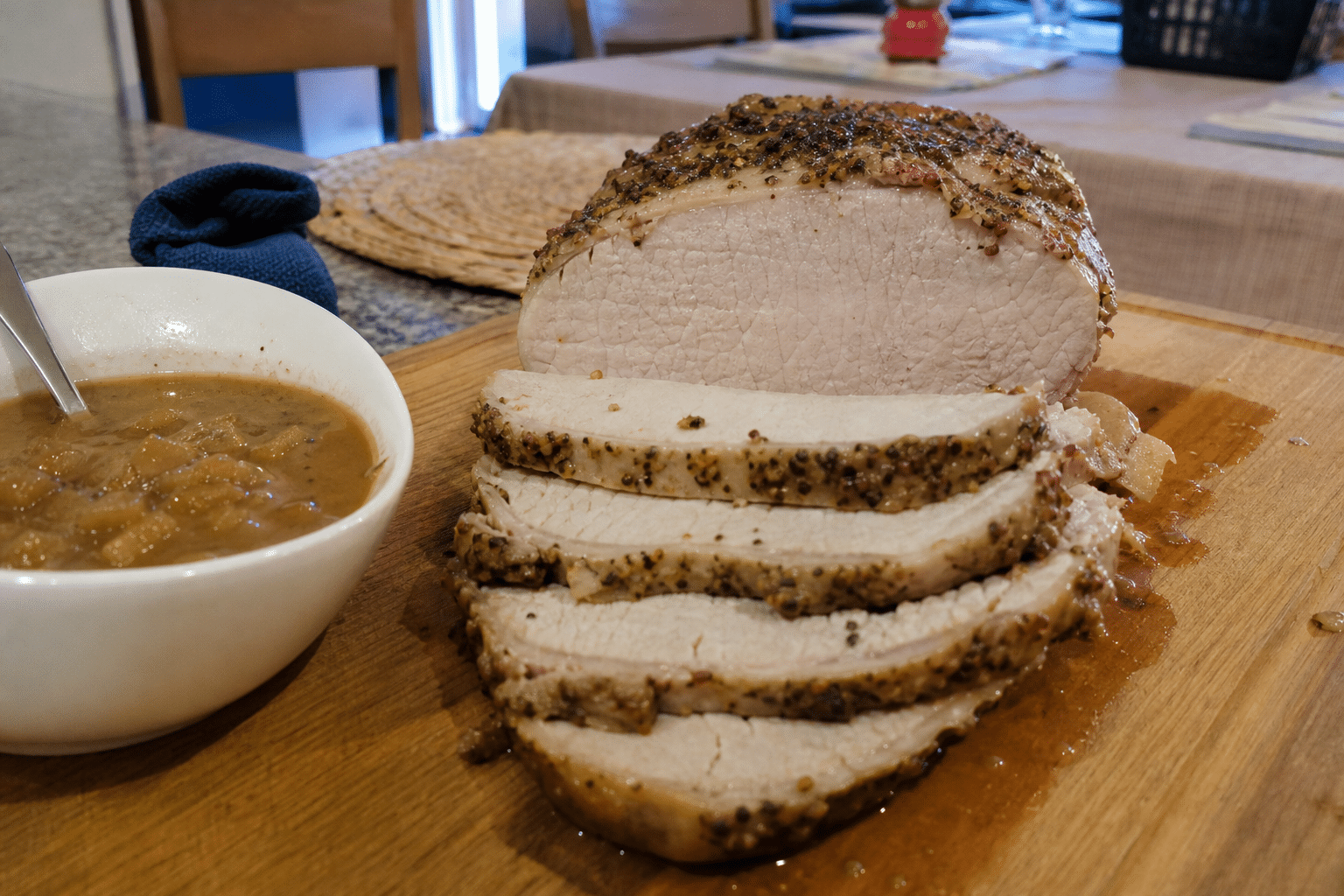

A bone-in or boneless pork loin roast is one of the most underrated holiday centerpieces: it looks impressive, carves cleanly, and costs a fraction of a standing rib roast. The technique here is a two-stage oven, starting with a 15-minute blast at 450°F (230°C) to lock in a golden, herb-scented crust, then dropping to 325°F (163°C) to bring the pork gently and evenly to temperature.
The apple and sage gravy is built right in the roasting pan while the meat rests, so there is no second pot and no wasted drippings.
Why this recipe works
Dijon mustard in the crust acts as a binder, holding the garlic and herbs against the surface through the high initial heat while adding a mild tang that cuts the richness of the pork. Starting at 450°F sets the exterior quickly; finishing at 325°F gives the interior time to come up to temperature without drying out the edges.
The USDA Food Safety and Inspection Service (FSIS) confirms that pork steaks, chops, and roasts are safe at a minimum internal temperature of 145°F (63°C), followed by a rest of at least 3 minutes. At this temperature the center may still show a faint pink blush, which is normal and safe.
Apples hit their seasonal peak in fall, according to the USDA SNAP-Ed seasonal produce guide, making November the ideal moment to build a quick pan sauce from whatever variety your store has at its best.
Ingredients
Serves 6 to 8
For the roast and crust:
- 1 boneless pork loin roast, 3 to 4 pounds (1.4 to 1.8 kg); bone-in works too at 3 to 5 pounds (1.4 to 2.3 kg)
- 2 tablespoons Dijon mustard
- 4 garlic cloves, minced
- 1 tablespoon fresh rosemary, finely chopped (or 1 teaspoon dried)
- 1 tablespoon fresh sage, finely chopped (or 1 teaspoon dried)
- 1 teaspoon kosher salt
- 1/2 teaspoon freshly ground black pepper
- 1 tablespoon olive oil
For the apple pan gravy:
- 2 medium apples (Granny Smith or Honeycrisp), peeled, cored, and diced
- 1 medium yellow onion, diced
- 1/2 cup (120 ml) dry white wine or unsweetened apple cider
- 1 cup (240 ml) low-sodium chicken or pork stock
- 1 tablespoon fresh sage leaves, torn
- 1 tablespoon unsalted butter
- Salt and freshly ground black pepper to taste
Instructions
1. Remove the roast from the refrigerator 45 minutes before cooking. Heat the oven to 450°F (230°C). Set a roasting rack inside a roasting pan.
Read more: Coq au vin at home: the classic French braised chicken that is easier than it looks
2. Stir together the Dijon, garlic, rosemary, chopped sage, salt, pepper, and olive oil in a small bowl to form a loose paste.
3. Pat the roast dry with paper towels. Rub the paste over all surfaces. Place fat-side up on the rack.
4. Roast at 450°F (230°C) for 15 minutes to build the crust. Without opening the door, reduce the oven to 325°F (163°C) and continue roasting.
5. Begin checking internal temperature after 50 minutes at 325°F for a 3-pound (1.4 kg) boneless loin, or after 60 to 65 minutes for a 4-pound (1.8 kg) loin. For a bone-in roast, the FSIS guideline is 20 to 25 minutes per pound at 325°F total. Pull the roast when an instant-read thermometer inserted into the thickest part reads 145°F (63°C).
6. Transfer to a cutting board, tent loosely with foil, and rest for at least 3 minutes before carving.
Read more: The one mistake that leaves turkey breast dry, and how to avoid it
7. While the pork rests, make the gravy. Set the roasting pan directly over medium heat, or pour the drippings into a large skillet. Spoon off all but about 1 tablespoon of fat. Add the onion and cook, stirring, until softened, about 3 minutes.
8. Add the apples and cook 2 minutes more. Pour in the wine or cider and scrape up any browned bits from the bottom of the pan.
9. Add the stock and torn sage. Simmer until the liquid reduces slightly and the apples are tender, 5 to 7 minutes. Swirl in the butter, taste for seasoning, and serve alongside the carved pork.
Tips and variations
A thermometer is the only timer that matters. Loin size and shape vary, and so do ovens. Pull the roast at exactly 145°F (63°C) and the 3-minute rest does the rest of the work. Even a couple of degrees over will start to dry the meat out.
Pink at 145°F is correct. FSIS notes that pork cooked to the safe minimum temperature may still look pink at the center. This is not undercooking. The 145°F standard replaced an older, higher target after USDA research confirmed it is fully safe for whole muscle cuts with the required rest.
Read more: The best homemade beef chili, thick and deep with a secret ingredient most people skip
Bone-in vs. boneless. Bone-in roasts are slightly more forgiving because the bone slows heat penetration and the fat cap basts the surface as it renders. Boneless loins are easier to find in the 3- to 4-pound range and carve more cleanly for a crowd.
Apple variety. Granny Smith holds its shape through cooking and adds tartness that balances the richness of the drippings. Honeycrisp softens faster and gives a sweeter result. Both work; avoid varieties that turn to mush, like McIntosh.
Make ahead. Mix the herb paste and rub it onto the roast up to 24 hours ahead. Cover and refrigerate. Bring to room temperature for 45 minutes before roasting.
Dairy-free. Swap the tablespoon of butter in the gravy for 1 tablespoon of olive oil. The texture is slightly thinner but the flavor holds.
Herb swaps. Thyme or oregano can replace the rosemary, or be added alongside it. Keep the Dijon regardless: it is the structural ingredient in the crust, not just flavor.