
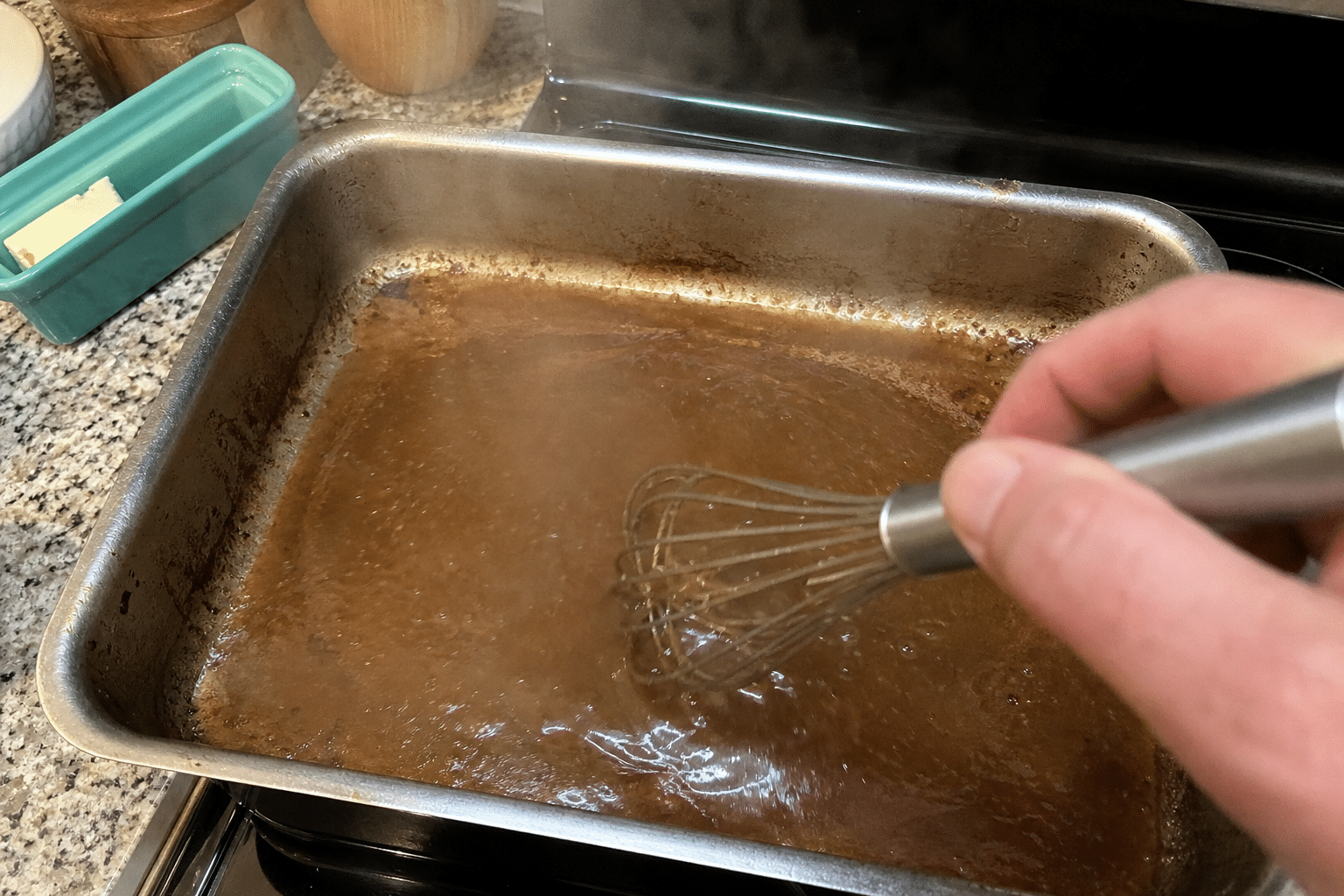

The drippings left behind after a turkey roasts are intensely flavored: caramelized meat juices, fat carrying the aroma of herbs and skin, and browned bits stuck to the bottom of the pan. All of that becomes gravy. The whole process takes about 15 minutes while the bird rests on the cutting board.
This recipe makes about 3 cups (710 ml), enough for 8 to 10 servings. It uses the pan-roux method: a small amount of fat from the drippings is worked into flour before the liquid goes in, which keeps the texture silky and avoids the starchy, gluey result you get from a cornstarch slurry.
Why this recipe works
The two things that ruin homemade gravy are lumps and weak flavor. Lumps happen when flour hits liquid all at once; building a roux first prevents that. Weak flavor happens when you skip the fond, the dark, browned bits crusted onto the roasting pan. Those bits carry deeply savory compounds from the Maillard reaction. Deglazing them into the gravy with hot stock is what separates pan gravy from anything made from a packet or a jar.
Skimming off most of the fat before you start also matters. Pouring all the drippings straight into a saucepan gives you greasy, shiny gravy. Using just 3 tablespoons of reserved fat for the roux, then adding the defatted juices, keeps every mouthful savory rather than slick.
Ingredients
For the gravy:
- Drippings from one roasting pan (a 12-14 lb turkey yields about 1 to 1-1/2 cups total)
- 3 tablespoons (45 ml) turkey fat skimmed from the drippings, supplemented with unsalted butter if needed
- 1/4 cup (30 g) all-purpose flour
- 2 cups (480 ml) low-sodium turkey or chicken stock, warmed
- 1/2 cup (120 ml) dry white wine or additional stock, for deglazing
- Kosher salt and freshly ground black pepper
Optional:
- 1 teaspoon soy sauce or Worcestershire sauce (deeper color and savory depth)
- 1 tablespoon fresh thyme leaves or a splash of heavy cream for finishing
Instructions
1. Let the turkey rest first. Once the bird comes out of the oven, transfer it to a cutting board and tent it loosely with foil. You have 30 to 45 minutes to make gravy without any rush.
Read more: How to glaze a Christmas ham: honey-mustard, brown sugar, and a broil finish
2. Pour off and separate the drippings. Tilt the roasting pan and ladle all the drippings into a fat separator or a tall glass measuring cup. Let it settle for 2 to 3 minutes: the fat rises, the dark juices sink. Pour or spoon off the fat into a small bowl and keep it. Reserve the defatted juices separately.
3. Deglaze the roasting pan. Set the empty roasting pan across two burners over medium heat. Pour in the wine (or the 1/2 cup of stock) and scrape every browned bit from the bottom with a wooden spoon or flat whisk, working quickly as the liquid sizzles. This takes about 2 minutes. Pour the deglazing liquid into the bowl of reserved defatted juices.
4. Build the roux. In a medium saucepan over medium heat, add the 3 tablespoons of turkey fat (or butter). Once it shimmers, add the flour all at once and whisk constantly for 1 to 2 minutes until the mixture turns pale gold and smells faintly nutty. Do not rush this step: an undercooked roux gives the finished gravy a raw, pasty taste.
5. Add the liquid in stages. Pour in roughly one-third of the warm stock and whisk vigorously until the roux fully absorbs it and the mixture is smooth and thick. Add the remaining stock in two more additions, whisking smooth after each. Then whisk in all of the deglazing-and-dripping juices from the bowl.
Read more: Cast-iron skillet cornbread with a crispy crust and tender, buttery crumb
6. Simmer and season. Bring to a gentle simmer over medium heat, stirring regularly, until the gravy coats the back of a spoon, about 5 to 7 minutes. Season with salt and pepper. For a darker color and more savory depth, stir in the soy sauce or Worcestershire now. Taste and adjust.
7. Strain and adjust consistency. Pour through a fine-mesh strainer into a warmed gravy boat or serving bowl. If it is too thick, whisk in warm stock a splash at a time. If it is too thin, return it to the saucepan and simmer for another 2 to 3 minutes.
Tips and variations
No fat separator? Use a spoon and a tall glass cup. Ladling the drippings in and waiting 3 minutes works fine. For large batches, slip the cup into the freezer for 5 to 10 minutes: the fat solidifies and lifts off cleanly with a spoon.
Rescuing lumpy gravy. If lumps form, pour the gravy through a fine-mesh strainer into a clean saucepan and whisk in 2 to 3 tablespoons of warm stock to smooth it out. This saves almost any situation.
Read more: Pico de gallo from scratch: the fresh tomato salsa with 15 minutes of prep
Make it ahead. Gravy can be made up to 2 days in advance. Reheat slowly in a saucepan, whisking as it warms, and add stock to thin it back to the right consistency.
Giblet stock. If you simmered the neck and giblets in stock while the turkey roasted, use that in place of store-bought. It adds another layer of turkey flavor and makes use of a part of the bird that often gets discarded.
Gluten-free version. Substitute sweet rice flour (also called glutinous rice flour) for the all-purpose flour in the same quantity. It makes a stable roux and holds its consistency without breaking.
Food safety. Per USDA FSIS guidance, keep gravy at or above 140°F (60°C) during serving. Refrigerate leftovers within 2 hours in shallow containers. Stored gravy keeps for 3 to 4 days in the refrigerator. When reheating, bring it to a full rolling boil before serving.